A Visit to the Kingdom of Greece

5%

Review and Herald Publishing Association · Tacoma Park Station, Washington, D. C. · Feb 27, 1908

FromReview and Herald, Vol. 85, No. 9.

Read the full edition

A Visit to the Kingdom of Greece

L. R. CONRADI
Of all the countries of Europe, Greece was the only one that I had not visited until recently. Several times I passed along its rugged shores, and among the many islands surrounding it; but as it is the only country on the Continent that is cut off from the general railway connections of Europe, and as most of the steamers going to Egypt and Constantinople do not call here, I had never had occasion to land at any Grecian port.
The route giving the best idea of Greece is that which takes one from Brindisi by boat, touching at Corfu, and landing at Patras, whence the tourist goes on to Athens by rail.
It requires fifty-two hours by fast train from Hamburg to Brindisi, via St. Gothard's Pass—the most direct route. After waiting about an hour in Brindisi, our steamer left, and carried us out onto the Ionian Sea that night. One could scarcely believe that the season was so far advanced, for it seemed to us more like a midsummer night in the north. The starry heavens shone in all their brightness. The sea was quiet and calm.
By sunrise, the rocky shores of Albania came into sight. Albania is the western province of Turkey. We learned that our boat was to call at a station known as Santa Quaranda (The Holy Forty), for a little while, and as we could see only the mountains, with now and then the ruins of an ancient castle, we wondered where the harbor could be, but we finally turned around a point of land, and a few houses appeared. This town was almost entirely destroyed by the Greeks in the war of 1897. Mountain paths lead from here to Janina, the capital of Albania, which is away up in the hills, cut off from the rest of the world, as there is neither railway nor a good wagon road connecting it with other parts of Europe.
From here we passed through a channel formed by the islands of Corfu on the one side, and Albania on the other. Corfu is the largest of the Ionian Islands, of which there are several, with a population of two hundred sixty thousand, mostly Greeks. These islands are quite mountainous, and contain many minerals. They have a fine climate. Their sixteen ports are all free ports. From 1809 until 1863 the islands were under British protection; and during that time schools were founded in every small village, and good roads were constructed. Yet, in spite of the favorable government, the people so often rebelled that England finally, in 1863, ceded them to Greece, after destroying the strongest fortress of Corfu, the main city. The island of Corfu is the largest of this group. It contains four hundred thirty square miles, and is about forty miles long by twenty wide. Its population is one hundred thousand. Its mountains rise about three thousand feet. There are here many fruit-trees—olive, orange, etc. Before the Greeks took the country, the higher classes spoke Italian, but now Greek, more or less mixed with Italian, is the leading language of the island. Our steamer stopped four hours at Corfu, a city of about twenty thousand people. It has an excellent harbor. Here there are several old forts, and a royal palace. Ten miles out from the city is the beautiful Villa Achilleion, built for the Austrian empress in 1890. It is noted not only because of its beautiful and healthful location, but also for its artistic decorations. It has been recently purchased by the German emperor. On account of their healthful location, the Ionian Islands are visited quite frequently by tourists. All considered, it would seem that this ought to prove a promising field for some of our laborers.
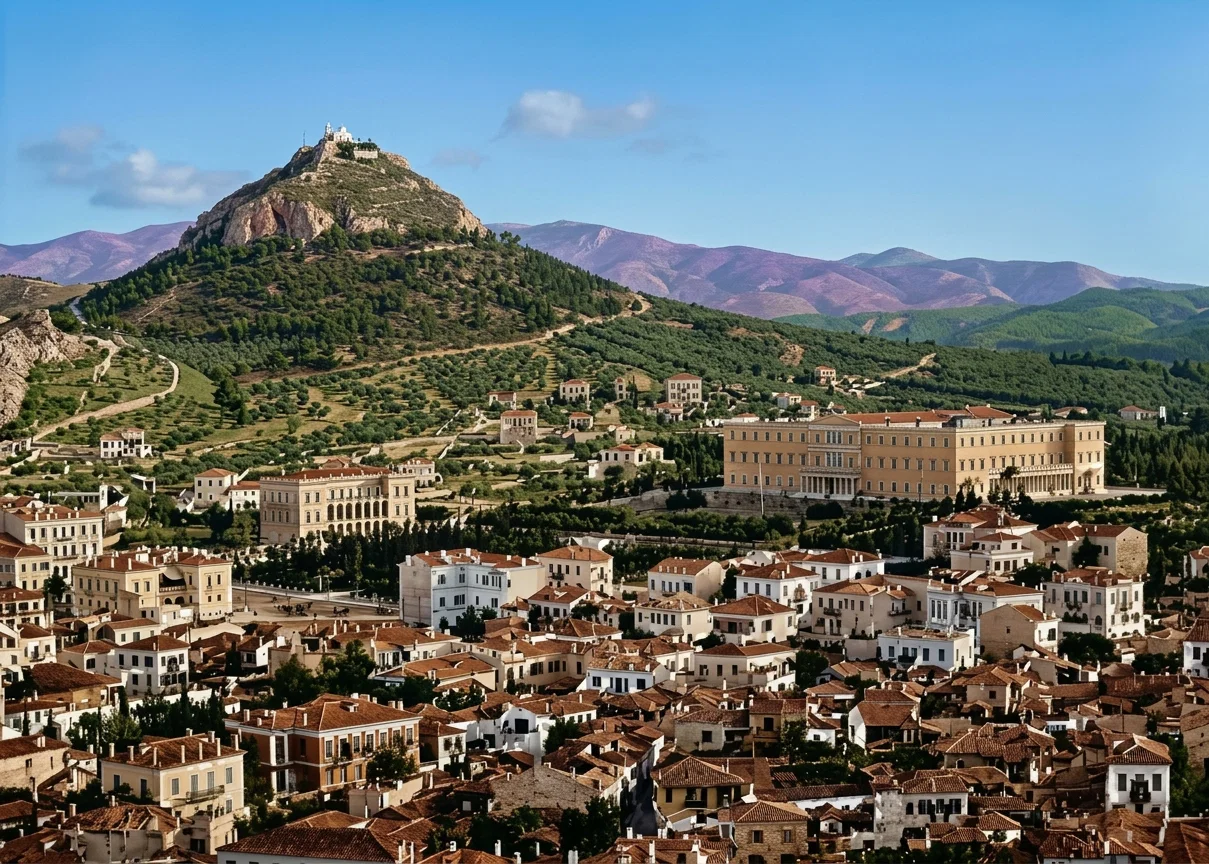
MODERN ATHENS
MODERN ATHENS
Early next morning, our steamer pulled into the Bay of Patras, which is really the entrance to the Gulf of Corinth. Here the most noted naval battle of Lepanto was fought, Oct. 7, 1571, in which the Turkish fleet was almost totally destroyed. In this neighborhood is also the fortress of Missolonghi, which was so heroically defended by the Greeks in their struggle for liberty in 1825.
After Athens, and Piræus its port, comes the city of Patras, in point of size. It has nearly fifty thousand inhabitants. A railway goes from there to Athens. At first the route is along the Gulf of Corinth, then it crosses the isthmus, and leads into Athens, making a journey of about one hundred forty miles. That I might travel cheaper, and that I might have more opportunity to view the country as we passed along, I took the slow train; I was ten hours in making the trip from Patras to Athens. During the first eighty miles, the plain and the hillsides along the railway were covered with the famous currant vineyards. With their wine and bread, the people also use a great deal of mutton. This is cut into small pieces, a number of which are strung onto a stick, when they are roasted over the fire, and then sold at so much a stick. Meat thus prepared has rather a peculiar, smoky taste.
As we rode along, we could see, on the other side of the Gulf of Corinth, the snow-clad Parnes, 4,640 feet high. Nearing modern Corinth, we saw a small town, of about four thousand inhabitants, at the end of the gulf, while five miles in the distance one sees the Acro-Corinth (the Castle of Corinth), an isolated peak rising abruptly from the plain, two thousand feet high, crowned on its top with the ruins of an old fort, which was the strongest fortress of antiquity—the key to the Peloponnesus. But to-day only a miserable little port is left in the place of the great commercial center where Paul so laboriously worked to raise up one of the apostolic churches. But I noticed one thing which indicated to me that God's Spirit is still striving with the men and women of this town—a British Bible Society colporteur, who was selling Greek Bibles and other Christian publications at the station.
Just behind the town, our train ascended about two hundred feet, and then crossed the bridge over the isthmus canal. This canal is only four miles long, and about seventy feet wide. We could see the whole length of the canal, which, as we crossed the bridge, lay two hundred feet below us. Because it is so narrow, it has been used only by smaller vessels, so it does not pay any too well.
We now came to the beautiful Bay of Athens, and soon sighted the noted Isle of Salamis, and we passed the town of Eleusis, which used to be the seat of the temple of the Grecian mysteries. The train then made a great bend, entered the Attic Plain, and Athens lay before us. As there were but few tourists in the city, I was able to secure a nice room in a modern hotel, with lift, electric-light, etc., at the modest price of forty cents a day.
The greatest difference between ancient and modern Greek is really in the pronunciation, and one who is versed in ancient Greek can read a modern Greek newspaper, and be able to understand its contents. The same holds true of the conversation.
Athens has a population of about one hundred thirty thousand. It contains some nice modern streets. I was rather surprised to see the good stores and business houses here. It shows up very favorably, if compared with other cities of the Levant. If with its population we were to include the inhabitants of its port, Piræus, with which it is connected by electric railways, it would contain 200,000 people. In 1832, the town of Athens scarcely had 2,000 inhabitants; ten years later, it had 22,000; in 1870, 48,000. When one views Athens from the top of the famous Acropolis, he is struck with the vast number of houses, the large extent of the city, and its many nice public buildings. It has more than sixty churches.
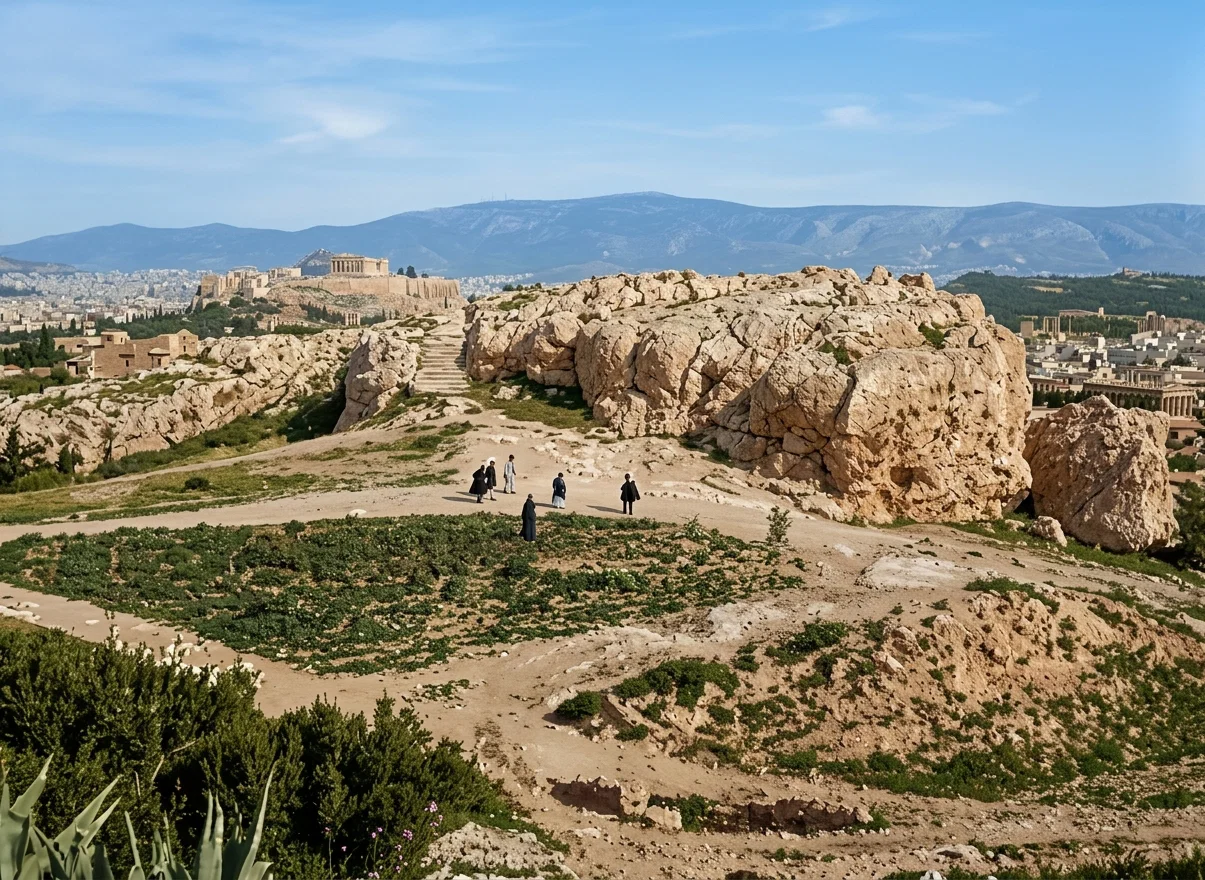
MARS HILL
MARS HILL
Early the morning after I reached Athens, Prof. W. E. Howell met me, and while we visited the ruins on Mars Hill, where Paul addressed the philosophers of ancient Greece, and while we were going to look at the imposing ruins of the Acropolis, we talked over the prospects of the work in this city to-day.
The kingdom of Greece contains only two and a half million people. Professor Howell has taken a dwelling about twelve miles from Athens, at a place called Kephisia, which is one of the few summer resorts that offer shade. We spent Sabbath together in talking of the circumstances in which the work in the various European countries began.
There are about four hundred Germans in the town. Some of them are prominent business men. On Monday I spent a few hours with a German printer, who expressed deep regret that I had not been able to call on him Sunday, and with him visit the Protestant church. I was very sorry that my steamer was to leave Monday evening, and thus I was unable to visit the old Protestant minister who has suffered so much for the spread of the gospel in that country.
Professor Howell is giving diligent study to the mastery of the language, and we hope that he will be of good cheer, and soon be able to converse fluently with the native Greeks, and bring to them the truth as it is for this time, in their own tongue, and to assist in preparing literature for them. Thus far we have only a few small tracts in the modern Greek. We trust our people in all lands will remember to pray for the work in this recently entered mission.
Hamburg, Germany.