Our Work in Sumatra

6%

Review and Herald Publishing Association · Takoma Park Station, Washington, D. C. · Mar 26, 1908

FromReview and Herald, Vol. 85, No. 13.

Read the full edition

Our Work in Sumatra

E. H. GATES
After Elder R. W. Munson left Sumatra for Australia nearly three years ago, no aggressive work was done there till about a year ago, when Brother G. A. Wantzlick, of Queensland, entered the field. Several months ago it was learned that Brother Immanuel, a young Battak of northern Sumatra whom Brother Munson had instructed in the present truth, had begun to keep the Sabbath. We wrote to this young man, asking him to come to Padang and stay awhile with our missionary there. Later we learned that there were six young men of that nationality keeping in the Sabbath.
A few weeks ago I received a translation of a letter from Immanuel in which he said there were twenty-three of the Battaks who had accepted the truth, and a few days later a cablegram from Brother Wantzlick saying that six young Battaks were at his home, and asking me to go to his place in order to counsel with him.
After one day's stay in Batavia, Java, I passed on to Sumatra, reaching Padang January 3. Here I met the six Battak men. They were all youth, ranging in age from seventeen to twenty-four years. It was a great pleasure to meet with these brethren, the first-fruits of a people who, till within the last half century, have for ages been degraded heathen.
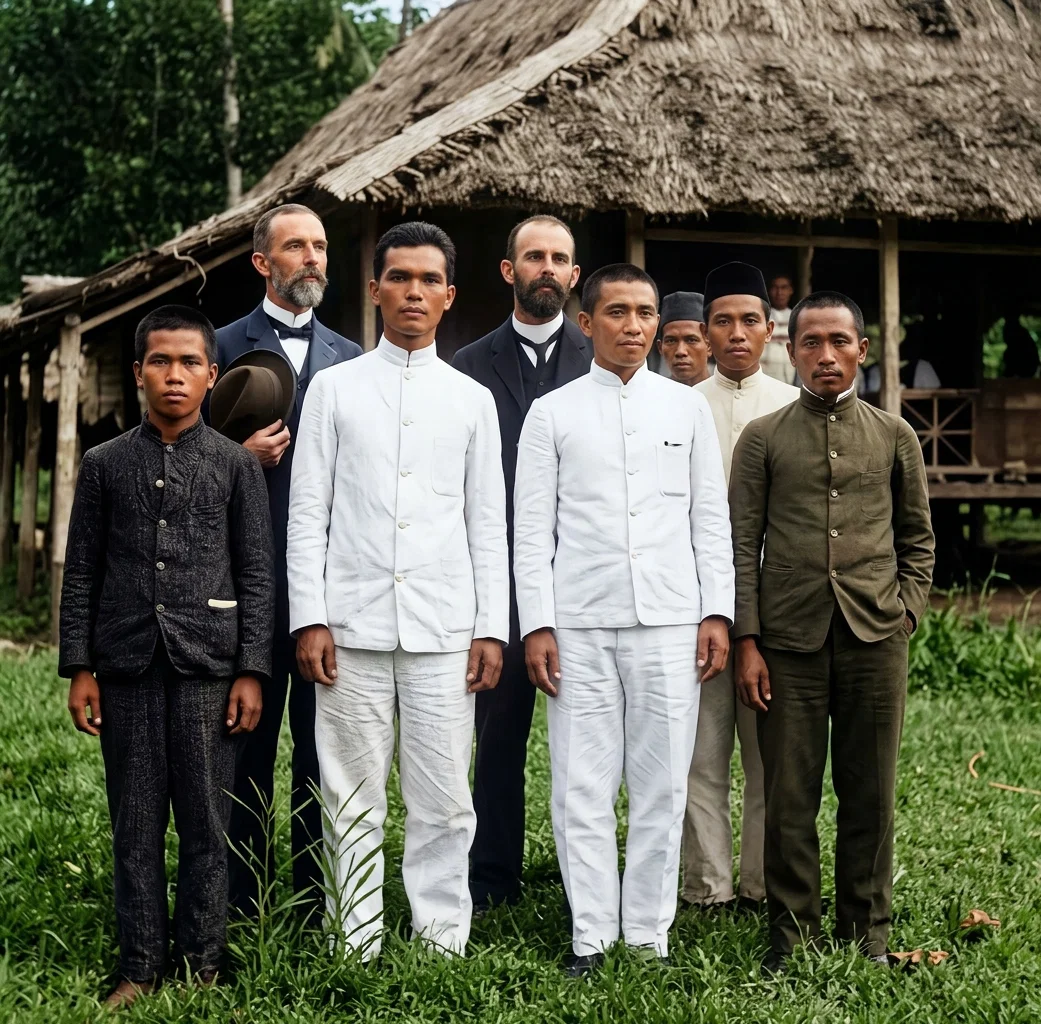
GROUP OF BATAKS, WITH TWO MISSIONARIES
The young man in the front row on the right, dressed in white, is Immanuel.
GROUP OF BATAKS, WITH TWO MISSIONARIES The young man in the front row on the right, dressed in white, is Immanuel.
The oldest of these was Immanuel. He is a young man of some ability and fair education, and is the son of the leading native missionary of Battakland, who was also the first native of that country to become a Christian under the labors of the Rhenish missionaries.
Since Immanuel has begun to keep the Sabbath, he has been active in teaching the truth to his acquaintances, going as far as Medan on the northeast coast, where there is a small number of Battaks in business.
Of the twenty-three whom he reports as keeping the Sabbath, a few are married, but the majority are single people.
The young men whom I have thus far met are quiet and respectful, and seem like honest persons, who, after a training in our school and association with our laborers, may become good workers. In intelligence and in general good sense, they seem far in advance of many whom I have met among those converted from heathenism. It should be remembered that fifty years ago the Battaks were all heathen, many being cannibals, and that these young men have had no instruction in the spiritual part of the message except what they have obtained by reading our Dutch "Bible Readings" during the past year.
We decided to take the three oldest of these youth to our training-school at Singapore, and at this writing I am on shipboard in the Indian Ocean, accompanied by them, on my way to that place.
According to the Dutch laws we are not at present permitted to send our missionaries to Battakland, so we shall, as soon as possible, have Immanuel translate our literature into the Battak language, and send it into that country.
Little being known about the Battak people and country, I will give a few facts concerning them. The district occupied by this people is just south of Acheen, the most northern district of Sumatra. From Acheen its western border is the same as the western border of Sumatra to a point between Siboga and Padang. Its southern and eastern border is very irregular, extending at one point almost to the east coast. The principal products of the country are gold, benzoin, camphor, and cassia. Until the introduction of Christianity, the people were noted for their wild savage practises. It is said by those who have studied the matter, that in early days aged parents were killed and eaten by their children after they had outlived their usefulness. This seems almost too horrible to believe; but the Word informs us that 'the dark places of the earth are full of the habitations of cruelty.' Cannibalism was practised as much to gratify revenge as to satisfy hunger; and so enemies taken in war were eaten by those who gained the victory over them, also great criminals met the same fate. Tribal wars were the almost constant occupation of the men. Polygamy was common, the men being allowed to take as many wives as they could maintain. The women, as is always the case under such circumstances, were greatly degraded, and were obliged to do most of the hard work, the men living in idleness except when engaged in war. The men could sell their wives and children.
The stature of these natives, as far as I have seen, is somewhat less than that of the Malays and Polynesians, and their complexion is slightly fairer. The Battak language is said to be the most ancient in Sumatra, and is the root of the various dialects that overspread the island; but it has very little resemblance to the Malay, which is used so extensively in the East Indies.
Since the preaching of the gospel by the Rhenish missionaries in this dark land, many thousands have become Christians, at least nominally. It is a cause of sincere thankfulness that the truths of the last message have found a lodgment in the hearts of a few of these former heathen people.
Singapore, Straits Settlements.