CLAUDE D. AC MOODY

8%

Review and Herald Publishing Association · Tacoma Park Station, Washington, D. C. · Jun 25, 1908

FromReview and Herald, Vol. 85, No. 26.

Read the full edition

CLAUDE D. AC MOODY

Notes Along the Way—No. 2

CLAUDE D. AC MOODY
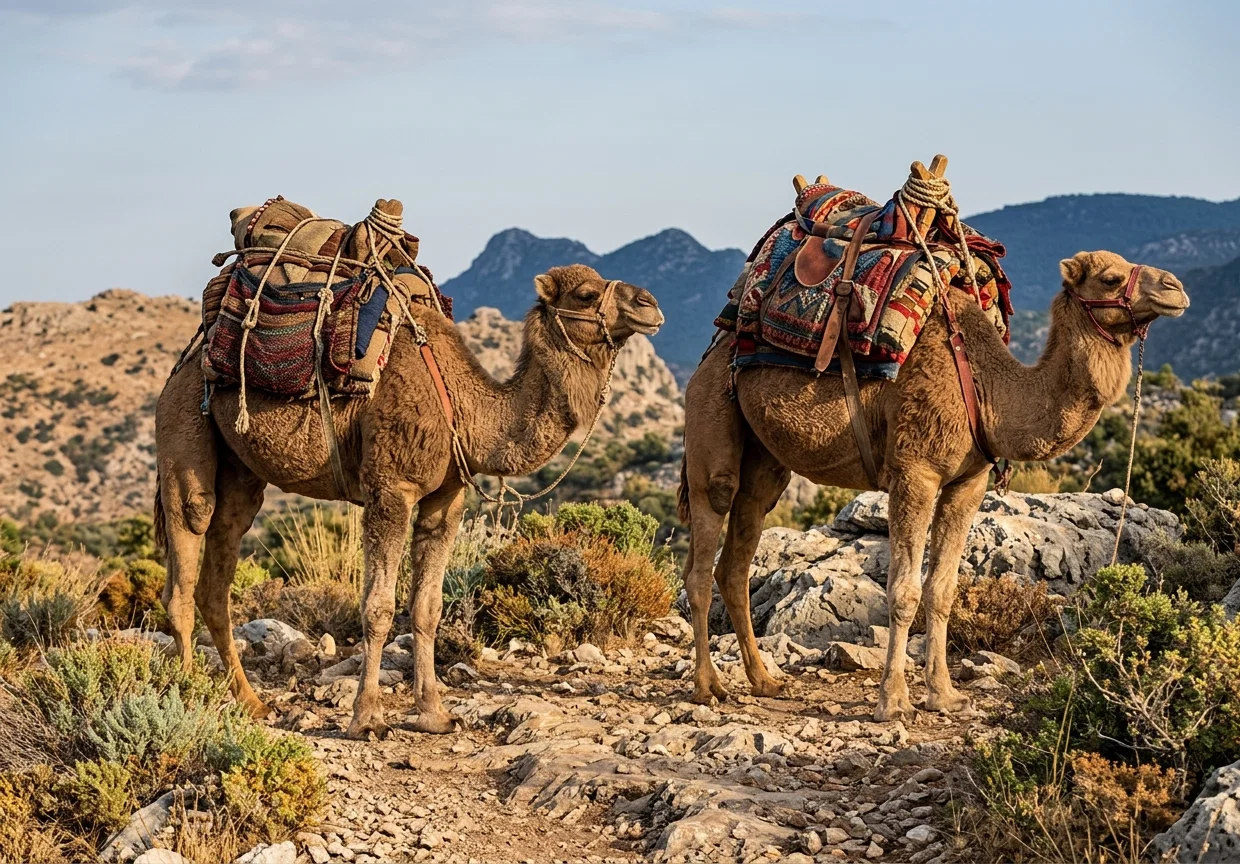
LOADED CAMELS, TURKEY
CHENGILER, MARCH 13, 1908.—We arrived here yesterday afternoon at a little past four o’clock, after two and three-quarters’ hours on horseback. We crossed over the ridge of the mountains lying between the Sea of Marmora and Lake Nicæa. I have seen many soul-inspiring views, too majestic, too grand to describe, but I never beheld an expanse of country which I felt less able to describe than the view spread before us yesterday as we crossed the crest of the divide. All eastern Marmora lay stretched beneath us, dyed in deepest blue. Even the Princes Islands, which are but mountains cast up in the sea, lay beneath, and over their tops, and to the farther shore lay Constantinople. To the left lay the Lake of Nicæa, now known as Isnik Lake, only a degree less blue than Marmora. Old Nicæa, where the first council of the Christian church convened under the auspices of the Emperor Constantine, was just out of sight behind a low point of mountain jutting out into Isnik Lake so as to hide from view the farther end of the lake. Before us, and a little to the left, and beyond a lower ridge of mountains, rose the peak of the Asiatic Olympus, clad in snow. South-eastward from Olympus ran a ridge also clad in white. All this was visible to the naked eye; but with a glass the grandeur of the view was greatly enhanced. Dotted over plain and hill were many villages. For several minutes our trail followed the narrow crest of the divide, and then swiftly descended into the village where we have just passed the night with an isolated young brother. As we descended, the great plain of lower Isnik lay before us, in the midst of which is situated the old Turkish city of Bazarkoi (Bazaar Village).
We leave in a few moments for Seuleus, where we shall find a good company of believers. The brother with whom we have passed the night will accompany us, and enjoy the meetings to be held there.
SEULEUS, MARCH 17.—We reached this village by a five and one half-hour horseback ride from Chengiler. Descending into the plain, we journeyed around the north end of Isnik Lake, and then for an hour and a half climbed mountains by a steep trail. The path lay along the edge of a beautiful gorge, but many times the horse swayed too close to the edge for the comfort of the rider. We reached here just before Sabbath.
This company consists of nine members. The Sabbath-keepers in Turkey do not have the weekly visits of denominational papers, and volumes of books to refer to, as do our American brethren. Some of these companies are indeed isolated but for the visit of the missionary occasionally. For four days we have had three meetings every day, and much of the time between meetings has been occupied in answering questions and in talking concerning the truth with the brethren privately. This little company raised about eighty dollars in tithes and offerings during the year 1907. Early in the morning we first leave for Brusa. We leave these brethren renewed in courage, and strong in the faith.
BRUSA, MARCH 25.—We arrived here one week ago to-day after a drive of forty-five miles by carriage from Seuleus. The road is very good all the way. One thing can be said for Turkish carriage roads,—though they are few and far between, what few there are are very well built. Along the best roads, yol bashi (road-master) houses are built every few kilometers. These are about the size of the ordinary railroad section-houses seen along the railways in America. Eighteen miles from Seuleus, and twenty-two miles from Brusa, we passed through the little city of Gemlik, situated at the point of a bay which creeps inland between the mountains from the Sea of Marmora. This city is situated very nearly on the site of the ancient Roman city of Cius. I have never been able, either by inquiry or personal observation, to find any ruins of the ancient city worth mentioning. Generally the Turkish government has exercised greatcare in preserving the various crumbling and decaying monuments of the earlier days of this country. Gemlik, being a very prosperous little seaport, seems to tolerate nothing but new, well-constructed buildings, and ruins and old buildings are destroyed. In the majority of cities and villages, however, the aged and weather-beaten appearance of the buildings is very noticeable. On the road from Gemlik to Brusa the yol bashi houses are built of nicely cut stone. Real skill is shown in the mason work, which is finished and pointed neatly. They are roofed with prettily laid yellowish-red tile. In fact, this gives a good idea of the general neatness and care shown all along the way in the construction of the road, its grading, bridges, etc. The accompanying photograph I took last fall, when covering this same drive. I was able to get very close to the camels as they were standing at rest but a little way from the road. They posed well.
During the week spent here I have enjoyed meeting with the few believers in their homes, encouraging them, studying the truth with them, and holding Bible lessons in the evening. Communion service was held Sabbath. Our greatest difficulty here is a place of meeting. The city is several miles in length, and the brethren live at the two extremes, and there is no central place for meeting. This is the place where the government caused our brethren considerable trouble last summer; several were arrested and fined for being found meeting together. The local head of the Protestant community has been greatly against us, but on this trip and also upon my visit last fall I have made it my business to gain his friendship to a degree. This was made possible by a friendly letter written to him by the Protestant millet bashi (church civil head) of Ismidt in behalf of our people. The latter is a friend to our brethren in the Ismidt district. We are proceeding with our work peaceably again. Through this endeavor to gain a proper understanding with the Protestant millet bashi here, he granted the proper paper to one of our Greek sisters to enable her to present herself to the government to secure a passport for England, whither she goes to take the nurses’ course at the Caterham Sanitarium. She made her application then for her passport and was refused. It is on this account that I am being held over here a few days longer than I had planned. I have carried the case to the local British consul (Brusa having a population of one hundred thousand, and being quite a commercial point), who has taken the matter up with the governor-general of the Brusa vilayet. On calling upon the consul last evening, he had not received final word; but he expressed his opinion that there was no question that the passport would be granted. This rejoices the sister, for she is anxious to enter upon her course. The foregoing gives but a faint idea of the methods necessary to the accomplishment of almost anything in this country. Careful pushing, forward, diplomatic working, is the only way to see a thing through. There are times when mandatory manners assist one’s progress; but by experience and care, one has to learn when to force, and when to submit.
I expect to leave to-morrow by a little narrow-gauge railroad, which will carry me to Moudania seaport in about two hours. From there it is seven or eight hours by steamer to Constantinople. I am parting from my interpreter here. Day before yesterday he started to return by land to the Ismidt country. Being an Armenian, and holding his civil private paper out of the old Gregorian Church, the government does not permit him to go by Constantinople. I leave the little company rejoicing in the Lord, their chief sadness just at present consisting in their having to part with the missionary on the morrow.
Constantinople.