Untitled article

6%

Pacific Press Publishing Company · Oakland, California · Dec 9, 1897

FromSigns of the Times, Vol. 23, No. 48.

Read the full edition

JOTTINGS FROM RUSSIA. NO. 3.

AFTER the close of the general gathering on the Don, I spent some time in the Caucasus, the district lying between the Black and Caspian Seas. Near the center of this region, extending from sea to sea, is the Caucasus range of mountains, the highest peak being Mt. Elbruz. 18,526 feet.
To the south of this range lies Georgia, with Tiflis as chief town; and next south lies Armenia. In the war of 1877–78, this country south of the mountains, Georgia, and a part of Armenia extending to Mt. Ararat, was taken from Turkey by Russia.
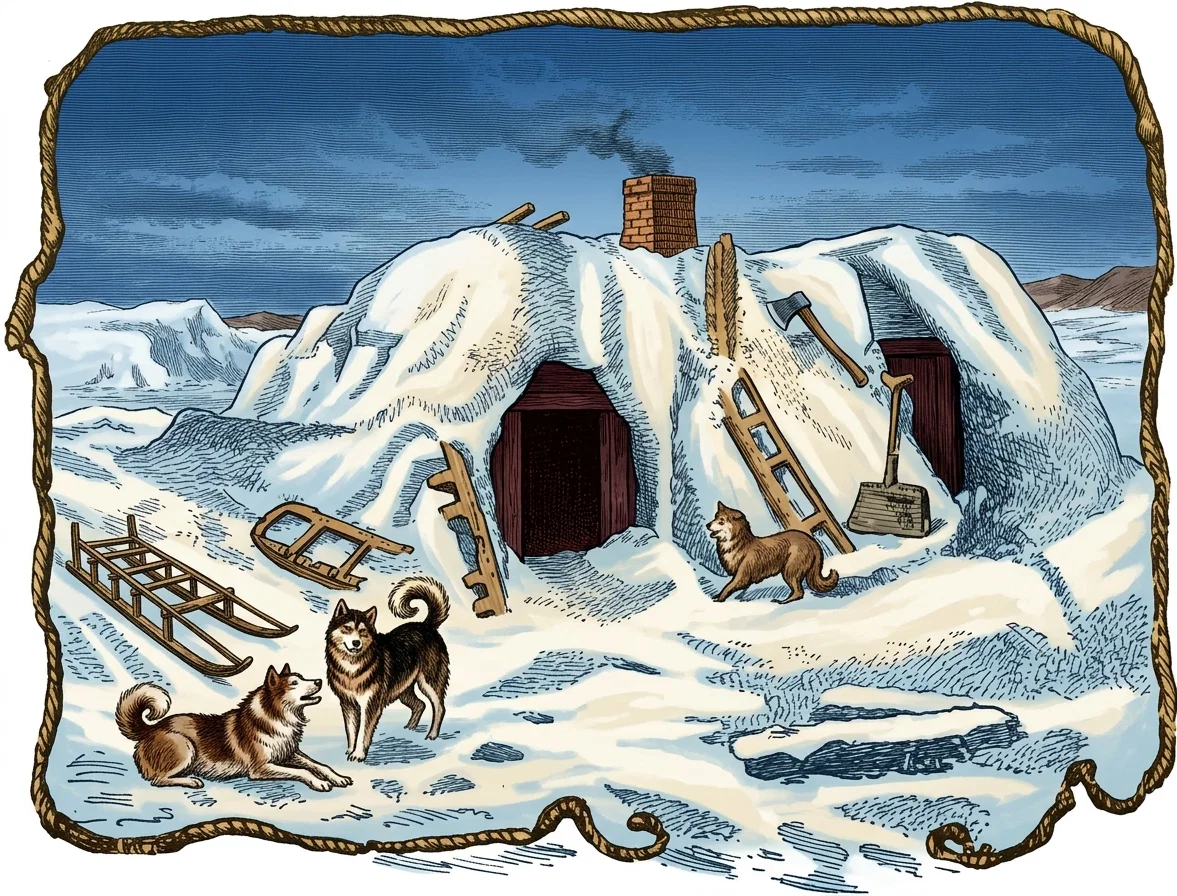
Exile's Hut—Without.
To the east of the mountains, on the shore of the Caspian, at Baku, are the great petroleum wells of Russia. A railway through Tiflis connects Baku with the Black Sea at Batoum, and the oil is conducted through large pipes from the wells to Batoum, a distance of several hundred miles, so that it flows from the wells into tank-ships on the Black Sea, whence it is transported to the various ports of Europe.
South of the mountains, the country extending down to the plains of Nineveh and Babylon is quite hilly; to the north, there is considerable rolling prairie, reminding one of Dakota and Nebraska.
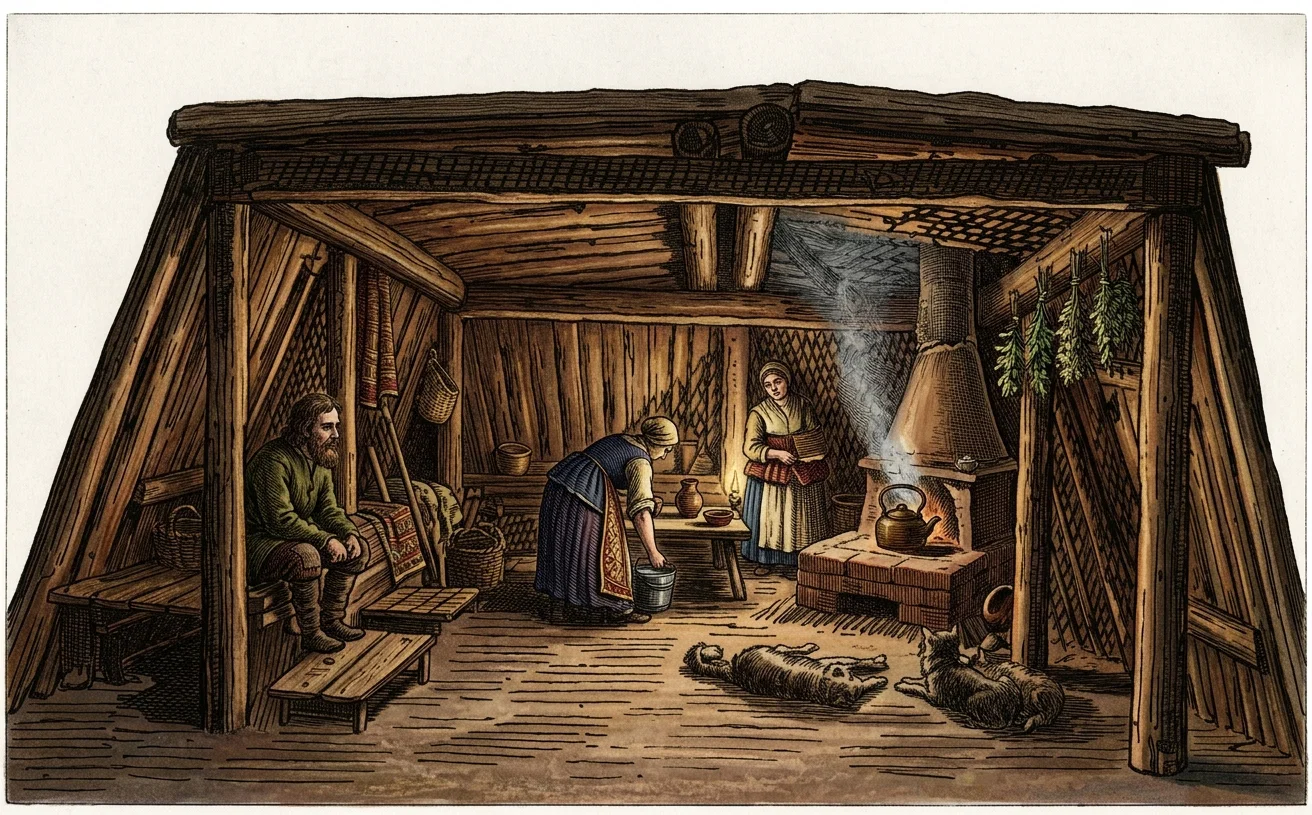
Exile’s Hut—Within.
Exile’s Hut—Within.
Until recently, this fertile region was like the ‘wild west’ of America in Indian days, various tribes of Asiatics taking the place of the redskins. After a long and expensive struggle, Russia subdued or dispersed these roving robbers. The worst of these tribes were the “Tscherkess” (Circassians), who long held the mountains as a fortress, and, like the Midianites and Amalekites in the days of Israel, made raids on the harvests of the settlers. When no longer able to withstand Russia, rather than submit to government, they fled to Turkey, where they still live after their old fashion,—by plunder,—chiefly in Asia Minor, while the Turks regret the day when they granted them asylum.
The Caucasus is now settled by Russians, Germans, Esthonians, Tartars, Tscherkess, Cossacks, and Kalmucks. Some of these Asiatics are learning agriculture from the Europeans, but they make rather awkward work of it. They use mostly the Syrian oxen and camels, and go to town with large two-wheeled carts, with axletree of wood. When the road is muddy, some of the wheels do not turn at all, while those that do turn, creak so frightfully as to cause the horses they meet to shy off to some distance on the prairie. The Germans are by far the best farmers. A Russian prince, governor of the Caucasus, on a recent visit to the villages, highly complimented the Germans for the thrifty appearance of their villages, while he severely scored the Russians for the dilapidated, semi-barbarous condition of their villages, roads, and bridges. Russian roads, and especially bridges, have long been a proverb, but no less proverbial is the manner in which the Russian teamster crosses these bridges, on which a European would scarce risk his life or team; as tho there were absolutely no hope in cautious driving, the teamster removes his cap, crosses himself in the Greek fashion, which embraces about twice as many movements as the Roman fashion, commits his destiny to some saint, and, cracking his whip, slams his team through at break-neck speed.
In the Caucasus, the villages are mostly mud huts covered with straw, the stable and dwelling-rooms usually being in one building. The ground serves as floor, chaff being occasionally used as an improvement on the bare earth. These huts serve as excellent breeding-ground for the least desirable sorts of insects. One is sometimes tempted to believe that the third plague of Egypt was transferred to this country. The families which desire to be “up” in the world whitewash the outside of the house. The Russians are taking lessons from the German settlers, and are making improvements.
Altho nearly all fruits flourish in this region, the average farmer has none; neither has he learned the relation of a good garden to his table. With some, even potatoes are a luxury. Flesh, cabbage, wheat, and rye bread, and tea, constitute his bill of fare the year round, except in summer and autumn, when water-melons and bread are the chief diet. One reason why fruit is so little grown is that most of the land is owned by the nobility and rented to the farmers, never for a period exceeding six years. The Asiatics are mostly herdsmen, under cover of which some of them carry on horse and cattle stealing as sort of side occupation.
The message, entering this field some seven years ago, has gained a good foothold. Some of the Germans have suffered considerable persecution, first, at the hands of the Russian officials at the instigation of prejudiced fellow-Germans; and, second, on account of Sunday work. But they have survived all, and now are little interfered with. But as the truth extends, new members will doubtless have a similar experience, for where the Church-and-State machine is always in readiness to grind, prejudice and hatred of the truth will not fail to operate it.
It was in this field that the truth first broke the ranks of the Russians. But from the first man of this nationality to embrace it, to the present, the enemy has disputed every foot of vantage-ground. The first man was banished to the Persian border, but the seed sown byhim continued to bear fruit and multiply until there are now over a hundred in this region. Several others have been banished; but the work among this people in this district advances now faster than ever, while those in banishment sow the seed in new fields.
While in the Caucasus, I held meetings at four centers, at which most of the Germans were gathered. The truth has the same blessed effect here as elsewhere, refreshing and rejoicing the soul. The members in this field sense the fact that the time has come to go forward and respond heartily to efforts made in this direction. As our members here come in contact with various classes of Asiatics, these are learning of the message; thus while our missionaries are working at the great Asiatic field from the east, we trust that from Russia the truth will enter the same field from the west.
H. P. H.
Sebastopol, November 4.