Untitled article

6%

Pacific Press Publishing Company · Oakland, California · Dec 9, 1897

FromSigns of the Times, Vol. 23, No. 48.

Read the full edition

“THE MOST HIGH RULETH.” NO. 7.

When Daniel, by revelation of the God of heaven, rehearsed King Nebuchadnezzar’s dream to him, he did not stop to ascertain from the king if the rehearsal was correct. There was no question about that, for God had shown it to him. So he confidently asserted, “This is the dream, and we will tell the interpretation.” Then without hesitation he proceeded:—
“Thou, O king, art a king of kings; for the God of heaven hath given thee a kingdom, power, and strength, and glory. And wheresoever the children of men dwell, the beasts of the field and the fowls of the heaven hath he given into thine hand, and hath made thee ruler over them all. Thou art this head of gold. And after thee shall arise another kingdom inferior to thee, and another third kingdom of brass, which shall bear rule over all the earth. And the fourth kingdom shall be strong as iron; forasmuch as iron breaketh in pieces and subdueth all things; and as iron that breaketh all these, shall it break in pieces and bruise. And whereas thou sawest the feet and toes, part of potter’s clay, and part of iron, the kingdom shall be divided; but there shall be in it of the strength of the iron, forasmuch as thou sawest the iron mixed with miry clay. And as the toes of the feet were part of iron, and part of clay, so the kingdom shall be partly strong, and partly broken. And whereas thou sawest iron mixed with miry clay, they shall mingle themselves with the seed of men; but they shall not cleave one to another, even as iron is not mixed with clay. And in the days of these kings shall the God of heaven set up a kingdom, which shall never be destroyed; and the kingdom shall not be left to other people, but it shall break in pieces and consume all these kingdoms, and it shall stand forever. Forasmuch as thou sawest that the stone was cut out of the mountain without hands, and that it brake in pieces the iron, the brass, the clay, the silver, and the gold, the great God hath made known to the king what shall come to pass hereafter; and the dream is certain, and the interpretation thereof sure.” Dan. 2:37-45.
Thus the history foreshadowed in the image described in this chapter began with the kingdom of Babylon under Nebuchadnezzar; particularly after it had acquired universal jurisdiction“Thou art this head of gold.” The king had been anxious to know concerning the future, and the God of heaven, who had laid such great responsibility upon him, would give him the desired information. “After these shall arise another kingdom.” This expression shows that Nebuchadnezzar stood for the kingdom of Babylon, for that other kingdom did not arise immediately after his personal reign ended. The kingdom of Babylon continued until the reign of Belshazzar, at which time six kings had succeeded Nebuchadnezzar, the last two, Nabonadius and his son Belshazzar, reigning conjointly.
Notwithstanding the great wealth and power and prestige of the kingdom of Babylon, it was but about sixty-four years after the prophecy of its downfall until it was overcome by the “inferior” kingdom which was to succeed it. It is said that throughout the kingdom there was a quite general disposition to revolt because King Nabonadius neglected the court and religion, leaving all to his profligate son Belshazzar. Be this as it may, Cyaxeres, or Darius, king of the Medes, in conjunction with his nephew, Cyrus, a Persian officer, led out in the rebellion.
After conquering other principal strongholds, Cyrus, who commanded the combined armies of the Medes and Persians, besieged the city of Babylon. Considering the massive walls and great brazen gates of the city, and the vast resources on the inside, the attempt to conquer it with the implements of war then in vogue seemed futile indeed. But the Most High, who “ruleth in the kingdom of men,” had decreed its downfall. He had even named its conqueror, Cyrus, many years before he was born. See Isa. 44:28 to 45:6.
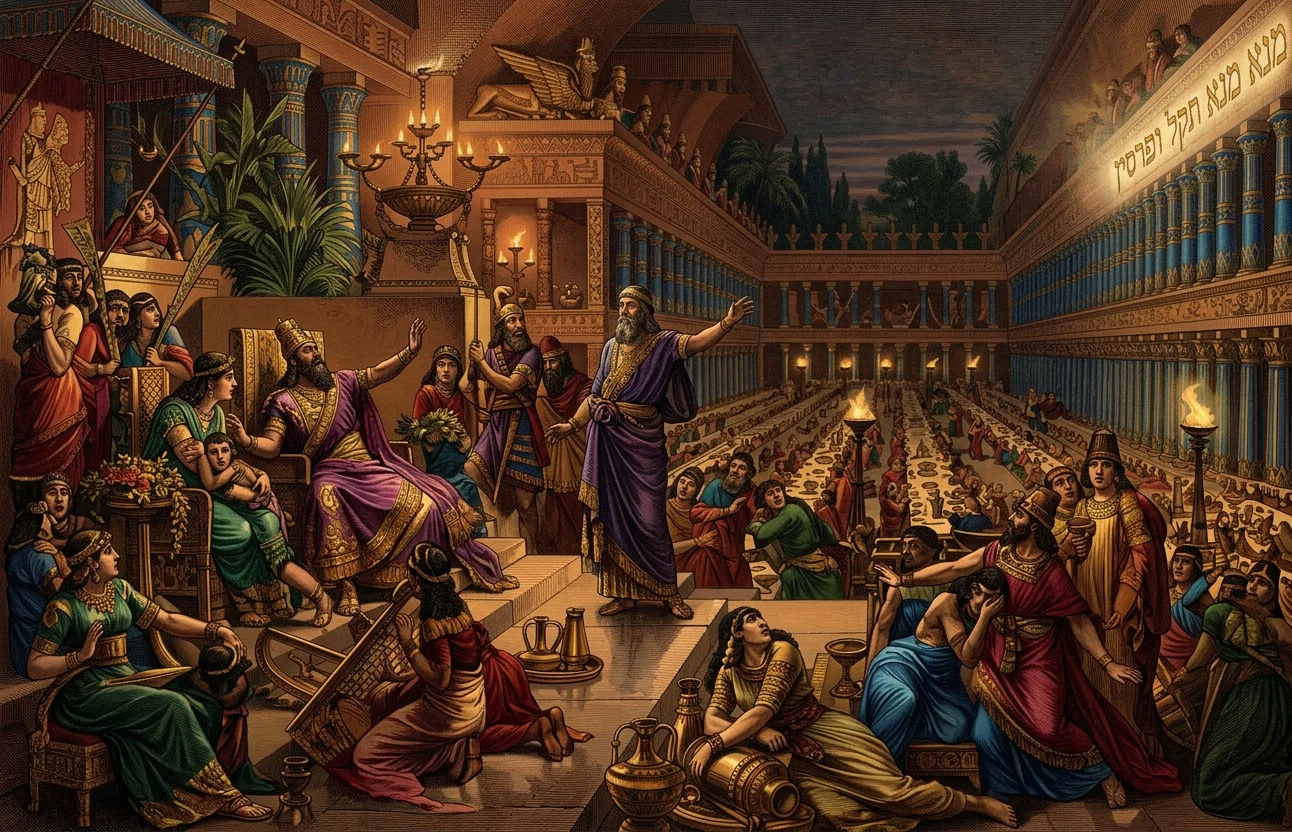
The downfall occurred on the fatal night of Belshazzar’s noted feast, when in the midst of hilarious revelry the king saw a mysterious hand writing on the wall the words, “Mene, mene, tekel, upharsin.” Again the “wise men” of Babylon, perhaps some of the same ones who had failed to show Nebuchadnezzar his dream, were called. They were asked to translate the mysterious writing on the wall, but, as in the former case, they utterly failed. Again Daniel was brought to the front, now an old man, and again honored his God by interpreting the writing for the king. These were the ominous words: “God hath numbered thy kingdom, and finished it. . . . Thou art weighed in the balances, and art found wanting. . . . Thy kingdom is divided, and given to the Medes and Persians.”
During the siege the army of Cyrus had made all preparation to turn from its course a large portion of the river which ran under the walls and through the center of the city. When it was known that all the city was given up to feasting and drunkenness, the water was turned off, and the besieging army passed under the great walls in the river bed. Ordinarily this stratagem of itself would not have given them any special advantage; for great walls were also built along both banks of the river throughout its course within the city. At all the crossings of the river there were great gates of brass, which were kept securely fastened at night. But God had said by his prophet Isaiah, as before cited, that he would help Cyrus, “his anointed.” He had said, “I will loose the loins of kings, to open before him the two-leaved gates; and the gates shall not be shut.”
Through the general feeling of security, the Babylonians had that night given themselves up to feasting and revelry, and the gates of these inner walls were not shut. So the great army of the Medes and Persians came in upon them unawares. They marched directly to the palace of the king, who was taken in the midst of the great confusion of the hour, and promptly put to death. The record is brief: “In that night was Belshazzar the king of the Chaldeans slain. And Darius the Median took the kingdom, being about threescore and two years old.”
The “head of gold” is gone. The “breast and arms of silver,” denoting a kingdom “inferior” in wealth and grandeur, was Medo-Persia. But the prophecy points to a “third kingdom of brass, which shall bear rule over all the earth.” To fulfil this prediction, Medo-Persia must needs give way; so history attests that such was the case. The armies of Darius and Cyrus overthrew Babylon in 538 B.C. Medo-Persia was the recognized master of the world until 331 B.C., about 207 years, with twelve successive kings. Then came Alexander the Great, at the head of his invincible army from Macedon, and, conquering the hosts of the Medes and Persians, at the battle of Arbela, B.C. 331, set up the “third” kingdom. In the final struggle, the invading army of Alexander numbered but one to twenty, but “the Most High ruleth in the kingdom of men;” he “removeth kings and setteth up kings;” numbers count for naught when the Word of the Lord is at stake. So the kingdom of Grecia became the “third kingdom” which was to “bear rule over all the earth.”
Grecia ruled the world from 331 to 161, or 170 years. Then came “the legs of iron,” or the “fourth kingdom” of the image. It was to subdue all things. What kingdom was this? Again history answers. The successor of Grecia in universal empire was Rome. Stronger than any of its predecessors, it held the reins of absolute control longer than all of them combined, that is, about 644 years. But the feet and toes of the image, being part of iron and part of clay, two ingredients that will not cling together under pressure, indicate a breaking up of universal empire; and the best demonstration of the fulfilment of this part of the prophecy that can be presented is the map of that part of the world which comprised the center of Rome’s ancient power, namely, Europe, Asia, and Africa.
When the iron empire began to break up, no human power could hold it together, and none has been or will be able to reconstruct its like. The sundered kingdoms that represent the iron structure “shall not cleave one to another, even as iron is not mixed with clay.”
The feet and toes of iron and clay, substances which will not cleave together, illustrate the fragile foundation upon which the whole structure of earthly empire stands. What only would be necessary to destroy the whole system of human government?—Merely a blow upon its insecure foundation, its inharmonious elements. So the interpretation of the dream tells us that in the time of the divided condition of earthly empire—the very time in which we are now living—the God of heaven will set up a kingdom which shall never be destroyed. This kingdom will not occupy the earth simultaneously with, nor be constructed out of, any of the preceding kingdoms. It is a stone “cut out without hands;” it strikes the whole system of earthly government on its brittle foundation, and destroys it all. The iron, the clay, the brass, the silver, and the gold—every phase of human rule, from the lowest to the highest—will become as chaff, which the wind drives away, and no place will be found for them; because the kingdom which the God of heaven will set up will fill the whole earth.
Not a particle of any of the corrupt civil governments of earth will have any place in that kingdom. They will have served their purpose, to be blotted out forever. “My kingdom is not of this world,” says the King, and his word is true to the letter. The ushering in of his kingdom will be the last act in the routine of removing and setting up kings. Not only will the kingdoms of this world be blotted out, but their territory will be baptized and purified by fire; and in its place will be a “new earth, wherein dwelleth righteousness.” See 2 Peter 3:10-13. History attests the fulfilment of the interpretation of the dream-image even into the feet and toes; who can be so skeptical as to doubt that the only remaining feature of the prophecy will as surely come to pass, and thatin the very near future? “The dream is certain, and the interpretation thereof sure.”
W. N. G.
THE LAST MAD REVEL—BELSHAZZAR'S FEAST.