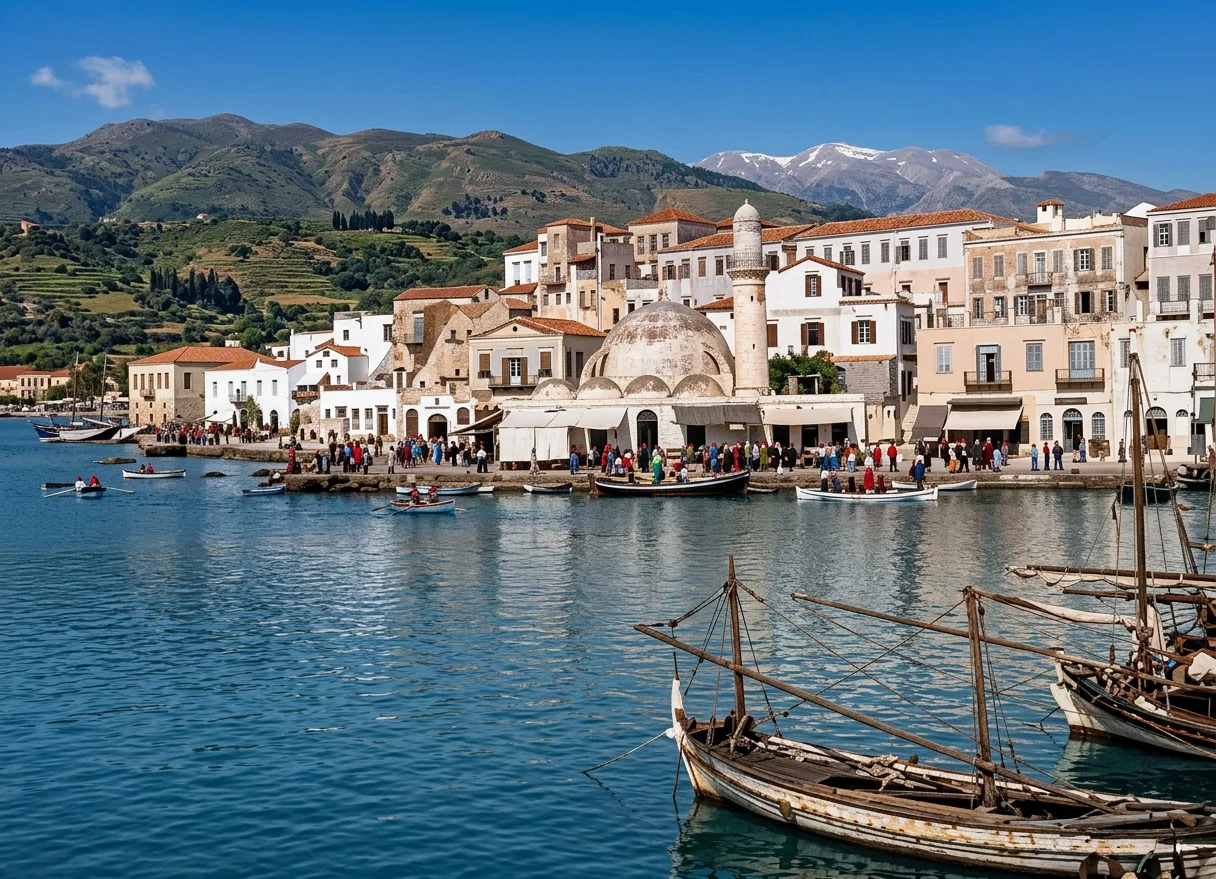
CANEA, CRETE

8%

Pacific Press Publishing Company · Oakland, California · Jul 12, 1899

FromSigns of the Times, Vol. 25, No. 28.

Read the full edition

CANEA, CRETE.

THIS morning strange voices, near the port-hole of our stateroom, aroused us from a sound slumber. The and hastily looking out, we saw the red-capped head of a Turk only a few feet from us; a closer inspection showed that our boat had cast anchor, and that a number of small boats were about her, some having come to carry away freight, mostly sulphur, brought from ports of Sicily, and some to take passengers ashore.
As we were going to stop only about six hours, and our boat being quite large for the small artificial harbor, we anchored almost a mile from the wharf in the open bay. Appearing on deck, one is surrounded by eager boatmen, who always know an English-speaking person, so accost him with all the English they know, which is, “Go ashore, mister?” Altho one expects to go ashore, experience soon teaches him to show no special desire, for financial reasons; so, shaking our heads, we walked along the deck to get a view of Canea, one of the principal cities of Crete. It is situated along the shore, on the slope of a range of hills, which seem to rise almost out of the sea, and which seem to be but a terrace to those cloud-piercing, snow-capped mountains just behind them.
Having made a bargain with a boatman for about one-sixth his original price, a party of us go ashore. Fortunately it is a holiday, commonly called Prince George’s Fête-day, in honor of St. George. The first impression on reaching the shore was very much like the one received in the Midway Plaisance at the Columbian Exposition in Chicago—people of almost every nationality and in as many different garbs.
Passing up through many winding streets, some so narrow that a carriage can not drive in them, we found ourselves following a stream of people into the country, and, desiring to see what was their purpose, we went along,
CANEA, FROM THE NORTH.
The people seemed to be enjoying themselves, many of the women, imitating the English ladies in their dress, with a good supply of paint on their faces, were sitting, with great dignity, upon their little donkeys, while the gallant youths, with their very loose knee trousers and buskins, traveled on foot. It is quite warm, and the way is dusty. On our way we pass a large olive orchard, between a vineyard on one hand and a rye-field, with the grain all headed out, on the other. The fences, where there are any, are of cactus or rose-brier hedge. The land seems fertile and is well kept. We approach a high wall, which incloses a building like a church. There are many people gathered without the wall. Temporary stands are erected, upon which are displayed for sale various articles, and especially refreshments. As the people are constantly entering at a large door in the wall, we follow the impulse of our curiosity, and endeavor to follow. A man with a turban on his head and something like a white blanket wrapped around him, stops us, and, after considerable useless talk, because we could not understand him, we hand him five centimes each (about one cent in our money), and we are allowed to pass in.
Inside the inclosure we find a number of people in a yard surrounding the church building, trying to enter the already well-filled church. The church is built in the form of a cross, the entrance being at what might be called the base of the cross. Seeing that we were strangers, the people made way, and we entered the church. In front of us were a number of images and paintings of the Passion, the Virgin Mary, and of apostles and saints. These the people were constantly approaching, kissing the feet of the images and crossing themselves. Through a small door, which opened into the head of the cross, could be seen a large image of Christ on the cross, and before it were several priests, with long hair, performing the ceremonies. During the entire time there is a ceaseless chanting, mostly by a boys’ choir. While this form of worship does not differ materially from that found all through Europe, and to some extent in America, it makes us desire more earnestly that the full liberty of the glorious Gospel of Jesus Christ might be manifested to this people.
Returning to the city, we again follow the crowd, and soon find ourselves on the seashore before the royal palace, which is just to the left of the flag-pole in the accompanying picture.
Crete, having been the bone of contention between Greece and Turkey, is now governed by Prince George, son of King George of Greece, placed in his position by the Powers, and supported by soldiers of England, Russia, France, and Italy, the flags of which nations are to be seen displayed in promiscuous confusion.
To-day we found the soldiers of these nations drawn up before the palace, while within the prince was receiving visitors. Not being in court dress, we had to content ourselves mingling with the crowd. Soon there was a great stir among the people; an open carriage drove up to the door, and Prince George, with an attendant, came out of the palace and entered it, lifting his hat to the crowd as he drove rapidly away. The soldiers and company dispersed, some running after the carriage, while we hastened back to the ship, and were soon on our way to Athens.
HERVY A. HENDERSON.