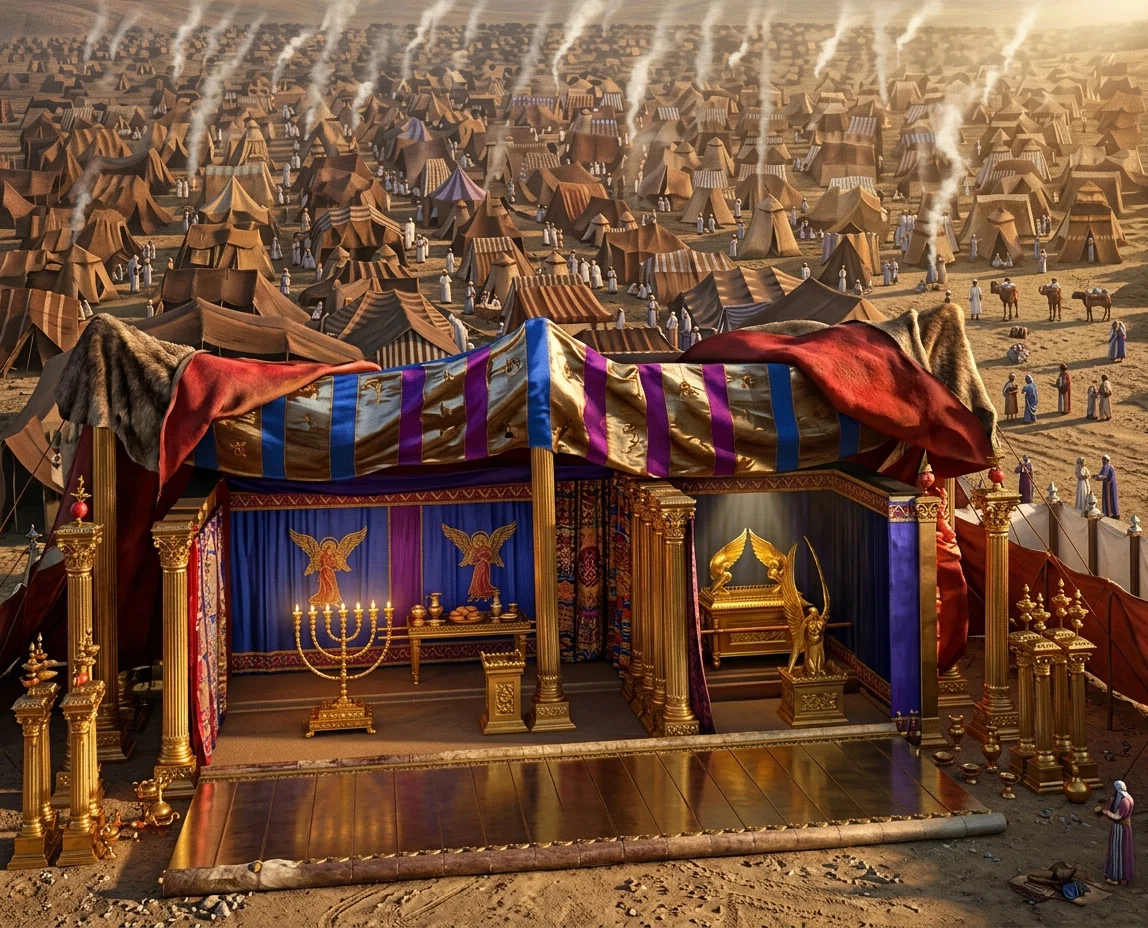
The sanctuary of old was so named because it was a sanctified place, set apart for God's dwelling. Ex. 25:1-8. This earthly building was divided into two apartments, in which separate services were conducted before God in behalf of sinners. Heb. 9:6, 7. Turning to the fourth chapter of Leviticus; we learn from verses 27-35 that if one of the common people became conscious of some violation of God's commandments, which he had ignorantly committed, he must immediately bring to the door of the sanctuary a kid of the goats, and there lay his hand on its head, thus setting it apart to die in his stead, for the sin of which he was guilty. He must then kill the victim, when the priest in attendance dipped a finger in the blood, touching with it the horns of the altar of burnt offering, and then spilled the remainder at the base of the altar. The body of the substitute was next carried into the sanctuary thru the body of the priest, and by some mysterious process, the substituted guilt it bore was lodged in the sanctuary.
The object of such a ceremony is obvious. “Sin is the transgression of the law.” 1 John 3:4. “The wages of sin is death.” Rom. 6:23. To transgress any one of God's commandments contained in the ark, within the sanctuary, was to incur the death penalty. To be relieved from this, the sinner was permitted publicly to substitute an innocent victim, thus giving wide acknowledgment to his guilt, and an expressed desire to be reconciled to God's will, as expressed in His law deposited beneath the mercy-seat, which was the typical throne of Heaven. On His part, God freely forgave a sin thus confessed, since the innocent substitute had borne the sin in the sinner's stead.
The Blotting Out of Sin.
This was the ordained method by which the Israelites of old expressed their faith in the future death of Christ for sin. It must be readily seen, however, that altho the Jewish ceremony granted forgiveness for sin, the sin itself was not then blotted out. Had this been done, the people receiving such grace would have been entirely freed from conscience concerning their sins, and the death of Christ would have been of no avail for them, since their sins had already been wiped away. It was therefore necessary that a “remembrance” of these forgiven sins should be had for after consideration. Heb. 10:1-3. For this reason these sins were conveyed into the sanctuary in the way described, there to remain till their final disposal.
The Day of Atonement.
This conclusive act required a special ceremony to be performed on the closing day of the ritualistic year, and by none other than the high priest himself, in the inner apartment of the sanctuary. The time chosen for this was the tenth day of the seventh month, and was called the day of atonement. Lev. 16:29, 30. This was the only day in the year when this at-one-ment of man with his Maker could be fully brought about. The offerings for sin on all other days were but preparatory steps toward that crowning day of all the ceremonial year. On this great day all the sins of all the people which had been conveyed into the sanctuary, thru the daily offerings, were to be atoned for, when they were removed from the sanctuary that its cleansing might be complete.
There was this great difference between the daily services in the outer apartment of the sanctuary, and the annual service conducted in the inner apartment. Thru the daily services sin was transferred from the sinner into the sanctuary, while the annual service was for the cleansing of all sin out of the sanctuary. In the first of these services, individual offerings were made for personal sin, while in the second, the whole congregation of repentant ones were freed from sin by a single offering. In the first, only under priests did the service, while in the second, the high priest alone filled the place of intercessor.
It is therefore clear that this day of at-one-ment—the last day of the ceremonial year—was the time when all the sins of the preceding year, which had been lodged in the sanctuary, were called to “remembrance,” under review, and final disposition made of5them. In other words, it was the time when Israel's life-work for the past year was examined, and their sins blotted (figuratively, of course) from the records of remembrance, or thrown back upon the guilty, that they might meet the penalty due for their wickedness.
On this day, the first work of the high priest, after offering blood for his own errors, was to bring two goats before the door of the sanctuary, where lots were cast upon them, one of these lots for the Lord, the other for the scape-goat. The goat upon which the Lord's lot fell was slain, and offered for a sin-offering. The other goat was kept alive before the door for another purpose. Lev. 16:7-10. The blood of the sacrificed goat—which was the people's sin-offering—was taken by the high priest into the “most holy” place, and sprinkled upon the mercy-seat, over which was the shekinah, the symbol of God's presence. In this way, an atonement was made for the holy place, because of the sins of the house of Israel having been brought thither. Verse 16. The same thing was done for the vessels in the outer apartment and for the altar. This was the cleansing of the sanctuary from the accumulated sins of the year. Verses 18, 19.
BOTH APARTMENTS OF THE SANCTUARY, SHOWING FURNITURE.
This having been done, the high priest came out to where the live goat was detained, and laying his hands upon the head of that goat, he enumerated the sins of his people, and so placed them upon the goat. This creature was then conveyed alive to an uninhabited part of the country, there to bear, for an indefinite time, all the iniquities of the house of Israel. Verses 20-22.
How Much It Covered.
This work of the atonement, it will be readily seen, covered only past sins, since each year had its own day of atonement. More than this, only those sins came within the scope of that atonement, which had, previous to the final act of the ceremony, been conveyed into the sanctuary by personal confession. Those who chose not to do this, retained their sins upon themselves, since only those sins were put upon the scape-goat which the high priest brought within the sanctuary. Such persons refused to be reconciled to God; therefore the atonement did not avail for them, and they were left to receive the consequence of sin, which is death.
All this was but typical, and was ordained to point that people to the work of Christ in man's behalf. It could go no further; “for it is not possible that the blood of bulls and of goats should take away sins.” Heb. 10:4. It therefore follows that when Christ came and offered Himself as the true sacrifice for sins, all that typical work ceased to avail before God. But the real work, the substance of which all that was but the shadow, must be performed somewhere by the true High Priest. But who is He, and when and where does He accomplish this work?
Concerning this transfer of the priesthood, the apostle says: “Now of the things which we have spoken, this is the sum: We have such a High Priest, who is set on the right hand of the throne of the Majesty in the heavens, a Minister of the sanctuary, and of the true tabernacle, which the Lord pitched, and not man.” Heb. 8:1, 2.
The Antitypical Day of Atonement.
Christ is therefore Minister of a sanctuary located in heaven. But is it one of definite shape, as was the one ministered in by Levitical priests? This question is clearly answered by the apostle: “Christ is not entered into the holy places made with hands, which are the figures of the true; but into heaven itself, now to appear in the presence of God for us.” Heb. 9:24. These words plainly reveal that the earthly sanctuary, (Continued on Page 9.)6
The Cleansing of the Sanctuary.
(Continued from Page 5.)
with its appointments, was a figure of the true sanctuary, where our Saviour ministers as high priest. In another sentence the apostle says that the priests of the earthly sanctuary served “unto the example and shadow of heavenly things.” Heb. 8:5.
The earthly sanctuary and its services having been a type, or shadow, of the heavenly temple and its services, we must conclude that the work of Christ, as our High Priest in heaven must have been truly pointed out by the earthly work. This being true, in Christ's work for the world there must be a specific time set apart as a day of atonement, when the sins of all men must be brought up in remembrance for final adjustment, preparatory to the Lord's return to receive the just to Himself, and to let the sins of the incorrigible rest on themselves for punishment.
This can be nothing less than the closing work for man,—an investigation of his life-work,—for the purpose of ascertaining whether he is to live forever reconciled to God, or whether he shall be forever removed from the divine presence. Such a work can not be righteously done until the influence of every one has borne its legitimate fruit. Men's influence does not die with them, as is shown in the cases of Voltaire, Paine, and others, on the one hand; or the Wesleys on the other hand, with all the various missionaries who have spent their lives in telling the story of the cross; for tho they are dead, they yet speak, and not till the last generation has lived will their influence for good or evil be told.
A Solemn Time.
The time of the cleansing of the heavenly sanctuary is therefore a most solemn period in the history of the world. Surely such a work could not be carried forward without divine warning to prepare men for the event. “The Lord God will do nothing, but He revealeth His secret unto His servants the prophets.” Amos 3:7. This matter can be no exception to the rule. Daniel heard two heavenly beings talk about this very thing, when one said to the prophet: “Unto two thousand and three hundred days; then shall the sanctuary be cleansed.” Dan. 8:13, 14.
This cleansing can not refer to the earthly temple which was cleansed once each year. This period covers too much time for that. No, this cleansing was to be in the distant future from Daniel's day; for he was distinctly told that the vision was to be fulfilled at the “time of the end.” May it not be possible that it applies in our own generation? Shall we not, then, seek out of the “Book of the Lord and read,” that we may be ready for all things to come?