By H. W. Cottrell, President of Western Oregon Conference
When Christ Jesus was on earth, He said, “If any man hear My words, and believe not, I judge him not: for I came not to judge the world, but to save the world.”
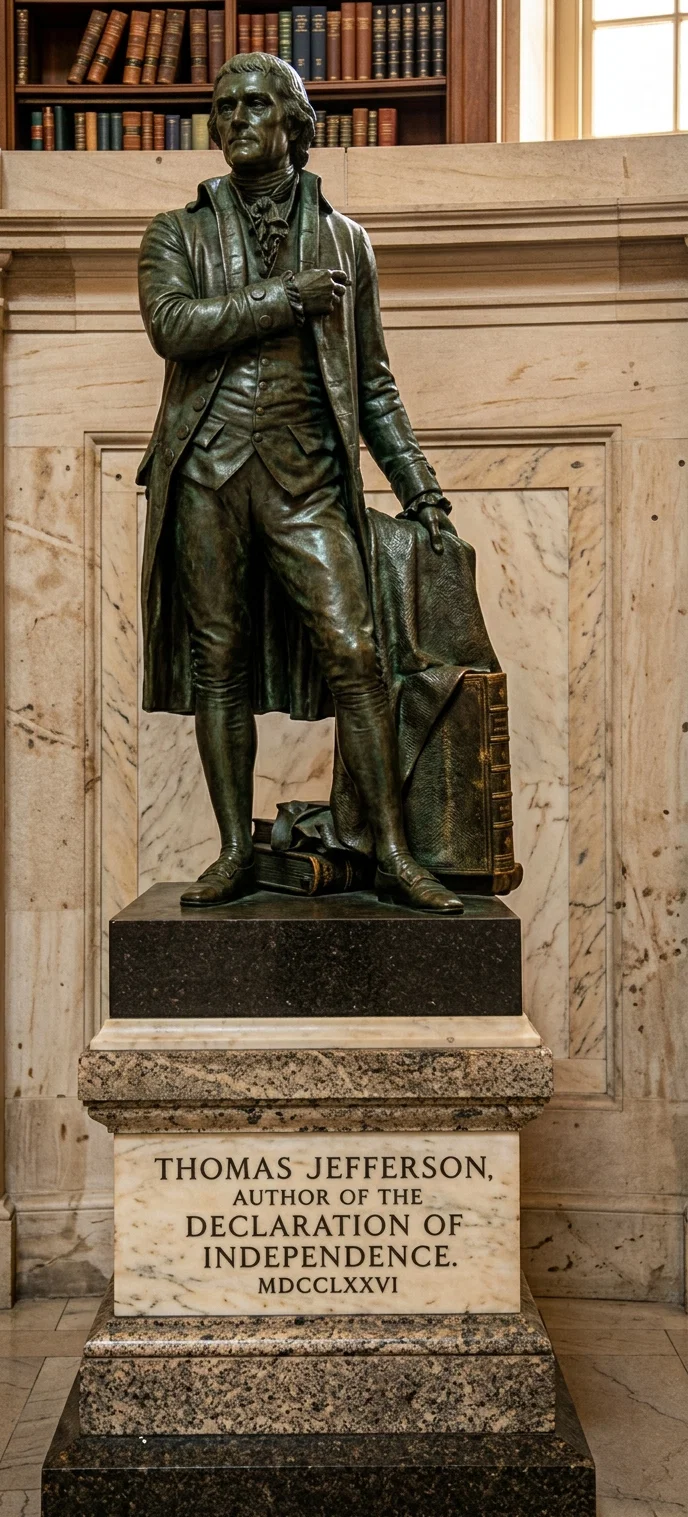
Statue of Thomas Jefferson, author of the Declaration of Independence. Jefferson stood for “equal and exact justice to all men, of whatever state or persuasion, religious or political.” Can we stand for less?
Christ’s mission here was to save men through the Gospel of love, by persuasion, but not to judge. The mission and work of His followers is to preach the saving grace of Christ, the powerful Gospel of His love. It was not His work when on earth to judge. It is not the work of His followers, or of any man, combination of men, or civil court to judge in religious matters; for religion is spiritual, prompted by heart motives, which realm civil government should not even seek to enter.
Man may judge and punish for crime, but God holds the exclusive right to judge and reward for sin. “For we must all appear before the judgment-seat of Christ; that every one may receive the things done in his body, according to that he hath done, whether it be good or bad.” His ambassadors therefore “persuade men.” 2 Cor. 5:10, 11. True ambassadors of Christ “persuade men” to accept the ordinances and rights of the church, such as the Sabbath, baptism, and the Lord’s Supper, but can not of divine right compel men by civil law, or other means of force, to observe them, or any one of them, the Sabbath day for instance. To do so would be for man to judge men in religious matters, a thing which the Master declined to do. “I judge him not.”
Christ’s purpose was to present to all people life, light, power, Sabbath rest, soul liberty, and multiplied grace and peace, in the gift of Himself. The eternal, spiritual, and religious features of these gifts, the individual must receive from Christ, for in Him only are they to be found. They can not be imparted to a nation, State, community, or individual by civil legislation, even tho that legislation were brought about by a union of the professed church and the State. The State is not spiritual, but civil, hence it can not decide spiritual questions.
No Power in the State to Save
Of the great Teacher it is said, “He came unto His own, and His own received Him not.” John 1:11. He judged them not. “But as many as received Him, to them gave He power to become the sons of God, even to them that believe on His name.” Verse 12.
The church and the State may form an unholy alliance, enter the realm of conscience, legislate on religious questions and other questions of conscience, and judge men in such matters—a thing which Jesus disdained to do; but it can not bring to a single individual in the mines, factories, or elsewhere, the power to become a child of God. Then why legislate, and judge religious men, in religious matters, or religion-less men in matters of religion, or conscience? Said the great apostle to the Gentiles, “We persuade men.” Paul knew the only way to save men was by the Gospel of love, through persuasion: that salvation could not be accomplished through civil legislation—for ce—but of individual choice.
It is contended by the Sunday-law advocates, that it has been scientifically demonstrated that men should have one consecutive twenty-four-hour day of rest in every week, for the lengthening of life and for his moral good. Their further contention is, of course, that the day must be Sunday. By what scientific rule this supposedly scientific conclusion has been reached, has not as yet been given out to the public. The Sunday-law advocates maintain that all citizens shall be under penalty to obey the proposed law, except such persons as sacredly observe another day of the week for rest and worship. From such deduction it is clearly evident that the proposed civil legislation for a civic sabbath, is civil legislation for a religious sabbath; and he who conscientiously violates such religious law because of his religion, or he who violates it because he is irreligious, must be judged and punished by man, either on account of his religion, or because he is religion-less. The example set His ministers by Jesus was, “If any man hear My words, and believe not, I judge him not.” “He that saith he abideth in Him ought himself also so to walk, even as He walked.” 1 John 2:6.
Christ’s mission on earth was to tender to all people grace to observe His Sabbath and all other Christian duties, without being forced so to do through civil legislation, and render them to God, and not to civil government, nor to God by the way of civil government, but by the individual direct to God, with conscience untrammeled.8
Christ came to His own people—the church; but not being in experimental touch with Him, “they received Him not.” He made no effort to force either Himself or His doctrine upon them, altho He knew there was “none other name under heaven given among men, whereby we must be saved.” Acts 4:12.
As time passed, conditions changed. The multitude followed Him. He was in the majority. They would declare Him king. Then, if He had chosen, He could have directed civil authority to enter the realm of conscience, and by force compel all men, religious or irreligious, to obey civil law in religious matters, under penalty of fine or imprisonment or both, and thus increase the membership of the church. But no! He rejected the humanly proffered kingship, recognized not the rights of the majority above the equal individual rights of the minority in matters of religion, but pressed His way onward, teaching the Gospel of love by persuasion.
Gifts of Goodness Divinely Imparted
The pretense of the supporters of the religio-civil sabbath law is that it will not only tend to lengthen the life of the laboring classes, but will enhance in them goodness—godliness. But Peter, speaking by inspiration, says that everything pertaining to life and godliness is a gift from the divine Christ, and can be obtained by the individual “through the knowledge of Him that hath called us to glory and virtue.” Seeing all these gifts are from God, any proposal to impart them to the individual through civil legislation can be but counterfeit. It rests, therefore, with the individual to choose whether he will receive the Sabbath and godliness from God’s divine power, whence only it can be obtained, or from civil government through religious legislation, which is but mockery.
If it be contended that the proposed Sunday law does not deal with a religious question, why exempt a class of religionists who “sacredly” observe another day?
Sunday legislation is religious legislation, and religious legislation must result in judging men in matters of religion, and still other men when perchance they are conscientiously unreligious. This the Master forbade. “I judge him not.” It is also the introduction of a religio-civil gospel, which is “another gospel,” which, even “tho we, or an angel from heaven, preach,” presents but a false hope. Gal. 1:6-8.
Paul, referring to religious matters, queries: “Who art thou that judgest another man’s servant? to his own master he standeth or falleth. Yea, he shall be holden up: for God is able to make him stand.” Rom. 14:4. “Who art thou that judgest” in matters of religion, when God is able to make him stand? is a question which every man who advocates religious legislation must answer before the heavenly tribunal. “Let us not therefore judge one another any more.” Rom. 14:13.
The fair State of California is not committed to the evil of religious legislation. It is the golden key to a golden condition—liberty of conscience. Every citizen in the State of California, and those in every State, who wield the ballot, should favor only such legislation as will assure liberty of conscience, not such legislation as will invade conscience. The ministers of the Lord should keep in mind that their work is like His,—to save men, not to judge them in religious matters. “I,” saith the Lord, “came not to judge, . . . but to save.”