Our London Letter

3%

Pacific Press Publishing Association · Mountain View, California · Jun 4, 1912

FromSigns of the Times, Vol. 39, No. 22.

Read the full edition

Our London Letter

By Our Own Correspondent

The Coal Strike

We have lately passed through a history-making crisis in the United Kingdom. The great coal strike had been heralded long before; but it was not until the astonished nation found itself in the strangling grip of the mighty movement, that it fully realized the peril. At first it was expected that terms of peace would be quickly arranged; but as the days lengthened into weeks, and one industry after another stopped, and the life-blood of commerce flowed more and more slowly in its veins, the nation began to see and acknowledge that the worst was possible. As the colliers felt their power, a large section of extremists among them seemed determined to push their advantage at any cost. But fortunately, counsels of peace prevailed after all; and after lasting five weeks, throwing eight hundred thousand miners out of work, and inflicting compulsory idleness on over a million toilers in other trades, at a loss of $55,000,000 in wages and an estimated loss to the nation of $180,000,000, the men returned to work the second week in April. But they had gained what they came out for, and a new chapter was opened in the story of capital and labor.
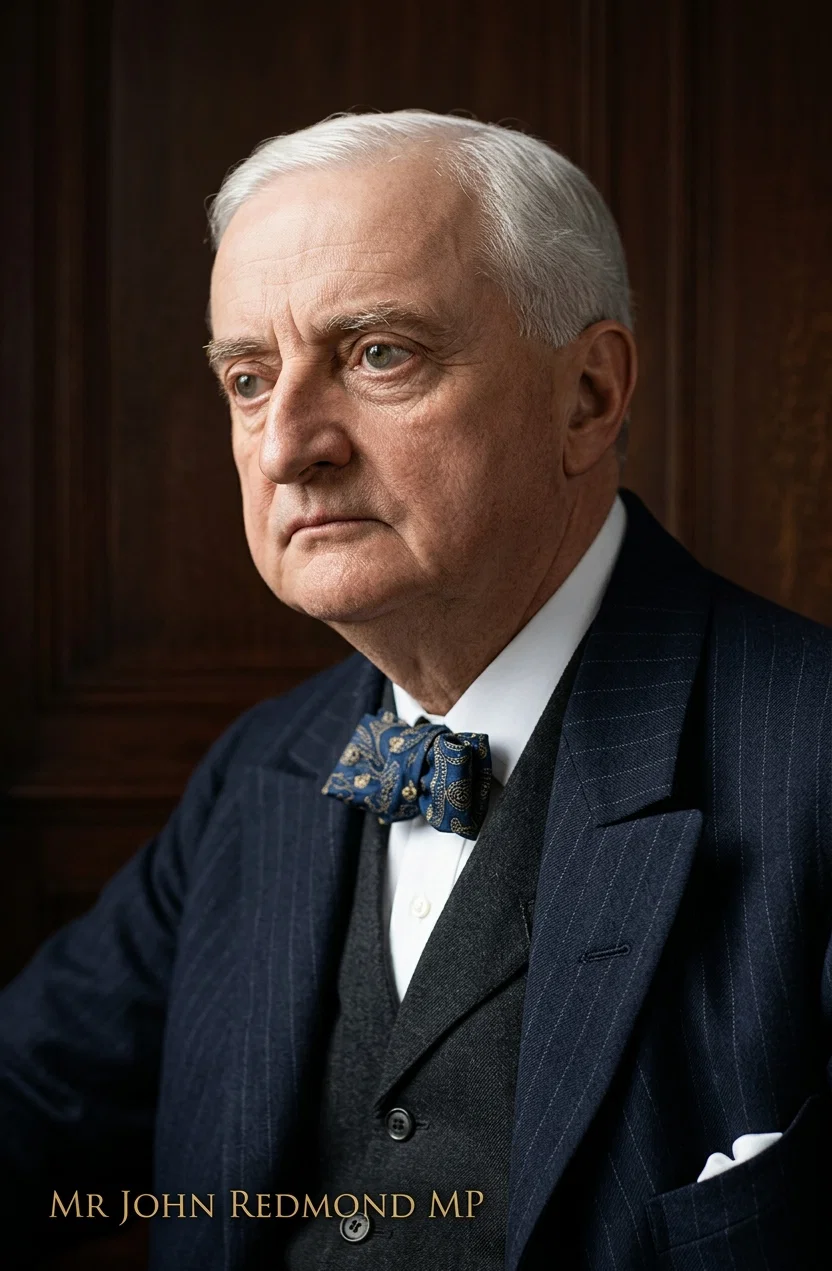
Mr. John Redmond, M.P., the Irish Nationalist leader
The contention of the colliers was for a minimum daily wage. They had been paid solely by results; and when they reached a “fault” in the seam of coal, or, through a fall of roof or some other cause beyond their own control, had been compelled to work for many hours without getting much coal, they received little or no pay. The masters contended that the price paid to the colliers took into account these possibilities, and was sufficient to pay a good man a fair wage after allowing for an average proportion of abnormal places. They also declared that the piece-work system was the only possible one, since it was impracticable, in a coal-mine, to keep hewers under the supervision of foremen. Sixty per cent of the colliery proprietors, however, were willing to agree to a minimum daily wage, and the public generally was in sympathy with the demand for this. It was on the basis that a minimum wage should be paid to every collier, that the dispute was finally settled by the passing of a government bill, altho the labor members voted against this, because it did not go far enough. The act is to be in operation for three years, and the minimum rate is to be fixed in the various districts by boards, representing equally the colliers and the mine owners.
A good deal of satisfaction has been expressed over the fact that from first to last the strike was attended with very little rioting or violence. It is questionable, however, whether this is altogether a matter for congratulation. The absence of violence was due to the strength of the unions, which included seventy-five per cent of the colliers. The non-unionists, however much they might have desired to continue working, realized the risk of attempting to do so. Wherever there was any disposition manifested to go to work, the strikers soon showed their teeth, so that the real explanation of the absence of violence is probably the solidarity and determination of the miners, rather than their pacific spirit.

The Last Experiment in Human Government

Sir W. Robertson Nicoll, editor of the “British Weekly,” sees the meaning of the situation, and has set it out in the following words:
“When Mr. Gladstone passed his great franchise bill, democracy came really into power. Men saw that democracy had arrived, that it would be strong, that it would be gifted with enormous strength, and clad in enchanted armor. Since then the people have been in power, but they have not known it. Now they know that they have all the power, and they propose to use it, and to use it for their own ends. Whether they will call themselves Tories or Radicals or Laborists we can not tell. What we may be sure of is that under any name they will be intent on the same purpose.”
“Nor is there going to be any substitute for democracy. Every other instrument of power has been exhausted and thrown aside, and from the judgment of the people there is no earthly appeal.
“Very much may be said and has been said about the evils and dangers of democracy. But while it is easy to criticize democracy, it is by no means easy to answer the argument that democracy is necessarily the righteous form of government.
“In any case, Demos is not going to abdicate. What he has gained by long labor and travail he is going to keep.
“He was never so fully conscious of his own strength and right as he is to-day.
“Are we to say, then, that Demos can do no wrong? On the contrary, all through the course of history the people have erred. As an able critic has said, ‘Tho they have chosen great rulers, they have often stoned great prophets,’ and there is yet little conclusive evidence that Demos will possess the morale which will alone make his strength or his wisdom safe. He may be warlike, he may be selfish, he may love money and ease. He will certainly be liable to make many blunders, and to fancy that the world can yield more happiness than it is capable of yielding. But the fact that confronts us is that democracy is the last experiment, that there will never be another.”
“The only hope for Demos is that Demos should be Christian. A people’s impulses are often capricious. Israel, Athens, Rome, and England all show that the people have had cowardly and blood-thirsty fits as well as moods of magnanimity and faith.
“Take away Christianity, extinguish public worship and private prayer, reduce the Bible to a book like any other book, give us a faithless world, and we shall have the inevitable end of black despair and bitter spite.”

Naval Rivalry

In face of this internal danger, the country to a considerable degree lost interest in the naval rivalry with Germany. Lord Haldane, head of the War Office, went to Berlin on a mission of conciliation, and it was understood that an amicable spirit was prevailing in official quarters. It has since transpired, however, that Germany has asked for some territorial concession in Africa in return for the abandonment of her immediate plans for naval extension. The British government was not willing to sacrifice some material possession for the sake of a mere provisional reduction in the German navy, but the discussions are continued along other lines. Germany, it is evident, does not intend to be second in any respect to any power on earth so long as her present prosperity continues. She is planning a still further increase in her already colossal army.
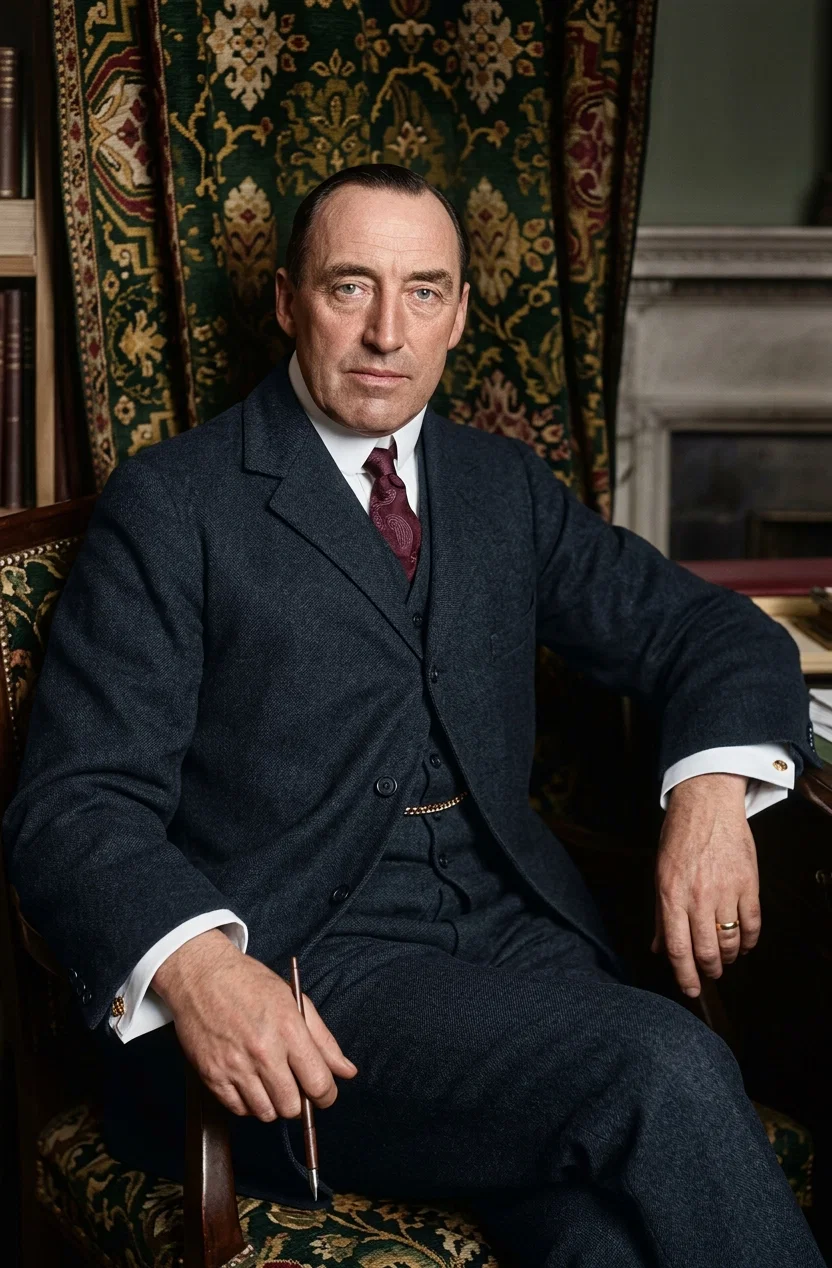
Sir E. H. Carson, K.C., M.P., leader of Ulster Protestants

Home Rule for Ireland

The unsettled condition of affairs in Europe, and the feeling that before long England will probably be engaged in a struggle for existence with a powerful rival, is the main argument employed against the bill for granting home rule to Ireland. This measure, however, is making progress in Parliament. It has been heartily accepted by Mr. John Redmond, the Nationalist leader, and by all sections of the Irish Party in the House of Commons. It has also been adopted by a great national convention in Ireland. Expressions of approval have been received from many leading statesmen in the British dominions. Surprise has been expressed in some quarters that the Irish Nationalists should accept so restricted a measure of home rule; but they profess themselves well satisfied, and tho they think the safeguards it provides are unnecessary, they have no objection to these.
The bill gives a full measure of local self-government, but withholds everything that would impair the supremacy of the Imperial Parliament. The lord lieutenant, who may be in future chosen without regard to his religious persuasion, has a power of veto over legislation, and so has also the Parliament at Westminster, in which forty-two Irish members are still to sit. The Irish Parliament is to consist of two houses, a House of Representatives with 164 members, and a Senate of 40 members, the latter to be nominated in the first instance by the imperial executive. The term of office for a senator is eight years; and as they retire by rotation, their places are to be filled by the Irish executive. Disputes between the two houses are to be settled in joint session. Six years after the passing of the act, the control of the police, the royal Irishconstabulary, is to be transferred automatically to the Irish executive.

Establishment of Religion Prohibited

The provisions of greatest interest are those that affect religion. The Irish Parliament is prohibited from passing any law, directly or indirectly, to establish or endow any religion, or to prohibit the free exercise of it, or to give any preference or privilege or to impose any disability whatever on religious grounds, or on account of ecclesiastical status. Further, it is prohibited from making any religious belief or any ceremony a condition of the validity of marriage. This last provision is aimed directly at the papal decree ne temere, about which so much has been heard lately. Under the provisions of the Home Rule Bill, this decree can never come into legal effect in Ireland. The Protestants of England are quite generally satisfied with the safeguards, and some of them are even inclining to the view that home rule will mean a weakening of Romish influence in the country; but the Protestants of Ireland declare that the safeguards will prove worthless, and they are positively refusing to be made subjects to an Irish Parliament. Sir Edward Carson is the leader of the Ulster Protestants, and on several occasions he has encouraged his followers to be prepared for violent measures rather than accept the domination of an Irish Parliament. Here is a specimen utterance representative of the spirit of the Orangemen of Ulster, taken from the Belfast “Northern Whig”:
Christian X, the new King of Denmark, who succeeds Frederick VIII. Christian X is fifty-two years old.
“Mr. Asquith has had fair warning that we in the north of Ireland will ignore the very existence of a Dublin Parliament. Mr. Asquith’s so-called safeguards would not preserve religious liberty, personal security, or public credit, and therefore we shall never submit to home rule while there is a Protestant left in Ulster strong enough to strike a blow against it.”
Orangemen are drilling in large numbers, and equipping themselves with firearms, with a view to making good their words.

Disestablishment in Wales

Parliament has also entered upon the work of satisfying the demands of Welsh national feeling by the disestablishment of the Church of England in that principality. This means the separation of four bishoprics from the see of Canterbury. The alien standing of the church has been so open and notorious a fact that little attempt has been made to urge its retention as a State church. The principal struggle has been over the proposals for disendowment. The adherents of the church naturally characterize these as an iniquitous policy of robbery and spoliation, but their opponents retort that the wealth of the church was not amassed without some resort to spoliation. The government measure provides that every existing incumbent shall continue to receive his present stipend as long as he holds his living; so that for a time the present income from endowments, amounting to $1,300,000, will be untouched. As the present incumbents die off, the income will gradually be reduced until it reaches a minimum of $435,000 a year. To this may be added the grants at present made to Wales out of a large fund administered by the Ecclesiastical Commissioners of England, amounting to $500,000 a year, which would bring the State grant in all to $900,000. The disestablished church is to meet and organize a representative body to which will be transferred all the cathedrals, churches, and parsonages. The sum of $133,500 now paid for the maintenance of Welsh bishoprics is to be handed over to the University of Wales; and another sum of $750,000 which is now collected annually in tithes from the Welsh farmers, will be transferred to the county councils for expenditure on charitable objects. One powerful argument used to justify the disestablishment of the church in Wales has been the experience of the church in Ireland. When this was disestablished in 1869 its supporters denounced the step as an attack on Christianity; but ever since, the church in Ireland has grown stronger. The same thing may easily happen in Wales. After it is disestablished, the church in that country will probably meet with a much larger degree of success in soul-saving work among the Welsh people.

Unfavorable Religious Statistics

The times are not favorable to religious life, whether in the established church or in the free churches. The Methodists are now lamenting another year of decline, the sixth in succession. The national drink bill has gone up by $25,000,000 in the past year, amounting now to $810,000,000. Social troubles are filling the minds of men; and the churches, instead of waiting on God for the spiritual power they lack, are seeking rather for increased popularity with the world, and finding that it does not come that way.
The loss of the Titanic has made a deep impression upon the public mind in England. All other matters have been overshadowed by this appalling disaster. The circumstances were well calculated to impress. The very name of the vessel suggested the Heaven-daring impiety of the mythological giants of old. Everything that could minister to the pride of wealth and the lust after luxury was to be found in the Titanic. It represented man’s boast over the forces of nature, at last, assuredly conquered. This vessel was on her maiden voyage, and had been sent on her way amid many congratulations. Then came the news of an accident, but the first reports spoke of every life saved, and the ship, which was unsinkable, being towed to the nearest port. A few hours later brought the fearful truth. The suddenness and completeness of the catastrophe suggested an awful stroke of divine judgment. The prayers of the doomed, the playing by the band of the well-known hymn, “Nearer, my God, to Thee,” appealed to the religious sense of men. The “Methodist Times” gives expression to it in these words:
“If there was one thing above another that ancient piety shrank from, the futility and fatality of which great religious literature displayed, it was the insolent self-confidence that flaunted the littleness of man before the omnipotence of God. And who that gages the temper of the present age, its lack of reverence and humility, can fail to recognize that this is our besetting sin! Shallowness, frivolity, and thoughtlessness—these are the dark shadows that overcast the secular progress of mankind. ‘As it was in the days of Noe,’ so now. It is high time that this warning should be heard, with its call to seriousness and simplicity. Let the whole world, in this season of sorrow, listen to the refrain, ‘Nearer, my God, to Thee.’”
The world is absorbed in its pursuit of wealth or pleasure; and even the churches, with hearts set on things below, have no ears for the message that makes known the coming of the Lord, and declares that we have reached the last days, that “the hour of His judgment is come.” But ever and anon the judgments of God fall heavy on the heedless world, and for a moment men pause in their haste to meditate the meaning of the stroke. In the presence of some great calamity, brought face to face with the solemn realities of eternity, they recognize the true character of the age, and acknowledge that as it was in the days of Noah, so it is now. Significant admission! For “as the days of Noe were, so shall also the coming of the Son of Man be.”
W. T. BARTLETT.