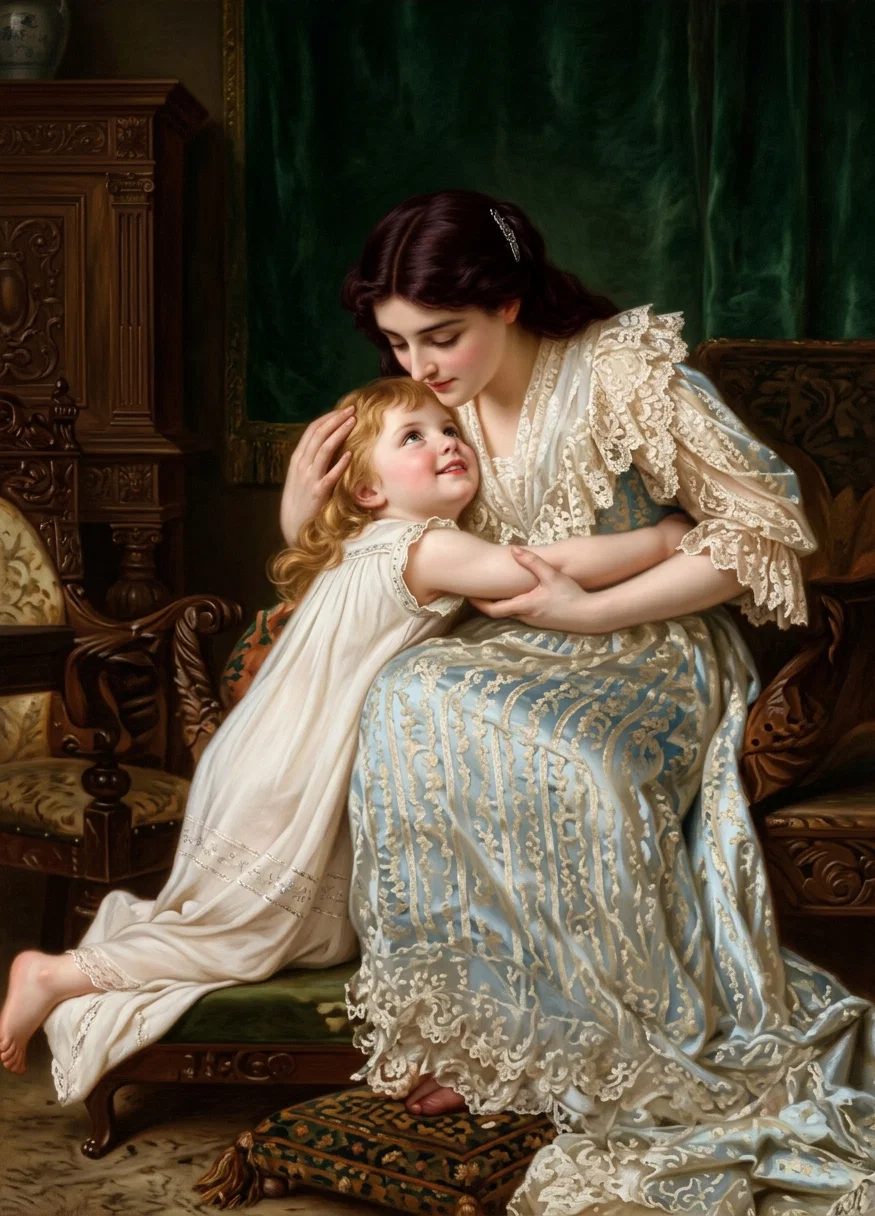
Some one has beautifully said, “Home is where mother is.” And truly, one can scarcely think of home without thinking of the mother who makes that home what it is to those who share its joys, its sorrows, and its blessings. The mother is the “keeper at home,” the director of the domestic affairs. Upon her especially rest the burdens and cares of the household, while she shares with the father the important duty of so rearing their children that they may become a blessing to the world. But as the father’s duties necessitate his absence from home much of the time, the greater part of the child-training rests with the mother. And O, how much patience, kindness, sympathy, and love, and at the same time firmness of purpose, she must have for the proper accomplishing of this her most difficult task in life! The mother directs her household along the lines of refinement, culture, love, and unselfish service, just in proportion to her ability in these directions. The mother who is overexacting in her demands, uncouth in manner, and unkind in disposition, leaves such an impress upon her work that her home is known by these unpleasant characteristics.
The mother should be loving, kind, and generous, and in return, she should be treated with kindness, love, and consideration by the father and children of the household. She should be made to feel that she is truly appreciated, and that home would not be home without her.
The divine purpose in child-training is so to instil into young minds the principle of loving service embodied in the fifth commandment that they will not only render cheerful obedience to parents, but that they will early learn to recognize their obligations to God, and be induced to serve Him gladly through life.
The Christian mother is strictly truthful in dealing with her children. Instead of telling Johnnie not to go away from home, because the bears will eat him, she teaches him from babyhood that the street is not to be his playground, and thus discourages the first lesson in street education. As Johnnie grows older, she teaches him to avoid evil associations, questionable amusements, cigaret smoking, strong drink, bad reading, etc., at the same time directing his mind into proper channels of employment and recreation.
The home reading-room, under Christian parents’ direction, is infinitely better for boys and girls than the public reading-room; and it is possible to make home so attractive as to satisfy many youthful longings for entertainment. The wise mother is not arbitrary and tyrannical in the home government. Some way she manages to have things at home just a little more pleasant for her children than they can find elsewhere — and so they enjoy staying at home. The children of well-ordered homes have well-ordered thoughts. And truly bright is the future of the child whose thoughts are of this character. It is said, “The human face is the masterpiece of God.” It is the mother’s privilege so to train the young mind that that masterpiece be not marred by evil; for the face is a revealer of the thoughts.
The Christian mother has many perplexing experiences which impel her to seek wisdom from above, that she may know how to solve successfully the many intricate problems which come to her, upon the proper solution of which may depend the present and eternal welfare of one or more loved members of her household. The morning and evening private devotions, the family altar, and the mid-week prayer-meeting do not always suffice to supply the needs of the Christian mother. She must have other special seasons of prayer — it may be with one or more of her children, it may be alone.
Mothers largely shape human destiny. There is much truth in the familiar saying, “The hand that rocks the cradle is the hand that rules the world.” The mother teaches the first prayer, the first song, the first step. She kisses the burned finger, she soothes sorrow, she assuages grief, she watches in illness. She enters into all the trials and triumphs of childhood with a sympathy that is born of hope; for the Christian mother never ceases to look to the future with longings for the success of her children, not simply temporal, but eternal. And O, how blessed at any time to be able to say to the Master, “Behold I and the children whom God hath given me”!
The dear, loyal Christian mothers! How their influence permeates the intricate affairs of the world — hidden and obscure, but nevertheless powerful! It is only when a Washington, a Wesley, or a Garfield arises into prominence that the mother’s influence is so perceptibly recognized. The mother who gives her best years in loving service to her children, may confidently expect that her children will “arise up and call her blessed.” Such service is not unfelt by the world, or unseen by Heaven, and no service surpasses it.
But many a mother is only a household drudge. She is the first one up in the morning, the last one to bed at night. “The drudge is only a drudge, and her compensation lies in the fact that she seldom knows it.” Many a mother is so blindly devoted to her children — constantly toiling that they may have ease — that she does not realize she is doing them as well as herself a great injustice. It is the nature of a baby to like to help mother do things. But how easily children outgrow their babyhood, in this respect, and come to look at mother as the one to whom belongs the long list of household duties, from which they are exonerated, unless they have been trained to actual service! And surely it is nothing less than a sin to permit children to grow up in idleness. The self-sacrificing mother rarely looks after her own rights; let both husband and children see that these are regarded,—a right to respect, to love, to time for study and rest, that she may be all a mother ought.
The mother who so rules her household that the children never find higher enjoyment than when seeking to lighten the parental burdens, is fitting them to help lift cheerfully the burdens of the great weary world. Children who are taught to share the household cares, and who take real pleasure in “doing the duty that lies nearest,” and in doing it to the best of their ability, are fitting themselves to perform well the duties which lie beyond their present grasp.
The mother of George Washington was a beautiful character. She was acquainted with the Source of all help, and trained her son so well during his childhood that she was pleased to remember him in later years, as her own good boy. No amount of earthly glory or fame achieved by her son seemed to affect her. She had taught him diligently to be good when a boy, and she looked upon his success in manhood as a mere result. The key-note of her success in conducting the affairs of her home is found in her piety. It is said of her in her later years, “She was in the habit of repairing every day to a secluded spot formed by rocks and trees, near her dwelling, where, abstracted from the world and worldly things, she communed with her Creator in humiliation and prayer.” And Washington’s devotion to his mother was one of the most noble characteristics of his life, and no doubt afforded her much comfort in memory during her closing days.
Froebel has given us this loving admonition: “Come, let us live with our children.” The true mother appreciates what this means. She is willing to sacrifice worldly pleasure and social distinction in her efforts to train her children so that they may gain the highest present benefit and pleasure from the hallowed associations of home, and achieve the greatest success possible for time and eternity. And such consecrated efforts bring great results.