THE LITTLE HORN

3%

Publishing Committee · Battle Creek, Mich. · Dec 24, 1857

FromReview and Herald, Vol. 11, No. 7.

Read the full edition

THE LITTLE HORN

SYNOPSIS OF THE PRESENT TRUTH. No. 7.

THE LITTLE HORN.
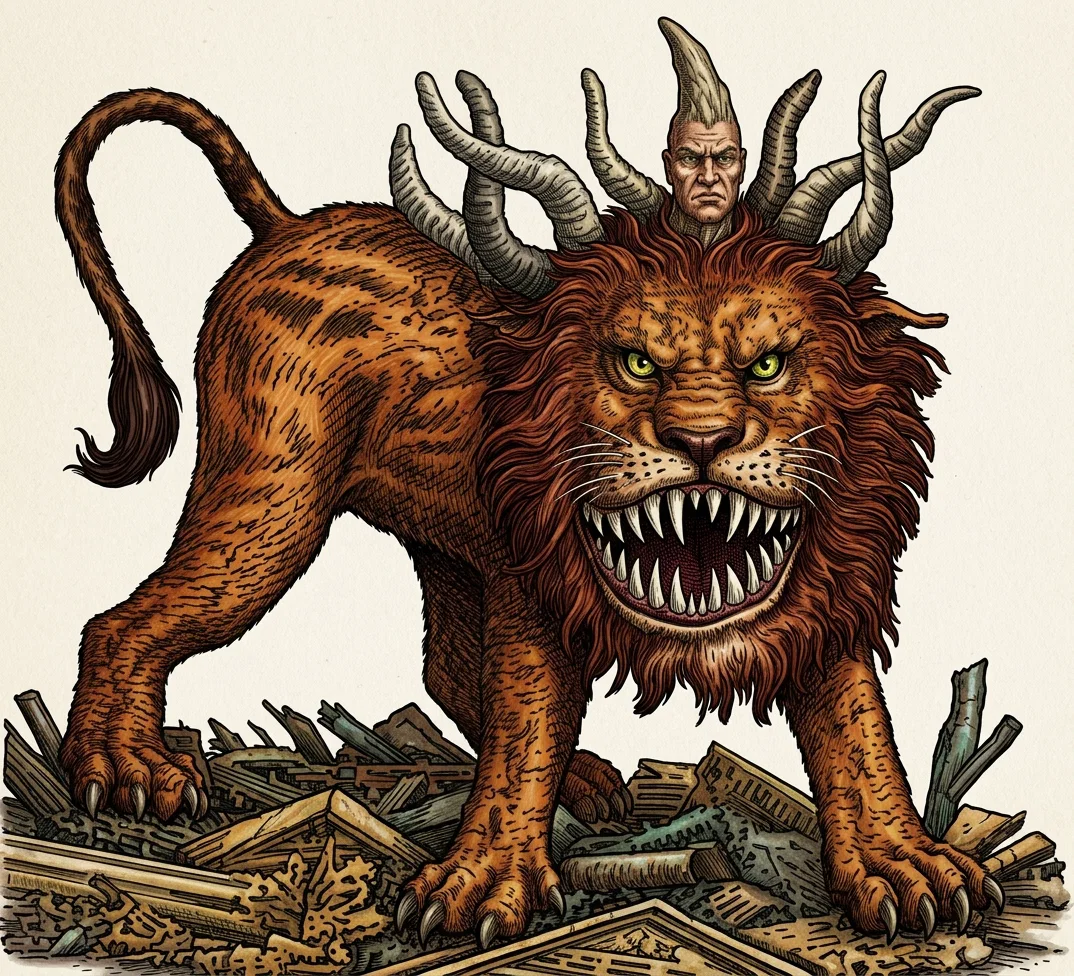
In taking our leave of the image, we do the same of the terrible beast of chap. vii. in its first form; but we are brought further down on the stream of time in that chapter, and have some additional particulars revealed to us, which next claim our attention.
As Daniel was considering this fourth beast, he suddenly presented to his view a new phase. A little horn thrust itself up among the ten, and plucked up three of them by the roots; and it had eyes like the eyes of man, and a mouth speaking great things. When the angel explained the ten horns to be ten kings, he also said: “And another shall rise after them; and he shall be diverse from the first and he shall subdue three kings. And he shall speak great words against the Most High, and shall wear out the saints of the Most High, and shall think to change times and laws; and they shall be given into his hand until a time, and times and the dividing of time.” Verses 24, 25.
Has such a horn arisen? and has such a revolution taken place among the kingdoms of Europe? We answer, Yes; and again cite the reader to the page of history. Protestants all agree in applying this little horn to the Papacy; and, indeed, the specifications are so plain, that there is hardly room for mistake.
In our investigation of this horn, three points claim our consideration: 1. The events of its rise; or the plucking up of three horns. 2. Its character as shown in speaking great words against the Most High, wearing out the saints, and thinking to change times and laws. And 3, its continuance, during a time, times, and the dividing of time.
1. Were three kings overthrown to prepare the way for the Papacy, in a manner to fulfill the prophecy? To ascertain this, we must consider a few items of its rise and progress. Paul said that even in his day the mystery of iniquity was already at work. 2 Thess. ii, 7. He knew the depravity of the human heart, the strength of ambition, and the intoxication that attends the possession and exercise of worldly power. And from the office of bishop, which was in his day established, and in Rome where he had preached in bonds “the salvation which cometh from God,” the Papacy, the Man of sin, the Son of Perdition, at length arose.
The first pastors or bishops of Rome enjoyed a respect proportionate to the rank of the city in which they resided; and for the first few centuries of the Christian era, Rome was the largest, richest, and most powerful city in the world. It was the seat of empire, the mother of nations. “All the inhabitants of the earth belong to her,” said Julian, and Claudian declared her to be “the fountain of laws.” “If Rome is the queen of cities, why should not her pastor be the king of bishops,” was the reasoning they adopted. “Why should not the Roman Church be the mother of christendom? Why should not all nations be her children, and her authority their sovereign law? It was easy for the ambitious heart of man to reason thus. Ambitious Rome did so.” The bishops of the different parts of the empire felt a pleasure in yielding to the bishop of Rome some portion of that honor which was due to the queen of the world. There was originally no dependence implied in the honor thus paid. “But usurped power in-
creases like an avalanche. Admonitions at first simply fraternal, soon became absolute commands in the mouth of the Pontiff. The Western bishops favored this encroachment of the Roman pastors, either from jealousy of the Eastern bishops, or because they preferred submitting to the supremacy of a pope, rather than to the dominion of a temporal power.”
Thus was everything tending towards placing the bishop of Rome on the supreme throne of Christendom. But in the fourth century, an opposing influence arose, in the promulgation of Arianism. The doctrine of Arius was “that the Son was totally and essentially distinct from the Father; that he was the first and the noblest of those beings whom the Father had created out of nothing, the instrument by whose subordinate operation, the Almighty Father formed the universe, and therefore inferior to the Father both in nature and dignity.” This opinion was condemned in the Catholic council of Nice in 325, which decreed that Christ was of one and the same substance with the Father. Hereupon Arius was banished among the Illyrians, and his followers compelled to give their assent to the creed composed on that occasion. The Arians therefore became bitter enemies and opposers of the Pope and Catholic Church.
With these facts before us, we can easily see how the spread of Arianism would check the influence of the Catholics, and how fatal the possession of Rome and Italy by a people of the Arian persuasion would be to the supremacy of a Catholic bishop. We are therefore prepared for the following statements of the historian:
Odoacer was king of the Heruli, and the first of the Barbarians that reigned over the Romans. He took the throne of Italy in 476. Of his religious belief, Gibbon says: “Like the rest of the Barbarians, he had been instructed in the Arian heresy; but he revered the monastic and episcopal characters, and the silence of the Catholics attests the toleration which they enjoyed.” But Odoacer in 493 was dethroned by Theodoric, the king of the Ostrogoths, who in turn took the throne and was acknowledged the king of Italy. He also had been instructed in the Arian doctrine. “The triumphs of Arianism were, however,” says Mosheim, “transitory, and its prosperous days were entirely eclipsed when the Vandals were driven out of Africa, and the Goths out of Italy by the arms of Justinian.” The Vandals fell before the victorious arms of Belisarius, Justinian’s general, in 534, and the Goths, retiring, left him in possession of Rome in 538. Justinian, five years before (A. D. 533), had issued a decree, declaring the bishop of Rome the head of all the churches, and that by the “decisions and right judgment of his venerable see, heretics are corrected.” By these conquests of Belisarius he was enabled to put this decree into effect.
D’Aubigne also testifies: “Princes whom these stormy times often shook upon their thrones, offered their protection if Rome would in its turn support them. They conceded to her the spiritual authority, provided she would make a return in secular power. They were lavish of the souls of men, in the hope that she would aid them against their enemies. The power of the hierarchy which was ascending, and the imperial power which was declining, leant thus one upon the other, and by this alliance accelerated their two-fold destiny. Rome could not lose by it. An edict of Theodosius II. and of Valentinian III. proclaimed the Roman bishop ‘rector of the whole church.’ Justinian published a similar decree.”
If the Pope was not hereby entitled the head of all the churches, he never could be.
“The authenticity of the title,” says Mr. Croley, “receives unanswerable proof from the edicts of the ‘Novellæ’ of the Justinian code. The preamble of the 9th states, ‘that as the elder Rome was the founder of the laws; so was it not to be questioned that in her was the supremacy of the pontificate.’ The 131st, on the Ecclesiastical Titles and Privileges, chapter ii, states: ‘We therefore decree that the most holy Pope of the elder Rome, is the first of all the priesthood, and that the most blessed Archbishop of Constantinople, the new Rome, shall hold the second rank after the holy apostolic chair of the elder Rome.’”
It is true that the Pope did not become a temporal prince till made so by Pepin, the French monarch, in 755; and he did not reach the height of his power till the tenth and twelfth centuries; but this is not the point in the prophecy: the question is, When did the Papacy become possessed of civil power, so that the saints, and times, and laws, might be given into its hands? This must have been in A. D. 538, when by the force of arms, Justinian established his decree by which he had constituted the Pope the head of the church and the corrector of heretics. And we conceive that the overthrow of the three kingdoms above enumerated, the Heruli, the Vandals, and the Ostrogoths, fulfilled the prediction that he should subdue three kings; for that three kingdoms were overthrown to make way for his supremacy, the Pope has ever since signified by his triple crown.
2. “And he shall speak great words against the Most High, and shall wear out the saints of the Most High, and shall think to change times and laws.” A sufficient commentary on the words of arrogance and blasphemy which this little horn was to speak will be found in the titles which the Pope has assumed. He claims to be “Universal Father,” “Holy Father,” “His Holiness,” “Sovereign Pontiff,” “Supreme Head of the Church on Earth,” “Pater Familias,” (i. e. Father of the family of God,) “Successor of Peter,” “The Infallible One,” “Prince of the Apostles,” “Vicar of Christ,” “Father of Fathers,” “Lieutenant of Christ,” “Father and Doctor of all Christians,” “Lord of lords,” “A God on Earth,” “Lord God the Pope,” “Prince of the World,” “Monarch of the Earth,” “King of kings.”
“And shall wear out the saints of the Most High.” No phrase could better denote the long and tedious persecutions of the saints by the Catholic Church. “It has been computed,” says the Religious Encyclopedia, “that fifty millions of Protestants have at different times, been the victims of the persecutions of the Papists, and put to death for their religious opinions.”
“And think to change times and laws.” There are but two kinds of laws with which the Pope could have anything to do; and these are the laws of men and the laws of God. But the laws designated in the text, are those over which he has no control, and no power to change; for it does not say that he should change them, but only think to do it. But human laws the Pope has instituted, changed or abrogated at his pleasure, and has also in this respect had a perfect right to do as he has done; these cannot therefore be the laws referred to: they must be the laws of God. Has the Papacy interfered with these? Read the following from Prof. Gaussen:
“Daniel says of the little horn: A king diverse from the other ten shall think to change times and laws. This denotes the unparalleled attempt which the Pope has made upon the Laws of God: pretended to change the Law in its sovereignty, in its sanction, in the extent of its promulgation, in its contents, in its morals, and in its doctrines. He alone on earth, proclaiming himself infallible, has dared to put his decrees and traditions on a level with, and above the Scriptures. He alone on earth has pretended to pardon the sins which the Law condemns, and to dispense from the duties which the Law commands.”
According to the boast and testimony of all Catholicsthe Pope has directly changed the fourth commandment; he has abolished the second, divided the tenth, and transposed nearly all. For proof of these statements we refer to the various Catholic Catechisms in the land.
3. “And they shall be given into his hand until a time, and times, and the dividing of time.” How long a period is denoted by this expression? This can easily be determined by reference to the Bible computation of time. In the language of Scripture a month has 30 days. Compare together Gen. vii, 11, 24; viii, 3, 4. There being twelve months in a year, a year would consist, according to this computation, of 360 days. A full year is also called a time. See Dan. xi, 13, margin. Compare also the marginal chronology of Dan. iv, 28, 34, which allows seven years to fulfill the period of Nebuchadnezzar’s degradation till seven times should pass over him. Josephus also plainly tells us “that Nebuchadnezzar was driven from his kingdom seven years. The period denoted by the text would therefore be, 1st, a time, one year, 360 days, 2d, times, two years, (the least that can be denoted by the plural number,) 720 days, and 3d, the dividing of time, half a year, or 180 days; which being all put together, make 1260 days. And a day in symbolic language, signifying just a year, [Num. xiv, 34; Eze. iv, 6] the period turns out, divested of all mystery, to be just 1260 years. This is the same that Dr. Clarke gives us in his note on Dan. vii, 25, where he says, “In prophetic language a time signifies a year; and a prophetic year has a year for each day. Three years and a half (a day standing for a year as in chap. ix, 24) will amount to one thousand two hundred and sixty years, if we reckon thirty days to a month as the Jews do.”
But the same period and same power are elsewhere brought to view in the word of God. In Rev. xii, 6, we read of a woman (the acknowledged symbol of the church) who fled from the face of the dragon to a place prepared of God, that they should feed her there a thousand two hundred and three score (1260) days. The same woman is again mentioned in the 14th verse, and the time during which she was to be nourished in the wilderness, as brought to view in verse 6, is here called a time, and times, and half a time. These two expressions therefore, the word of inspiration for it, denote the same period.
Again: In Rev. xiii, John speaks of a beast to whom there was given a mouth, which he opened in blasphemy against God, to blaspheme his name, and his tabernacle, and them that dwell in heaven. This power is on all hands acknowledged to be the Papacy; and who can fail to see its identity with the little horn of Dan. vii? But it is said of this beast, that “power was given him to continue forty and two months.” As we have seen that in Bible language, a month consists of thirty days, forty-two months would amount to just 1260 days; which is farther proof that the two powers are identical, and that the expression, a time, times, and dividing of time through which the little horn was to continue, denotes in prophetic language, 1260 days, and in literal language 1260 years. There can be no doubt therefore in regard to the duration of the little horn’s dominion over the saints, and times, and laws; and this being settled we are prepared for the application.
Having shown that the Papal supremacy commenced in 538, we have but to add 1260 years to that date to find its termination. They carry us to A. D. 1798; and here history has set up a towering waymark for the comfort and encouragement of all those who, waiting for the consolation of Israel, are watching the signs of the times, and patiently studying the word of prophecy. If clothing the Pope with temporal power gave the saints into his hands, and marked the commencement of his career, depriving him of that power, would terminate his supremacy; and the Pope was thus deprived of his civil authority in 1798. It is a notable fact of history, that on the 10th of February, 1798, Berthier, one of Napoleon’s generals, at the head of the Republican army of France, entered the city of Rome and took it. On the 15th of the
same month, the Pope and his cardinals were taken prisoners, and shut up in the Vatican. The Papal government was abolished, and Rome and Italy, at the request of the people, were erected into the Roman republic. The Pope was carried a captive to France, where in 1799, he died a prisoner and an exile.
But the Papacy was still to exist after this event; for the Prophet goes right on to say, “And they shall take away his dominion to consume and to destroy it unto the end.” This abolition of the Papal government by Buonaparte, is set forth in Rev. xiii, by the captivity and deadly wound of the blasphemous beast; but the wound was to be healed. The Papacy has indeed been restored, but not to its former dominion: it has no more power to depose kings, and put the saints to death; and it is compelled to tolerate Protestantism.
A clearer and more definite fulfilment of prophecy, than is afforded us in this instance, could not be required. From 538 to 1798 is just 1260 years. The Prophet saw the Man of sin arise, and the saints given into his power. He ran his eye over the long period of his grinding persecutions, and told us that at a given point he should be driven from his throne and his power broken. Time rolled on to the period specified, and it was so! Fifty-nine years have elapsed since that event, and his power has been consuming and wearing away. The Bible has been circulated by millions of copies, which it was always the policy of the Pope to suppress; and the ancient institutions of Papacy are crumbling in her strongest holds. What is the next event in this chain of prophecy? The beast shall be slain, and his body given to the burning flame, and the kingdom and dominion and the greatness of the kingdom under the whole heaven shall be given to the saints of the Most High. What more could we require? If a chain of prophecy like this will not convince mankind that earth is acting its final scenes, that time’s last sands are falling, would a hundred more just like it? If one solemn “Thus saith the Lord,” from the mouth of Jehovah, that the end of all things is at hand, will not convince and arouse, would it though uttered an hundred times? For us it is enough. When a prophet has told us with unerring certainty ninety-nine particulars in a series of events, for our part, we can trust him for the hundredth. The beast will be slain and his body given to the burning flame. The Man of sin will be consumed by the spirit of Christ’s mouth and destroyed by the brightness of his coming. The saints will take the kingdom. Blessed privilege to be among them! There is always good spoken concerning them. There is no chain of prophecy but carries them to a glorious end. There is an endless age of unutterable glory always held up before them. They shall take the kingdom. They shall be delivered, whose names are found written in the book. They shall shine as the brightness of the firmament forever and ever. They shall stand on Mount Zion with the Lamb having the harps of God, and shout victory over the beast and his image, and the number of his name. May the writer and the reader of these imperfect lines help swell the ranks of God’s mighty, shining ones, when they go in to possess the kingdom.
(To be Continued.)