Untitled article

4%

CHRISTIAN CITIZENSHIP IN BABYLON.

The lives of Daniel and his three companions afford us a useful lesson upon the rights and duties of Christian citizens under civil government.
Carried captives to Babylon in their youth, Daniel, Hananiah, Mishael and Azariah found a test of loyalty to God awaiting them almost from the hour of their entrance into the city.
As recorded in the first chapter of the Book of Daniel, the king commanded to select “certain of the children of Israel, and of the king’s seed, and of the princes; children [youth] in whom there was no blemish, but well-favoured, and skillful in all wisdom, and cunning in knowledge, and understanding science, and such as had ability in them to stand in the king’s palace, and whom they might teach the learning and the tongue of the Chaldeans.”
Among those chosen to be thus educated in “the learning and the tongue of the Chaldeans,” were the four young men already named. “And the king appointed them a daily provision of the king’s meat, and of the wine which he drank.” But Daniel and his three companions had conscientious scruples against partaking of such food; and as the record runs, “Daniel purposed in his heart that he would not defile himself with the portion of the king’s meat, nor with the wine which he drank: therefore he requested of the prince of the eunuchs that he might not defile himself.”
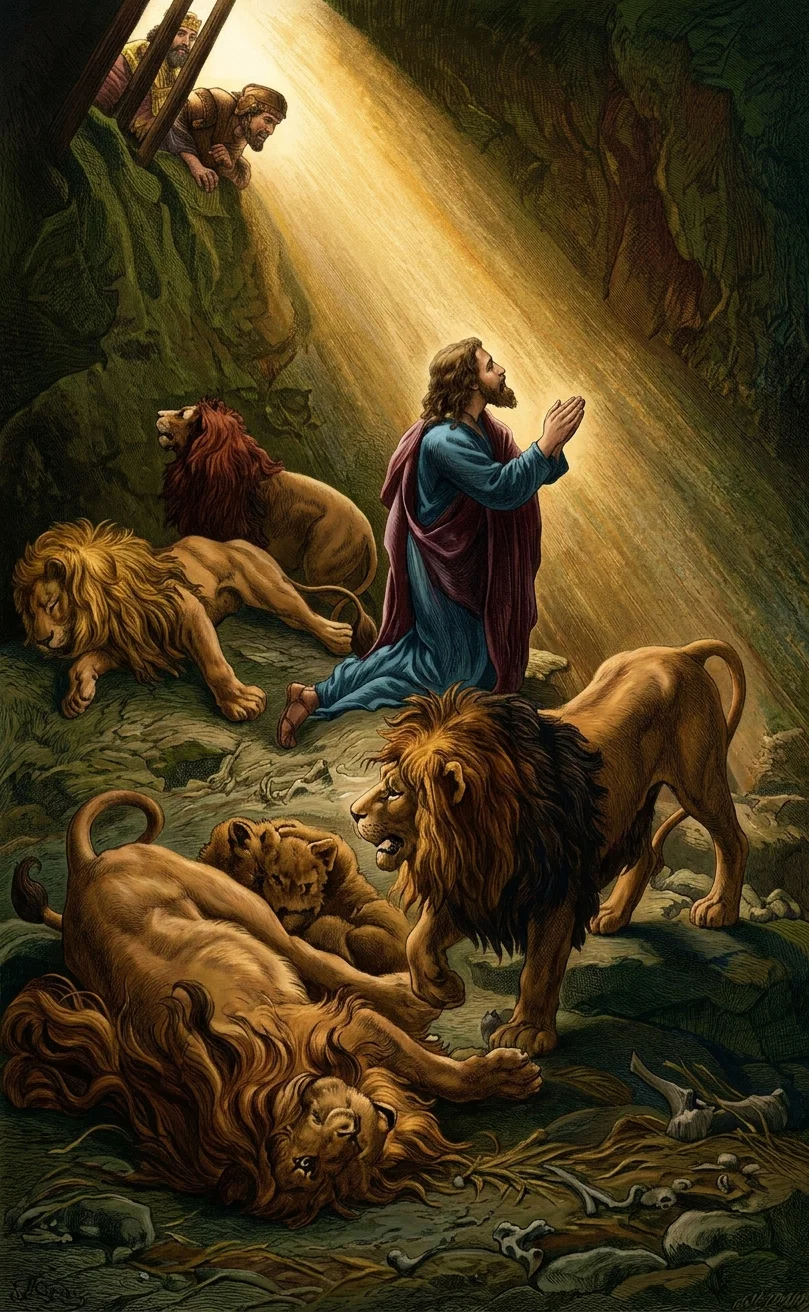
Daniel, the First of the Three Presidents, in the Lions’ Den.

“Be ye Wise as Serpents, and Harmless as Doves.”

The prince of the eunuchs was fearful lest he might endanger his head to the king; but upon further representation by Daniel he consented to try the four young men for ten days. The test was satisfactory and they were not required to eat the objectionable food.
Notice carefully the facts stated. First, Daniel purposed that he would not defile himself. But instead of offensively refusing to partake of food from the king’s table, he put his protest in the form of a request, in behalf not only of himself, but of his fellows. Nor did he in this thing concede the right of the king or of the prince of the eunuchs to control his conscience; he simply combined the wisdom of the serpent with the harmlessness of the dove. Had it been necessary he doubtless would have braved death itself, as he did subsequently, rather than violate his conscience; but craving as a favor that which was his absolute right, he not only retained the sympathy, respect, and confidence of Ashpenes, but obtained his request, not only for himself but for his companions. This is an example of Christian citizenship. Daniel and his companions rendered to Cæsar the things that were Cæsar’s, and to God the things that were God’s. Respect was shown for those in authority, and at the same time conscience was preserved void of offense.

Royal Counselors.

When their education had been completed the king communed with the young men who had been selected for special training for the public service, “and among them all was found none like Daniel, Hananiah, Mishael and Azariah: therefore stood they before the king” as counsellors. “And in all matters of wisdom and understanding, that the king inquired of them, he found them ten times better than all the magicians and astrologers that were in all his realm. And Daniel continued even until the first year of King Cyrus.”
The next account we have of any of the public acts of Daniel we find him among the wise men of the kingdom. He is condemned to die with them because of their inability to interpret the king’s dream, recorded in the second chapter. In this matter also he shows remarkable tact, and after gaining time for prayer he saves not only his own life but the lives of all the wise men of Babylon by making known to the king his dream and the interpretation thereof.

Daniel’s Reward and His Request for His Friends.

For interpreting the dream Daniel was highly honored. The king first commanded that an offering be made to him. But to this the prophet evidently objected, declaring that to God belonged the glory; for “the king answered unto Daniel, and said, Of a truth it is that your God is a God of gods, and Lord of kings, and a revealer of secrets, seeing thou couldst reveal this secret. Then the king made Daniel a great man, and gave him many great gifts, and made him ruler over the whole province of Babylon, and chief of the governors over all the wise men of Babylon.” And so far was Daniel from refusing all part in civil affairs, and from saying that since his citizenship was in heaven he could not participate in the affairs of earthly governments, that he “requested of the king, and he [the king] set Shadrach, Meshach, and Abed-nego [Hananiah, Mishael, and Azariah] over the affairs of the province of Babylon.”
How long Daniel’s three friends retained their positions before their religion brought them into conflict with the king we are not told, but a severe trial was in store for them. As recorded in the third chapter of Daniel, the king made a great image and caused this proclamation to be made: “O people, nations, and languages, that at what time ye hear the sound of the cornet, flute, harp, sackbut, psaltery, dulcimer, and all kinds of music, ye fall down and worship the golden image that Nebuchadnezzar the king hath set up: And whoso falleth not down and worshippeth shall the same hour be cast into the midst of a burning fiery furnace.”

Deliberately Disobeyed a Royal Mandate.

The three Hebrews exalted to high office at the request of Daniel, were present upon this occasion and heard the sound of the music, but remembering the command, “Thou shalt not bow down to them, nor serve them,” they deliberately disobeyed the king’s decree. “Wherefore at that time certain Chaldeans came near and accused the Jews. They spake and said to the king Nebuchadnezzar, O king, live for ever. Thou, O king, hast made a decree, that every man that shall hear the sound of the cornet, flute, harp, sackbut, psaltery, and dulcimer, and all kinds of music, shall fall down and worship the golden image: And whoso falleth not down and worshippeth, that he should be cast into the midst of a burning fiery furnace. There are certain Jews whom thou hast set over the affairs of the province of Babylon, Shadrach, Meshach, and Abed-nego; these men, O king, have not regarded thee: they serve not thy gods, nor worship the golden image which thou hast set up.” The king then summoned the culprits before him and offered them another opportunity to obey him, assuring them that a failure to respect his authority would be swiftly punished by death in the burning fiery furnace. “Shadrach, Meshach, and Abed-nego answered and said to the king, O Nebuchadnezzar, we are not careful to answer thee in this matter. If it be so, our God whom we serve is able to deliver us from the burning fiery furnace, and he will deliver us out of thine hand, O king. But if not, be it known unto thee, O king, that we will not serve thy gods, nor worship the golden image which thou hast set up.”

Their Punishment.

From the king’s standpoint this was a most high-handed and flagrant defiance of his authority, and he attempted to visit it with swift and condign punishment. To suffer such insubordination was in his eyes to forfeit the respect of all his subjects and invite anarchy. The integrity of his throne demanded prompt action. The three men were hastily bound and hurried to the furnace, heated seven times hotter than it was wont to be heated. Into this seething caldron of fire these men, only a short time before occupying some of the highest official positions in the gift of the king, were cast. “And these three men, Shadrach, Meshach, and Abed-nego, fell down bound into the midst of the burning fiery furnace.”

Their Vindication.

But while from the standpoint of the king they merited only death, the God whom they honored and who had clothed them with certain inalienable rights, who himself had ordained civil government, not to rule over the consciences of men but to secure, among others, the very right which was by the king denied these men, made bare his arm for their deliverance. “Then Nebuchadnezzar the king was astonied, and rose up in haste, and spake, and said unto his counsellors, Did not we cast three men bound into the midst of the fire? They answered and said unto the king, True, O king. He answered and said, Lo, I see four men loose, walking in the midst of the fire, and they have no hurt; and the form of the fourth is like the Son of God. Then Nebuchadnezzar came near to the mouth of the burning fiery furnace, and spake, and said, Shadrach, Meshach, and Abed-nego, ye servants of the most high God, come forth, and come hither. Then Shadrach, Meshach, and Abed-nego, came forth of the midst of the fire. And the princes, governors, and captains, and the king’s counselors, being gathered together, saw these men, upon whose bodies the fire had no power, nor was an hair of their head singed, neither were their coats changed, nor the smell of fire had passed on them.”

Daniel’s Trial and Triumph.

Daniel was not involved in this matter, for what reason does not appear. It seems probable, however, that his office of counselor did not require his presence on this occasion, while his three companions being more actively engaged in the affairs of government were doubtless prominent figures in all public functions.
But Daniel’s time of trial was coming. The kingdom had changed rulers, but Daniel was still in public life. He did not find the service of his fellowmen any bar to the service of God. He did not reason that because Babylon was a pagan kingdom he could have nothing to do with it except to live in it, without renouncing his heavenly citizenship. On the contrary he recognized the fact that while rendering to the king and to his fellow-citizens their due he could also render to God that which was due to him. The sequel shows that in Daniel’s mind the limits of civil authority were clearly drawn. With him the right of conscience was dearer than life itself. Neither political patronage nor fear of the royal disfavor could swerve him from the path of duty or lead him to surrender his God-given rights—rights the exercise of which he could not forego without yielding to man that which belonged alone to God.
The sixth chapter of Daniel tells the story of Daniel’s trial and of his triumph. Being of easy access to all we shall not quote it here. Suffice it to say that whereas his three companions had been required to do an act expressly forbidden by the second commandment, Daniel was by a general law binding alike upon all Darius’ subjects, forbidden to ask any petition of any God or man for thirty days save of the king only. Prayer, and especially prayer open to the observation of the public, is not directly required by the law of God. Indeed the Saviour taught that the closet was the proper place for prayer, so that from one standpoint it would appear that Daniel might very properly have ceased to pray, except mentally, for thirty days, and that without any abandonment of principle and without incurring moral guilt.
But viewed from another standpoint, and as we believe the right standpoint, to have complied in any degree with the king’s decree forbidding prayer to God for thirty days, would have been a violation of the first commandment, “Thou shalt have no other gods before me.” To have admitted the right of the king to forbid prayer for thirty days, or for any time whatever, would have been to admit his right to forbid all service to God for all time, and that would have been to put the king in the place of God, and so to violate the first commandment.
Nor are we left in doubt upon this point. Daniel’s miraculous deliverance from the lions is positive evidence that God approved his course, and shows that the Christian citizen, even though he be a public official, can, while rendering to Cæsar the things which are Cæsar’s, render also “to God the things that are God’s.” Christianity does not require, nor even permit men to use force in matters of conscience, neither does legitimate civil authority, the power ordained of God for the preservation of natural rights, warrant any invasion of God’s realm, the sacred precincts of the soul.