A Woman's Story

6%

Review and Herald Publishing Association · Takoma Park Station, Washington, D.C. · Jul 2, 1908

FromReview and Herald, Vol. 85, No. 27.

Read the full edition

A Woman's Story

MRS. J. N. ANDERSON
Another unfortunate life has passed into the shades of a heathen grave. Tai So, as we called her, died yesterday. She lived in a tiny little house built against a jog in the wall of the fish-market on our west side. Her husband works at the market, overseeing the distribution of live fish to venders. She was always so cordial in her invitation to come in and sit for a cup of tea; though the room is so small one almost wonders how one would ever get turned around to come out again face first. But she seemed real happy there, and after the baby came, devoted herself to it with a slavish attention. It lived in a bundle on her back; winter and summer she was always on the lookout for a shady place to sit and amuse the little creature. It is a year and a half old now, and has always been a favorite in the alley where they live and among the men in the market.
Tai So was a second wife, and therefore was taken by the husband's own selection. He seemed very fond of her, and did most of the cooking and whatever housework there was to do. After the morning distribution of fish was over, one might see him coming down the alley toward their door with some tender bean sprouts or other greens intended to go with a slip of fresh fish and a steaming kettle of rice to make the family breakfast. They lived very agreeably together. In fact, we often remarked that real domestichappiness prevailed in that tiny home. When the first wife came down from the country with her children for a visit, as she often did, she was received with the same cordiality as any other guest. The quantity and quality of the two daily meals was increased, and there were tea and some knick-knacks at noon. The two women sat together, smoked the little they could afford, chatted and exchanged compliments on each others' children in apparently perfectly easy relations till the visit ended, and the “Big Lady,” as Tai So called her, returned to the country.
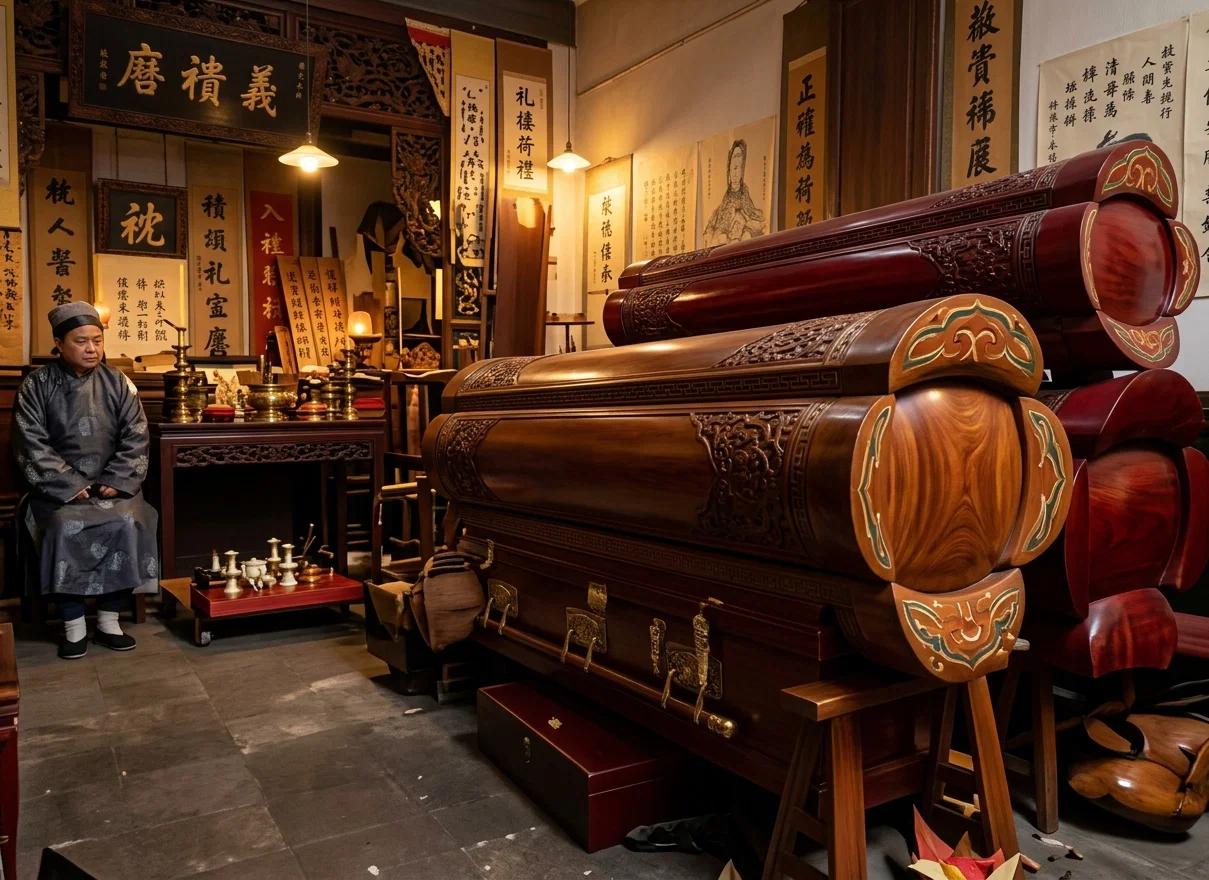
A CHINESE UNDERTAKER'S SHOP, SHOWING COFFINS
Tai So's life had not always run so smoothly, and perhaps the hardships she endured made this life bright by contrast. Born some place,—she did not herself know just where and when,—she had not been wanted as a girl-baby, and so had passed as a bond-servant into another family. Unfortunately she grew up good-looking; and so, as her unscrupulous owner could realize a large price for her, she was sent to the Canton Flower boat service, instead of being sold as a wife. How she made her escape, I do not know. I first saw her sitting at the door of a woman in our street making clothing. From early light till dark she sat stitching away at the heavy, blue homespun cotton. The face was delicate and pale, and the thin, slender fingers scarcely ceased stitching as the sad eyes were raised in greeting when we passed her at work. There was something appealing in her tone, though it was a long time before I knew a bit of her story, or anything about the character of the woman whose guest she was.
After a while there was a terrible quarrel at the place. Men and women scolded till they were red in the face, and too hoarse to yell longer. I could not tell what the trouble was, for the words were so indistinct; but evidently Tai So was concerned in it, for once in a while the blue sewing work was dashed to the ground, and she stepped inside to give vent to the indignation she could not repress. During the night things quieted somewhat. On the second day the storm burst out anew, till Tai So, pale and excited, gathered up the little she could get possession of, and left the house.
What could she do? She sat down on some building stones at the far end of the alley to rest and to think,—a young woman, penniless, a stranger, and alone. Some kind heart gave her a welcome, some supper, a straw mat, and an earthenware pillow for the night. A few months ago, when the old woman across the way was arrested for kidnapping, the real cause of the quarrel with Tai So came out. The girl saw through the plot, mistrusted she was not to be respectably married, according to promise, but was being betrayed back into the old life of shame, and so refused to follow her lead. This excited the old woman's vengeance.
The next day there was a stir in the alley—a grating of saws, a pounding of nails, and a general hurry-scurry of workmen. Then, after a few hours, everything was ready. Tai So came back to the door of her former hostess, but not alone. The man from the fish-market came with her, and a group of the alley neighbors came to back the claim she made. After a stormy defense, the old woman finally surrendered her unfortunate guest's few personal effects, and the young people went home to the tiny house that had so suddenly sprung into existence in the alley.
When the long, hot days came, followed by sultry nights in which the pillow was torture to one's head, I said to Tai So, “Do you find it very warm sleeping in your room?” The bedroom was so small that the broad bed four feet wide and six feet long reached the wall on all four sides and there was not a window, nor an opening for one, in the house. “When it gets too hot inside, I sit out here till it gets cooler. There is always a breeze from the river in this street,” she said, contentedly, adding, “but it must be hot in the houses farther in the city.” Then came the little daughter—an added joy into the woman's life. After three years of domestic life, and just twelve days before her death, a son was born; but the poor mother never rose from her bed in the tiny, dark room. I knew a boy baby had come, and thought how happy she must be; for she had told that it was because the first wife had borne only girls that the husband, though a poor laborer, had felt compelled to take a second wife. When I called, two evenings ago, they told me the baby had died five days before, and that they feared the mother must die too. She recognized me in the same sweet voice as before, only it was very weak now.
To my entreaties to allow the foreign doctor to call, they promised to send for her “to-morrow.”
Early in the morning I sent a boy to tell them the tide of the river was now favorable for the doctor to come in a boat, and beg them not to delay. He had just passed through the door when the shrill tones of a fife and the clanging of brass cymbals came from the alley. He sprang back, shut, and fastened the door, and then, turning with a broad grin all over his pale face, threw down his hands helplessly, and said, “Why should I ask? do you not hear that noise?”
“But go, and find out for sure; I can not bear to think that Tai So must die a heathen, and she has known only so little,” I insisted.
“How shall the women of China ever know about your Saviour? Think of all the women back in my country home who can not read, and have not yet heard a little. How will they ever know, when there is no one to teach them?”
That afternoon my friend in the alley was carried away to the hillside to fill another of the constantly increasing number of heathen graves of China. Only the Light of life can dispel this awful darkness. The servant boy's question is God's question put to his church to-day, “How shall they hear without a preacher?”
Canton, China.