CLAUDE D. A. C. MOODY

7%

Review and Herald Publishing Association · Takoma Park Station, Washington, D.C. · Jul 2, 1908

FromReview and Herald, Vol. 85, No. 27.

Read the full edition

CLAUDE D. A. C. MOODY

Notes Along the Way—No. 3

CLAUDE D. A. C. MOODY
CONSTANTINOPLE, MARCH 29.— We have to learn not to be in a hurry in this country, especially when dealing with the government. I was not able to leave the Brusa until to-day, and then came away without the passport concerning which I wrote from Brusa, the twenty-fifth. It is hoped the British consul will receive it so as to mail it to me this week.
The narrow-gauge railroad from Brusa to the coast runs through a great olive-producing country. The road winds through the foot-hills of the majestic Mt. Olympus, at the foot of which lies the city of Brusa. The railroad does much angling about the sides of these coast hills before it is able to span out a short distance of track at sea-level as it approaches the Moudania port. The vast expanse of olive orchards stretching out on these slopes and across the basins was a rich sight to behold this morning. The region is so noted for its olives, that our consul in Brusa told me that he had just made out a special report of the manner of setting out the trees, the care and cultivation of them; in fact a complete report of the olive industry from the nursery tree to the marketed fruit, in response to a request for the same by those endeavoring to extend olive growing in California. In the immediate vicinity of Brusa many peaches are also grown. A few days ago from a position in the higher part of the city, looking down across a vast plain surrounding the lower side of Brusa, I saw one great field of pinkpeach blossoms, the most beautiful sight of this kind I ever witnessed. Over the same district are olive-trees which are always green. These are not yet in blossom. The pink donned by the peach was greatly enhanced in beauty by the green olives about them. I have enjoyed a pleasant trip across Marmora to-day, and this evening finds me back in the Ottoman capital—the Levantine metropolis.
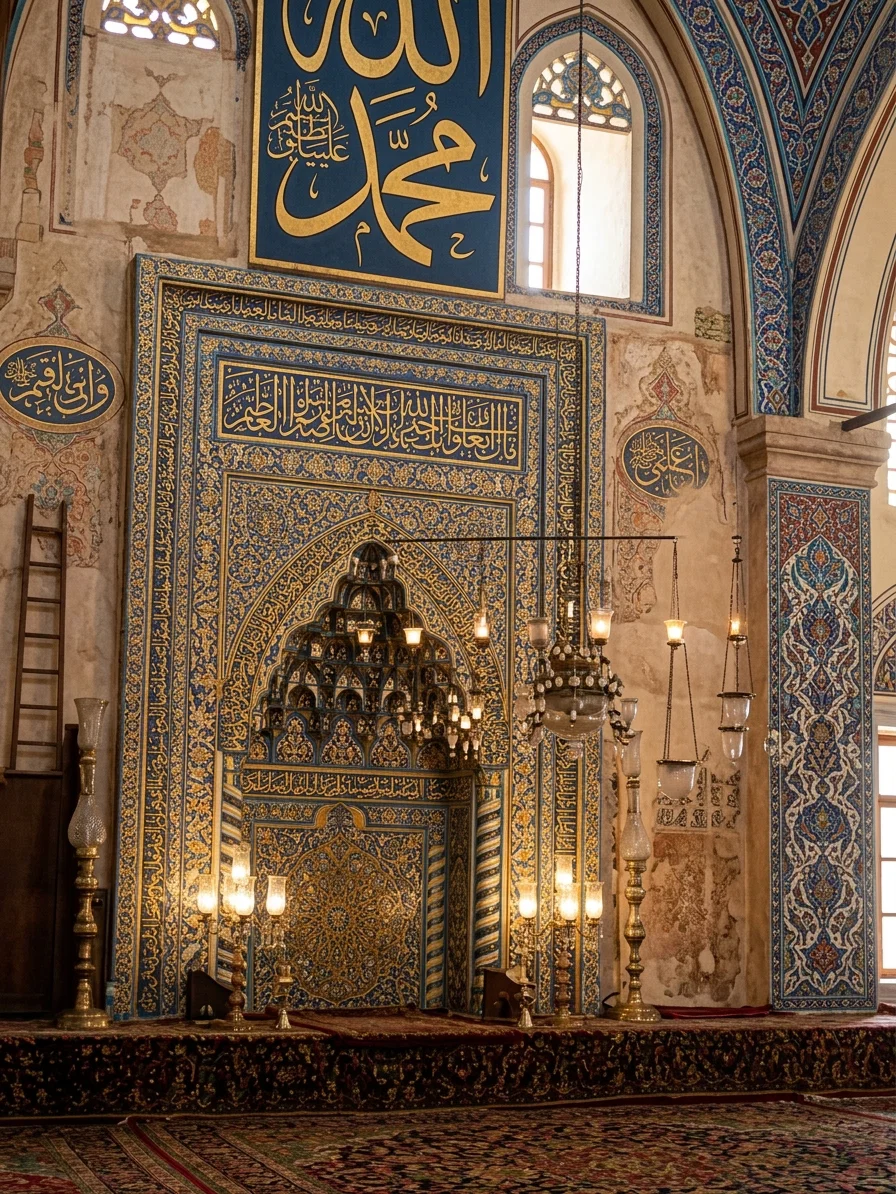
VIEW OF SANCTUARY IN ULU JAMI, MOSQUE OF BRUSA
BAGTCHEDJIK, APRIL 14.— I came down here from Constantinople eleven days ago, and will be going back to the city to-morrow. As I did not close and mail these notes while in Constantinople a few days ago, I desire to add something regarding Brusa.
The mosques and tombs of the kings in Brusa are among the most interesting features of the city to the visitor. Of the tombs, I visited several, but those of Osman I and Murad I are the most deserving of attention. To secure a photograph of the inside of these mausoleums a little strategy was necessary. Fortunately I secured some plates, which, though far from perfect, are very good considering the darkness inside a tomb, and the general conditions under which the photographing was done. Of course I prize them highly on this account.
The mausoleum of Murad I stands on a hill opposite the mosque bearing the same name. I also secured an inside view of this mosque. Besides the remains of Murad I, those of other members of the royal family are also seen inside the mausoleum. The central part, directly under the dome of the tomb, where are the remains of Murad himself, is most richly and artistically decorated, part of the railing enclosing it being overlaid with gold. There is also the Koran, used by the sultan, with the hand- written Arabic characters written to a nicety. The pedestal-like things before the tomb are for bearing the Koran. The mausoleum of Osman I, considered by the Turks to be their first sultan, is not so imposing as that of Murad. The most beautiful thing in this, and a thing that is really magnificent, is the great chandelier hanging immediately over the tomb.
In these tombs, as well as in others which I visited, breastplates and various pieces of armor worn by the early sultans are to be seen. But the thing of greatest interest to me was the horse-tail standards seen in several of these mausoleums. The horse-tail standard was an emblem of the power of the Ottoman rulers. How perfectly John the Revelator saw this in vision when he says, "And they had tails like unto scorpions," and "their power is in their mouth, and in their tails." It is impossible to express by pen one's feelings upon visiting these old monuments—tombs of the early sultans. Mighty conquerors were the successors of Muhammed once, but to-day he totters upon a weak throne.
The largest mosque in Brusa is Ulu Jami, and it is really grand. Three different sultans had a part in its construction: Murad I, Bayagid I, and Muhammed I. It was completed in the early part of the fifteenth century. Its massive roof is an arrangement of twenty small domes. In the center of the mosque is a magnificent fountain. The pulpit is a work of sculpture by an Egyptian artist. The sanctuary is all overlaid with gold. My photograph, though quite good in detail in showing the Arabic characters, can convey no idea of the wealth of gold in it. The two large Arabic words at the top of the picture, between the two windows, are Allah, and Muhammed, or "God," and "Mahomet." These two words are of course associated together on the walls and columns of every mosque. The chandelier seen before the sanctuary bears little cups of olive-oil.
One of the most beautiful mosques of Brusa is "Yeshil Jami." I took only an outside view of this, as at the time I visited it the inside was being repaired. It was built by Muhammed I in 1418, and is chiefly noted for its exquisite marble work on the inside. Its great gate is inscribed with the first chapter of the Koran, carved in marble. Opposite the mosque is the Green Tomb, containing the cenotaph of Muhammed I and others. It is faced inside with exquisite green and blue tiles. All the mausoleums are kept up and in good condition at an enormous expense. Each mausoleum has one or two keepers.
Though monuments of early monarchs stand for centuries, yet their marks of decay, with many entirely in ruins, show us the instability of earthly grandeur. We know that the "king of the North" shall soon come to his end, "and none shall help him." Now is the time to work with utmost vigilance that He who shall ride upon "the white horse" conquering, may come quickly to possess himself of his kingdom. His kingdom shall not be destroyed.
Constantinople.