THE evangelization of China has generally been regarded as a difficult work, owing to the serious task of learning the language and the variety of dialects to be met with; and it is true that Chinese is one of the most difficult languages to master, and equally true that there are about fifteen distinct dialects.15But when we come to consider the population included in each of these various dialects, and the number of people that can be reached through each, the incentive grows stronger for mastering this difficult language, and the possibilities of printing literature in each of these different dialects appeal to us more strongly.
Take a similar aggregate population in any other part of the world in adjoining territory, and see in how many dialects or different languages you would have to print literature, in order to reach all classes. Suppose you start with Asia. The different dialects of India, Burma, Siberia, etc., in fact, including all the rest of Asia, with the exception of Japan, in which the total population is not equal to China,—take all these fields, and consider that it will require three times the number of languages to reach their people as are required to reach the population of China. Again, these nationalities and languages differ far more widely than do the languages of China. Or let us take North and South America, with all their adjoining island groups; and here, with a population only one third that of China, we would have more languages than would be found here.
Perhaps for specific comparison we can better take Europe, which has double the number of languages, even if we should include all the distinct dialects found in the Chinese empire, including Manchuria, Tibet, and Mongolia. China has a written language which is equally intelligible to the educated classes of all the different dialects, except the Mongols and the Tibetans; but in order that the less educated classes might have the Bible in a more intelligible form, the Bible Societies have issued versions in the various dialects, in which the text conforms more nearly to the spoken language.
Standing first among these is the Mandarin, which is called the official language of China. Those who speak and can understand this language, number approximately three hundred seventy millions. It will be noticed, as we give approximate numbers of the various dialects below, that the aggregate is more than the population of China. This is due to the fact that Mandarin is understood by a large percentage of the people who are classed under the other dialects. For instance, it is estimated that twenty or thirty per cent of those who speak the Shanghai dialect can understand the Mandarin, and a much larger percentage of those who read the Shanghai can read the Mandarin also.
Think that there are more people who speak and understand one language in China than are found in all Europe, with its multitudes of different languages.
It is true that there are some variations in the Mandarin, so that it has been classed into Northern, Southern, and Western Mandarin; but these differences are not more noticeable than are the differences between literature printed in England and that in America. And the variations are those found in the spoken rather than in the written language.
The dialect varying most widely from the Mandarin is that of Amoy, which contains twice as many different syllables as the Mandarin. This dialect is spoken by over twelve millions, more than double the number that speak the Roumanian language in Europe. Then comes the Cantonese, with twenty million, which is more than the population of Spain. And we have the Shanghai-Soochow dialect, which is spoken by twenty million, and can be understood by forty-four million,—more people than are found in the British Isles.
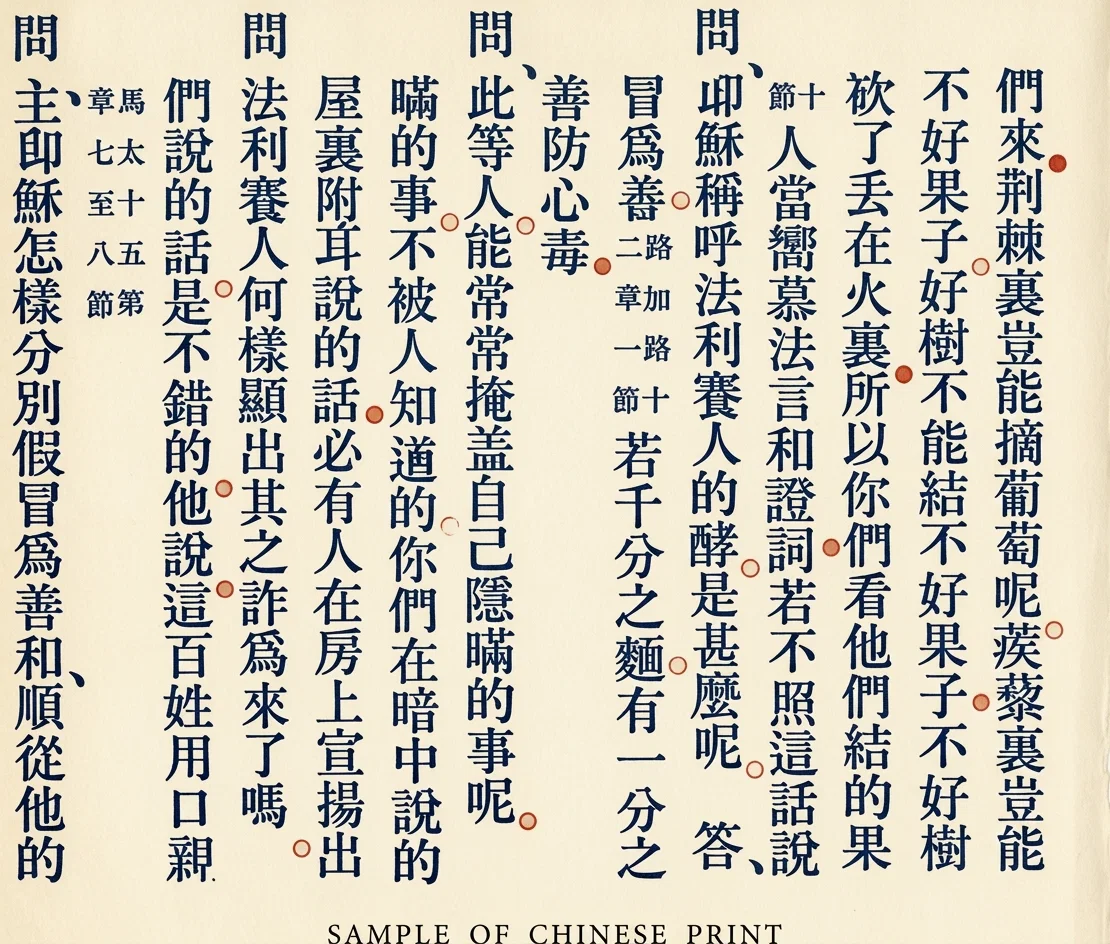
SAMPLE OF CHINESE PRINT
When once any one language or dialect of the Chinese is mastered, it requires only a few months to change to any of the other dialects, the exact time depending on the extent of similarity. Having just gone inland from Shanghai one hundred twenty-five miles, I found all this distance those who spoke and understood the Shanghai dialect. The Hakkas, in the province of Kuangtung, are estimated as numbering between eight and ten million, three times the number found in Bulgaria. Near to these people are those who speak the Swatow dialect, which is somewhat akin to Amoy. These number some five million, equaling the population of Sweden. The Mongols, with their five million, might be compared to the Netherlands. Those speaking the Hainanese number over three million, more than are found in the island of Sicily; and for the Ningpo the estimate would be five million, double the number in Denmark. Tibet, with from three to five million, contains a much larger population than Norway.
Thus we have covered the principal dialects of the Chinese empire. The Bible Societies have already published the Scriptures in a score of dialects, so that to-day all classes of China have the Scriptures in the language most intelligible to them. It will be seen that while we have covered, in comparison, nearly all the principal dialects of China, we have not enumerated half of the different languages of Europe, but we have selected the countries in Europe in which we are publishing literature.
A remarkable work has been done there in getting out the printed page in so many of the different languages. It is necessary to have compositors acquainted with each of the different languages to set up the literature in the same; and it was a very interesting sight to see, in the Hamburg Printing-office, men standing side by side who could not understand one another, setting up the pages of the gospel truth.
While there is a movement on foot in China to make the Mandarin language universal, so that the four hundred twenty millions can be reached with one language, it should not at all be thought impossible to print the third angel's message in all these different dialects of China, the same as the Bible Societies have printed the Bible. And it would not be nearly so perplexing as printing the message in a like number of European languages.
Although we can be said to be just starting our work in China, still we have to-day entered work on three of these dialects besides the Mandarin, and will, before the end of the year, be prepared to issue literature in all of these as well as in the literary language, which will reach the educated class all over the empire and in all the different dialects.
With this brief statement it is hoped our brethren in the home land will join with us in an earnest effort to get the printed page before the millions of China, since the possibility of doing so is assured. God has not given this people an insurmountable task of warning the world of his soon coming; but it will be accomplished, and the ways and means are with him and his people. Ought not what has been accomplished in Europe in reaching so many different nationalities be an assurance to us that the same work can be done in China?
That which encourages us most in getting out literature for this people is their respect for the printed page. Remarkable progress has been made in China during the last five years in the publishing work. Ten years ago there were not more than five or six native newspapers in all China, but to-day there are scores of these; and the newsboys are seen running the streets with the dailies the same as in the large cities of our home land. The press is, and will be, a powerful factor in carrying the message to this people. We believe that funds spent for the publication of the message in this field will mean many souls for God's kingdom. We ask the reader to pause for a short time, and consider the needs of a people that have been in heathen darkness for centuries, and are now with eager enthusiasm running to and fro for knowledge. Shall we not equip a publishing house equal to the task of giving them this message by means of the printed page?