Purpose and Prophecy

6%

Review and Herald Publishing Association · Takoma Park Station, Washington, D. C. · Sep 10, 1908

FromReview and Herald, Vol. 85, No. 37.

Read the full edition

Purpose and Prophecy

INSPIRATION has plainly designated a power which was to bear sway for a time over all the earth. That power the Revelator calls “the beast,” and concerning it he says: “And the whole earth wondered after the beast; and they worshiped the dragon, because he gave his authority unto the beast.” Rev. 13: 3, 4. That power is also represented as one which man is powerless to oppose. The question is asked, “Who is like unto the beast? and who is able to make war with him?” Above all human power, and unlike any other power, these are two of the chief characteristics of the organization referred to.
There can be no question as to the identity of that power; for its characteristics are too prominent to admit of uncertainty. It was to make war with the saints and prevail against them—a statement which could not be made truthfully as to paganism; for in spite of the persecutions under pagan emperors, Christianity continued to increase. Christians were sawn asunder, torn to pieces, thrown to the wild beasts of the arena to make a Roman holiday, burned alive as torches to light up the Roman theater, slain by the thousands by the soldiers of the realm; but paganism never prevailed over the Christians. In fact, Constantine, on coming to the throne, found them so numerous and so staunch that he thought it wiser to enlist their support than to continue the war against them. But following paganism there did come a power that made war against the Christians and prevailed. Paganism persecuted; the papacy fondled, flattered—and persecuted, and that till the objects of her wrath were either dead or hid away in the fastnesses of the mountains.
That power took every title of divinity and applied them to its chief official; set its head above the law of Jehovah; and even assaulted heaven itself in its blasphemous assumption of the right of opening and shutting heaven, forgiving sins, and releasing from punishment beyond the grave for a monetary consideration.
The time of the rule of that power is also prophetically foretold, and the prophecy already fulfilled—another incontrovertible means of identifying it.
The prophecy further declares that this power shall again bear sway as in days of old; but that consummation is brought about through the agency of another power, designated by the same prophetic writer as “another beast.” That other “beast” itself is not an image of the first mentioned power; but it says to “them that dwell on the earth, that they should make an image to the beast who hath the stroke of the sword and lived.” Rev. 13: 14. That other “beast,” however, has power to “give breath to it, even to the image of the beast.” The second power, the other “beast,” thus becomes the prime mover, the invigorator, the inspirer, of the image that is set up, which all men throughout the world are commanded to worship under pain of death.
What power is that other “beast,” or power, which the prophet brings to view? Is there any movement in any nation which bids fair to give strong assistance to the fulfilment of the purposes of the papal power? That power which fulfils the specifications of that other “beast” has been designated in these columns many times, and we shall not treat that phase of the question here specifically. The papacy is looking to the United States as her child of promise, from whom she expects much. What Constantine accomplished by flattery of the early church, Pius X is seeking to accomplish by flattery of America. American archbishops and bishops are always received at the Vatican “with marked distinction.” On August 3, while Archbishop Farley, of New York, was visiting the pope, the latter said to him: “It is marvelous what you Americans can do. You make miracles. Indeed, the centennial was a most remarkable religious event. That is the result of a church breathing free air and enjoying real liberty, and not being restricted within the bounds of certain concordats.” It will not be out of place to remark, in passing, that it is strange that the papacy clings so tenaciously to her concordats, when the church is so much freer and makes so much greater progress without them. But flattery has its purposes, and the papacy leaves no agency untried that will help it to achieve its ends. One of its principal objects just now is to bring America under its control—to use America in achieving its purposes. Its chief purpose is to bring the whole world under its domination. America is to be its tool to help to bring it about,—so reads the prophecy,—and so is shaping Rome’s purpose.
Has Rome hopes of bringing that about? Let us see. On August 8, “Father” A. P. Doyle, the rector of the Apostolic Mission House at the Catholic University in Washington, D. C., was graciously received by the pope. It isreported that the rector succeeded in stirring up the usually calm waters of the Vatican with his enthusiastic prophecies concerning the triumphs of the Catholic Church in America. Father Doyle has in charge that department of the Catholic work in America whose object is the winning of Protestants to Catholicism. That work is represented as having been wonderfully successful. The press report of the rector’s visit to the Vatican says:—
With the optimism of all prophets and proselytizers, he predicts that, through the work of the Mission House, in a few years the Roman Catholics in the United States will be four times as many as they are now, reaching the figures of sixty to seventy-five millions, so that America will be practically a Catholic country.
Father Doyle has submitted his plans of organization to the pope, Cardinal Merry del Val, and to other members of the sacred college, and has succeeded in impressing all with the enthusiasm he has for the success of the enterprise. According to his calculations, if he were to receive the support needed, in ten years from now two hundred million more English-speaking people will have joined the Roman Catholic Church.
Mgr. Merry del Val, in speaking of Father Doyle, said that he has followed with keenest interest the growth of the work since its beginning ten years ago, and that he seemed to have a comprehensive knowledge of the wonderful results secured by arousing among the priesthood an all-consuming zeal for convert-making by sending trained missionaries to address non-Catholics and by instituting centers of missionary energy.
The secretary of state thinks that the time is particularly ripe for an aggressive propaganda among the English-speaking peoples. The cardinal continued: “The way mission work has been carried on in the United States shows that it has been inspired with the ripest wisdom. There undoubtedly is on the part of non-Catholics a desire to know what the Catholic Church teaches. Non-Catholics are looking to the Catholic Church as one which speaks with authority.”
The same kind of work which Father Doyle is directing in America, and which has proved so successful and satisfactory here, is beginning to be organized in England along the same lines. It is not without significance that such a work as this should have been instituted in America. It seems not to have been a plan originated in Rome, but was initiated here by American Catholics, and later received the indorsement of the Vatican officials. The fact that English Catholics are to follow the lead of America is also significant; for was not that other “beast” to make “the earth and them that dwell therein to worship the first beast, whose death-stroke was healed”? Purpose and prophecy have met, and Rome’s purpose will fulfil the prophecy. She is not working for the special purpose of fulfilling that, or any, prophecy; but she can not accomplish her purpose without showing in her acts the complete fulfilment of those prophetic words.
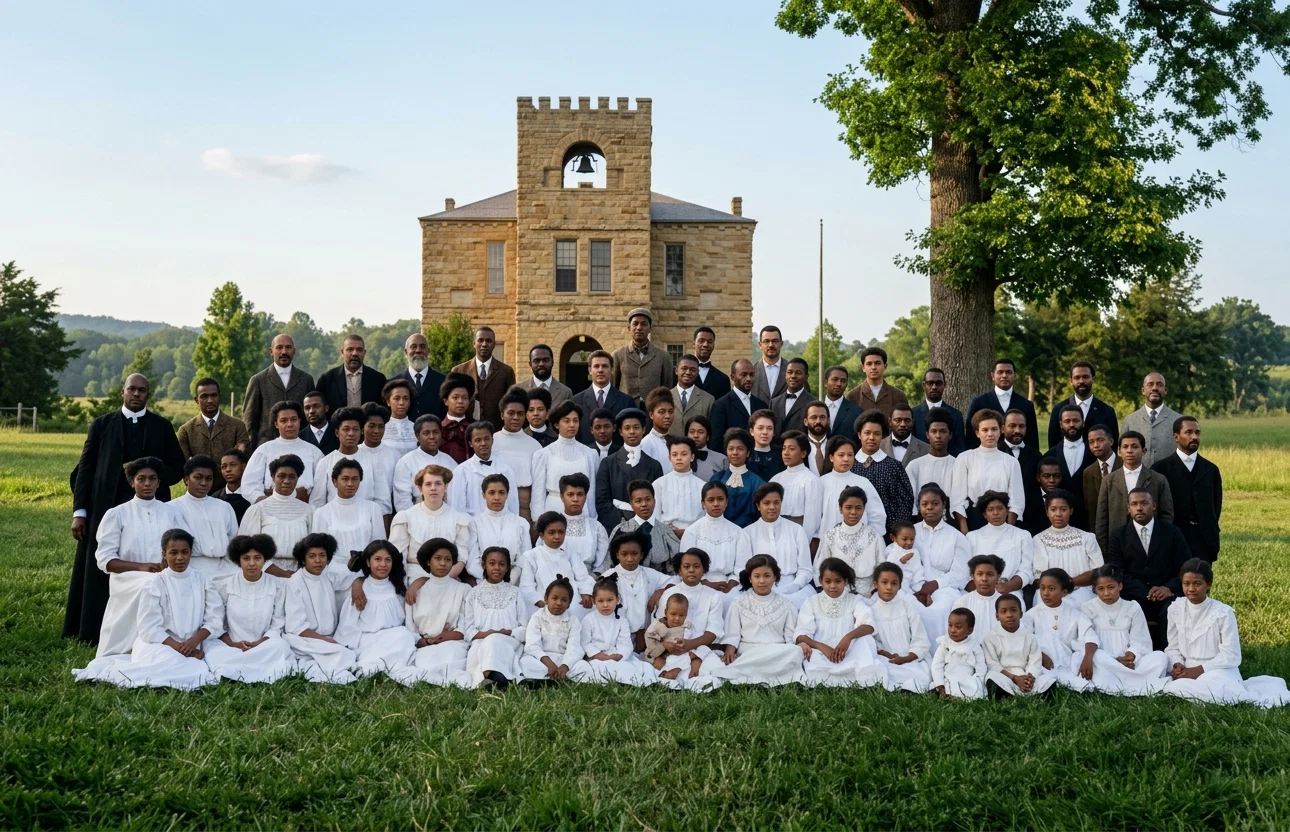
STUDENTS AND MISSION SCHOOL-TEACHERS AT THE OAKWOOD SCHOOL, HUNTSVILLE, ALA.
The purpose of the Apostolic Mission House is also the purpose of the American Federation of Catholic Societies. The one is to make America Catholic through individual accessions to the Roman Church, the other to make America Catholic through political influence. They are working along different lines but to the same purpose, and both by their success are securing the benedictions of the Vatican. At the same time American Protestants are being lulled to sleep by pastors who have forgotten for what Protestantism stands, and are extolling the wonderful progress of the Church of Rome. “Eternal vigilance is the price of liberty;” but America has ceased to be vigilant. “America all Catholic” is the purpose of Rome; and she will achieve her purpose for aught that the great religious bodies of America are doing to prevent it. America is destined to lead the world in a great procession to the feet of that so-called successor of St. Peter. America, through the wonderful influence which she wields, will give life to that “image of the beast” whose work fills up the cup of this world’s iniquity. The prophecy and the purpose are working out together.
C. M. S.