A New Epoch in the History of Turkey

9%

Review and Herald Publishing Association · Tacoma Park Station, Washington, D. C. · Sep 24, 1908

FromReview and Herald, Vol. 85, No. 39.

Read the full edition

A New Epoch in the History of Turkey

CLAUDE D. ACMOODY
(Concluded)
For several months Sir Edward Grey has been pushing a plan for the solution of the Macedonian question. The plan was to put Macedonia under a governorship. Of course this meant simply another Balkan state; for in order for the governorship to be efficacious in bringing about the desired reforms, it must, naturally, be dominated by some other authority than the authority of the sublime porte.
In June the king and the czar met at Reval. And the meeting proves to have been almost solely for the purpose of arriving at some conclusion regarding Macedonia. Sir Edward Grey's plan seems to have been practically decided upon. The following is quoted from W. T. Stead, in the Review of Reviews (London) of this month: “The only serious business of a diplomatic sort done at Reval was the discussion of the scheme for the pacification of Macedonia. This, it is reported, was advanced a step or two further, and the agreement of the two powers is said to be complete in principle. The only outstanding difference is due to the fact that Russia has a keener realization of the difficulty of securing Germany's assent to the project of reform, than that entertained by Sir Edward Grey.”
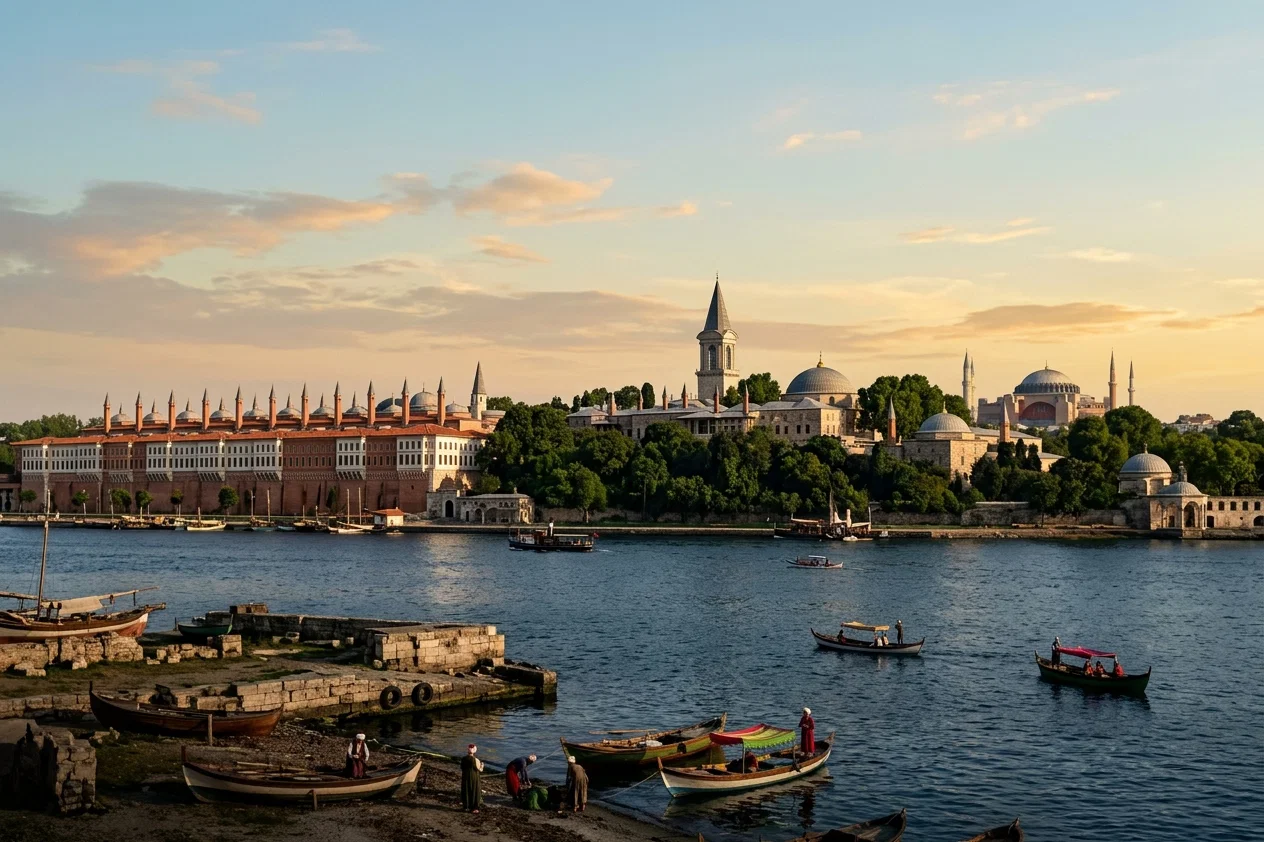
THE SERAGLIA, PART OF THE SULTAN’S PALACE
This concert of the powers, together with the Young Turk movement, has brought things to the climax, and the sultan faced these alternatives either to lose Macedonia or to grant the constitution and a parliament. Now it remains to be seen what the great powers will do since the sultan has given the constitution. France may be counted upon to stand with England and Russia; and though Italy is a member of the triple alliance, (Germany, Austria, and Italy), in this Macedonian question she is quite likely to stand with England and France; but viewed from the history of the past, one must indeed question the probability of England and Russia standing together for any length of time in the Macedonian field. As to Germany, she has so far stood for the integrity of Turkey. The kaiser and the sultan are on very cordial terms, and it was rumored extensively in the English press last month that if a European-Turkish war broke out, Germany would fight for Turkey. German capital controls a large per cent of all the railroads in Turkey. The trunk line running from Constantinople to Eregli, which is being projected to Bagdad, is a German road. Germany is resurrecting Asiatic Turkey. But this brings about another striking political situation. Through this railroad line, Germany becomes interested in the Lower Euphrates country, which brings her interests altogether too close to England and Russia in the near East. Austria, of course, is with Germany.
Such a transition from abject absolutism to the most open liberalism, as set forth in the constitution of last Friday, is not accomplished in one day. This is not the end. Why is it that the eastern question is always Macedonia and not Persia or some other section of the near East?—Russia's determination to control Constantinople is not abated. Russia is determined to find an entrance to the sea where she is not blockaded with ice nine months in the year. The Japanese conflict ended in shutting her from the Pacific. The Russian-English agreement of last September shuts her from the Persian Gulf. Now there must be another attempt through the Bosphorus and the Dardanelles. This week war with Bulgaria is rumored, and Bulgaria is only the paw of Russia. There is already talk of taking Armenians for soldiers, and preparations are being made for a struggle.
“He shall plant the tabernacles of his palace between the seas in the glorious holy mountain; yet he shall come to his end, and none shall help him.” “When they shall say, Peace and safety; then sudden destruction cometh upon them.” The Hague conference has cried, Peace, and now the sultan has cried, “Peace, justice, and rest.” What will be the sequence? Will this be a second 1877 experience? or will it be that “none shall help him?”
We are praying that this liberty may last long enough to give us an opportunity to carry the third angel's message to the Turkish empire. One week ago today such an article as this, if seen by postal authorities, would have been confiscated; and if seen in the hands of a native Armenian or Greek, would have been sufficient ground for years of imprisonment. To-day this can be carried before the doors of the palace by the humblest of the sultan's subjects! It can be read upon the streets. Turkey is now open for the gospel. Two years ago Russia's doors were thrown open to us. To-day, Turkey's doors are open. What shall we do to enter? We must move now? May God help us to give the message of the closing verses of Daniel the eleventh chapter to this nation immediately. Words are not strong enough to express the necessity of immediate action. We need money now for creating an Adventist literature for this empire. We need more young people preparing for work in this country. May the Lord seal home to the hearts of each one of his children the significance of the present political situation, and sanctify us to renewed service just now. “The way of the kings of the east” is being prepared.
Bagtchedjik, Asia Minor.