Santo Domingo

8%

Review and Herald Publishing Association · Takoma Park Station, Washington, D. C. · Oct 1, 1908

FromReview and Herald, Vol. 85, No. 40.

Read the full edition

Santo Domingo

B. E. CONNERLY
I SUPPOSE that this is the first report from Santo Domingo that the readers of the REVIEW have ever read; and for this reason it may be well first to say a few words about the republic and conditions there, for there may be those who are not familiar with its history. Santo Domingo has an area of eighteen thousand square miles, five times that of Porto Rico, but the population numbers only six hundred thousand, thus making it, in point of numbers, one of the smallest republics in the world. The island was discovered by Columbus on his first voyage, and was made a Spanish possession. Later the great navigator made this island his home. The early Spanish colonists did no permanent good, spending their time in filibustering, warfare, and gold hunting.
In 1785 France took possession of the island, and it remained under French control until 1809, when it was again returned to Spain for a short period, becoming later a part of the republic of Colombia, organized by Simon Bolivar. In 1821 the Haytians took possessionof the country, and retained it until the rebellion of 1844, when the patriots were successful, and established the Dominican republic, which they retained until 1861. Then Spain again got a foothold, but succeeded in holding it only four years. The Dominicans again triumphed, and it has remained a republic up to the present time.
Because of incessant revolutions and political strife, there has been but little progress. One of the first maxims of the country is, “Men for war, donkeys for work,” and thus agricultural development has been neglected, education has received little attention, and foreign capital and settlers have been kept out.
Three years ago the American government came to the aid of the Dominicans by guaranteeing the payment of seventeen million dollars of debts to different European powers; and to secure themselves, they have taken possession of the customs of the republic, thus securing peace for at least ten or fifteen years. Already there can be seen multiplied evidences of prosperity. The foreign trade last year was more than twelve million five hundred thousand dollars, the exports $7,628,356, and the imports $4,948,961. Railroads and public roads are being constructed, and streets and sidewalks are being improved in the cities. Schools are being built, and the last legislature voted to make large inducements to foreigners to settle in the country and improve the vast tracts of virgin soil. We wish some of our Adventist brethren would take advantage of these inducements.
The country last year exported 108,210,326 pounds of sugar, 3,376,970 pounds of coffee, 22,384,082 pounds of cocoa, and 21,802,982 pounds of tobacco.
The Roman Catholic religion is, of course, the religion of the country, having been established there since the beginning. The people seem to be satisfied with that form of worship; for I failed to find here the general discontent with priestcraft which is found in many Catholic countries. However, the government tolerates, or rather ignores other religions. Protestantism was introduced into the republic in 1822, when three companies of colored people from Maryland and Virginia settled there; it can not be said, however, that they did much toward propagating their religion, but it was at least known that they were Protestants. Of late years the Methodists, Moravians, and two or three independent workers have been laboring among the English-speaking colored people, but practically nothing is being done for the Dominicans.
Brother C. N. Moulton and family went over there from Porto Rico last December to begin the distribution of our literature; we have also a faithful sister in Monte Cristi, another in Samana, and two brethren in San Pedro de Macoris. In the latter place as a result of seed sowing with the literature, I was permitted to baptize eight persons. This will give a good impetus to the work there. These seem imbued with the spirit of service for others of their countrymen. The Sabbath-school here numbers twenty-five. We now have two Sabbath-schools in the republic.
We began the circulation of El Centinela there last year, and had splendid success. This greatly stirred up the Catholics, and they have made a hard fight against us this year, but Brother Moulton is nevertheless prospering in his work, and selling a good many Bibles and a number of our subscription books. His address is La Cruz de Mendoza, Santo Domingo, R. D.
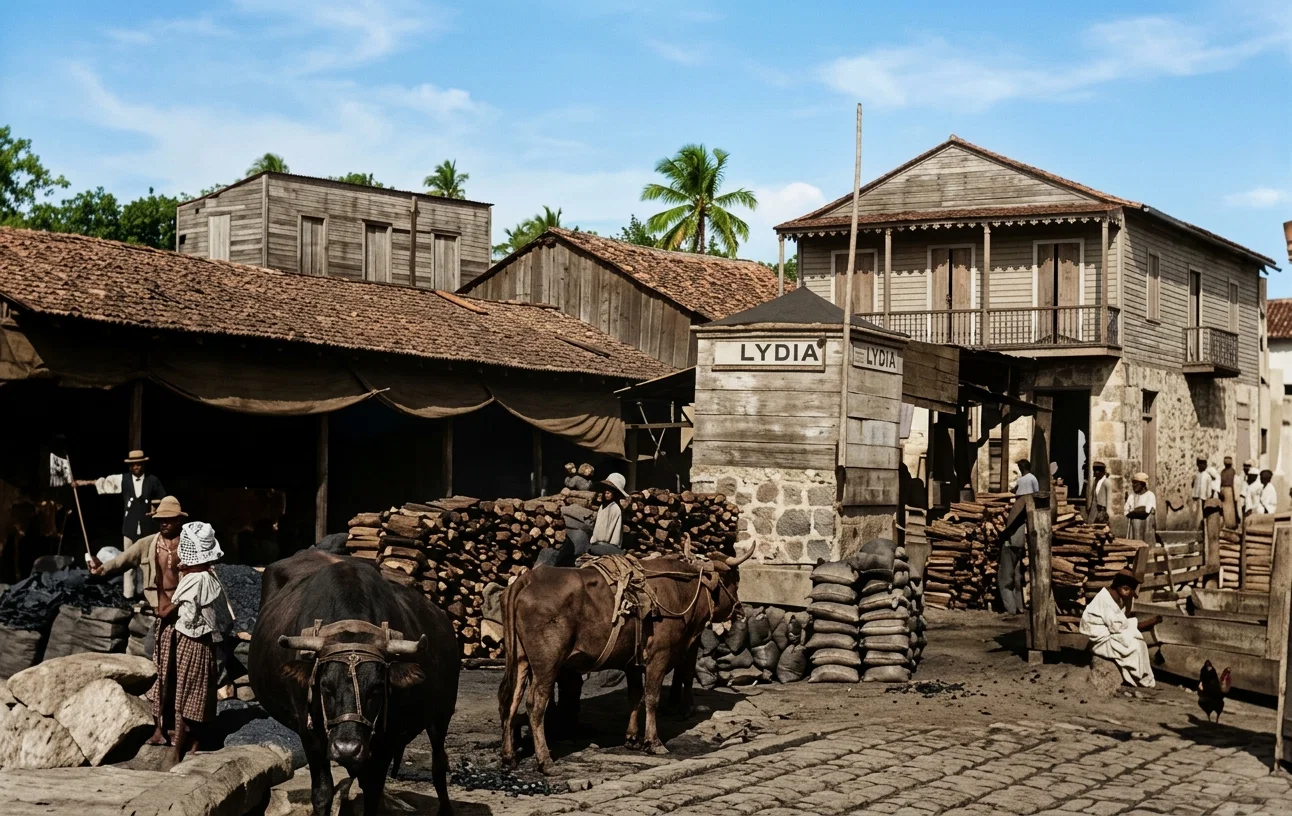
A CHARCOAL MARKET IN SANTO DOMINGO
We feel of good courage concerning the work in Santo Domingo, and earnestly desire that this neglected field may have an interest in the prayers of those who are aiding our work, and remembering us at the throne of grace.
Mayaguez, Porto Rico.