The European Tangle

25%

Review and Herald Publishing Association · Takoma Park Station, Washington, D. C. · Oct 29, 1908

FromReview and Herald, Vol. 85, No. 44.

Read the full edition

The European Tangle

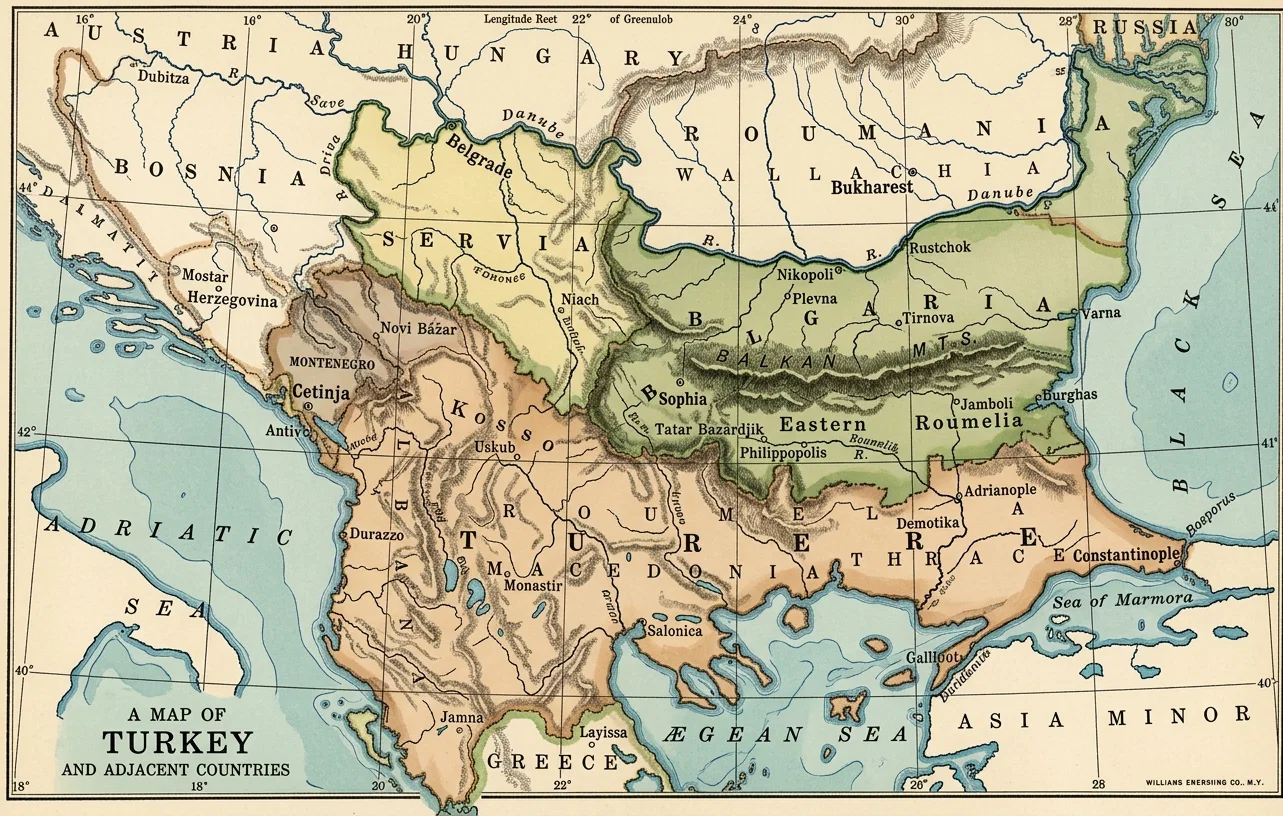
A MAP OF TURKEY AND ADJACENT COUNTRIES
A study of this map shows that Turkey has already lost more than half of her original European territory
A MAP OF TURKEY AND ADJACENT COUNTRIES A study of this map shows that Turkey has already lost more than half of her original European territory
THE accompanying map shows the larger portion of the territory immediately involved in the present unpleasantness in southern Europe. When the majority of the European powers united to compel Russia to permit a revision of the treaty of San Stefano, those powers declared by that act that any question involving Turkey must be settled by the powers rather than by any one of them. The revised treaty of San Stefano became the treaty of Berlin. Under that treaty Rumania, Servia, and Montenegro were made independent principalities. Bulgaria and Eastern Rumelia were taken from Turkey, the former being granted autonomy, and being given a guaranty against Turkish oppression; and the latter, while remaining nominally a Turkish province, was to have a Christian governor. Eastern Rumelia refused to accept this arrangement, and united itself with Bulgaria. Bosnia and Herzegovina, while remaining under the overlordship of Turkey, were to be under the administration of Austria-Hungary. The two latter provinces, as well as Montenegro, are peopled largely by Serbs (Servians), and it has been the ambition of Servia to unite Servia, Bosnia, and Herzegovina into one kingdom. It is the blocking of her cherished plans by Austria’s annexation of Bosnia and Herzegovina that has so angered Servia; and it is because of the strong ties of race that Montenegro has been so willing to join Servia against Austria. There is no doubt that both Bulgaria and Austria, fearing that Turkey, rejuvenated by the Young Turks and the new constitution, would seek to regain control of Turkey’s vanished possessions, decided to accomplish their purposes while Turkey was least prepared to resist. This seemed to Crete also an auspicious moment for throwing off the Turkish yoke. Bulgaria, in declaring her independence, and Austria, in annexing Bosnia and Herzegovina, have both violated the provisions of the Berlin treaty. England and France are not willing to see the treaty violated; Russia is not willing to see it violated unless she gains valuable compensation therefrom; Germany displays an inclination to permit Austria to have her way; and Italy, though one of the signatories of the Berlin treaty, has given no decided expression of purpose. Out of this tangle of conflicting purposes it will be a difficult task for even the wisest statesmen to bring peace. England’s notification to Crete that her annexation to Greece would not be permitted at the present time, and Russia’s threat to invade Bulgaria if the latter continued military preparations, have served to quiet the situation to some extent. Austria, because of the moral pressure of England, France, and Russia, has consented to discuss the annexation of the two provinces direct with Turkey. Russia’s demand that Bulgaria modify her attitude toward Turkey at once, has induced the latter country to express to Turkey her desire for peace, and her willingness to negotiate conciliatingly the railroad question and other matters. The great powers’ jealousy of one another is the only thing, humanly speaking, that guarantees to the sultan any portion of his European estate; and were it not for God’s special agents, commissioned to hold the winds of strife till his work is done, the European powers would have leaped upon one another long ago to determine the destiny of European Turkey.
C. M. S.