ED. F. FORGA

8%

Review and Herald Publishing Association · Takoma Park Station, Washington, D. C. · Nov 12, 1908

FromReview and Herald, Vol. 85, No. 46.

Read the full edition

ED. F. FORGA

A Plea for the Inca Indians of Peru—No. 3

ED. F. FORGA
I WILL now present to our readers a single document from among many similar ones which in different epochs have been handed to the authorities of Peru. This was presented five years ago (Oct. 12, 1903) to the president of Peru by Moriano Charaja, an Indian of the community of Llacutura, a district of Acora, in the province of Puno:—
“EXCELLENT SIR: I present myself before you to explain that I am one of the aged Indians who have always advised the young people of my race to be prudent and patient in regard to the constant injustice of the local authorities. Our sad experience has been, however, that this has proved futile in our effort to get justice done to us. For the first time, now in my advanced age, I have been obliged to come to Lima, the victim of the most violent exploitation and injustice that I have ever suffered. If it is true that I have always willingly suffered in the past unjust fines, forced labor, taxation, etc., it has been because, notwithstanding the great injustice, I have never been deprived of all I had; a little of something has been left in my hand. Never has the unjust exploitation been so extreme in the past as completely to deprive me of all my little capital and lands, leaving me without subsistence for my family.
“Excellent sir, the crime that I have committed is that of having received from my forefathers the lands of Ccanahua, which are bounded on one side by the farm of ‘Caruma,’ which belonged to the richest man in Acora, with whom I established a modus vivendi, which existed between us as long as he lived. A short time ago the owner of Caruma died, which entirely changed matters; for his son, who inherited the hacienda, has displayed a systematic hostility toward me, and has tried to bring about my ruin. I have always defended myself and my liberty, not allowing him to change the state of things previously existing. He, however, planned a fierce attack against me to rob me of what I possessed, and this actually took place on Monday, the third of August, 1903.
“On the evening of that day, the time when we gather our flocks and go to our rest, the overseer of Caruma put Cirilo Pedraza and others at the head of fifteen men armed with clubs and long leather thongs, some on foot and others on horseback, and all yelling ferociously. These destroyed the walls which divided our property, scattering what I possessed, clubbing us, and using their thongs, and threatening my wife and me with death. They stole my flocks, consisting of llamas and other animals, numbering about two hundred head, which they drove onto their own property, and my wife and myself were obliged to escape to the mountains.
“Now what has been the pretext for committing such violence against property, against the law which considers such crimes as highway robbery, distortion by cruel force, the violation of guaranty of personal security as punishable by imprisonment?—It is simply this: The owner of the hacienda, Meliton Aroyo, putting aside the modus vivendi which had been established between his father and myself, made me a debtor for things which I never received; arbitrarily sought to settle our imaginary accounts, constituting himself judge in his own case; and ordered me to pay him three hundred soles [one hundred fifty dollars].
“I told him that this demand was unjust, because, since I had served his father as a shepherd over three hundred head of cattle, llamas, and alpacas for thirteen years, it was just that my work should be put against his supposed debt. If I earned only the insignificant sum of twenty cents a day, it would amount to over nine hundred soles [four hundred fifty dollars]. Then his flocks were pastured on my lands, and if he paid me at the rate of fifty cents a head annually, he would owe me nearly two thousand soles [one thousand dollars] more, making a sum total of about three thousand soles [fifteen hundred dollars]. When I told him that any man of common sense would easily see that justice was on my side, he became indignant, and sentenced me to the unjust punishment indicated.
“After that sad night of the third of August, I and my family were left in absolute misery, going from place to place over the deserts of Titicaca, without the means of life and without our animals—the most loyal and humanitarian companions upon which we can count in our sad and desolate life.
“To whom could I appeal, most excellent sir, to secure justice and better my position? It was impossible for me to present myself in Caruma to reclaim my animals, for that would be equal to delivering myself up to my enemies, from whom I was providentially saved. Besides, I could not but recall the terrible crime committed on the eleventh of October last in the same hacienda, where the unfortunate Miguel Aro presented himself with the object of reclaiming, as I wished to do, three hundred llamas and alpacas that had been sequestered as a punishment, it is said, for pushing the curé of Acora off his horse on the road that passes through Scopapujio and through the lands belonging to the said Miguel Aro. On the twelfth of October, the body of Aro (the Indian) was found hanging on one of the trees near by. If I had presented myself to the local authorities, it would have been equal to giving myself up to the proprietor of the hacienda already mentioned.
“Under these circumstances, my wife, Patrona Huaraya, without any other companion than her little daughter, and without any other defense than her weakness, and without any other arms than her tears, tried to escape in order to save herself from hunger and misery; but her attempt was futile. She received cruel treatment and humiliation at the hands of the enemy, besides which, by their invectives and threats, they finally obliged her to promise to discover my hiding-place, and present me to the authorities of Caruma, saying that until she did so, the animals would not be returned. But I had escaped, and in the desert I met Mariano Istana, who, as a messenger representing thirty-three lots of land, was on his way to the city, escapingfrom persecution, like myself. He was able to give me some hope of salvation from my sad condition. He finally brought me to Lima, the capital of the republic, where I have just arrived after a tedious and hard journey, and where I am now, with many other Indians, trying to secure justice from the authorities. “Lima, 12th October, 1903.”
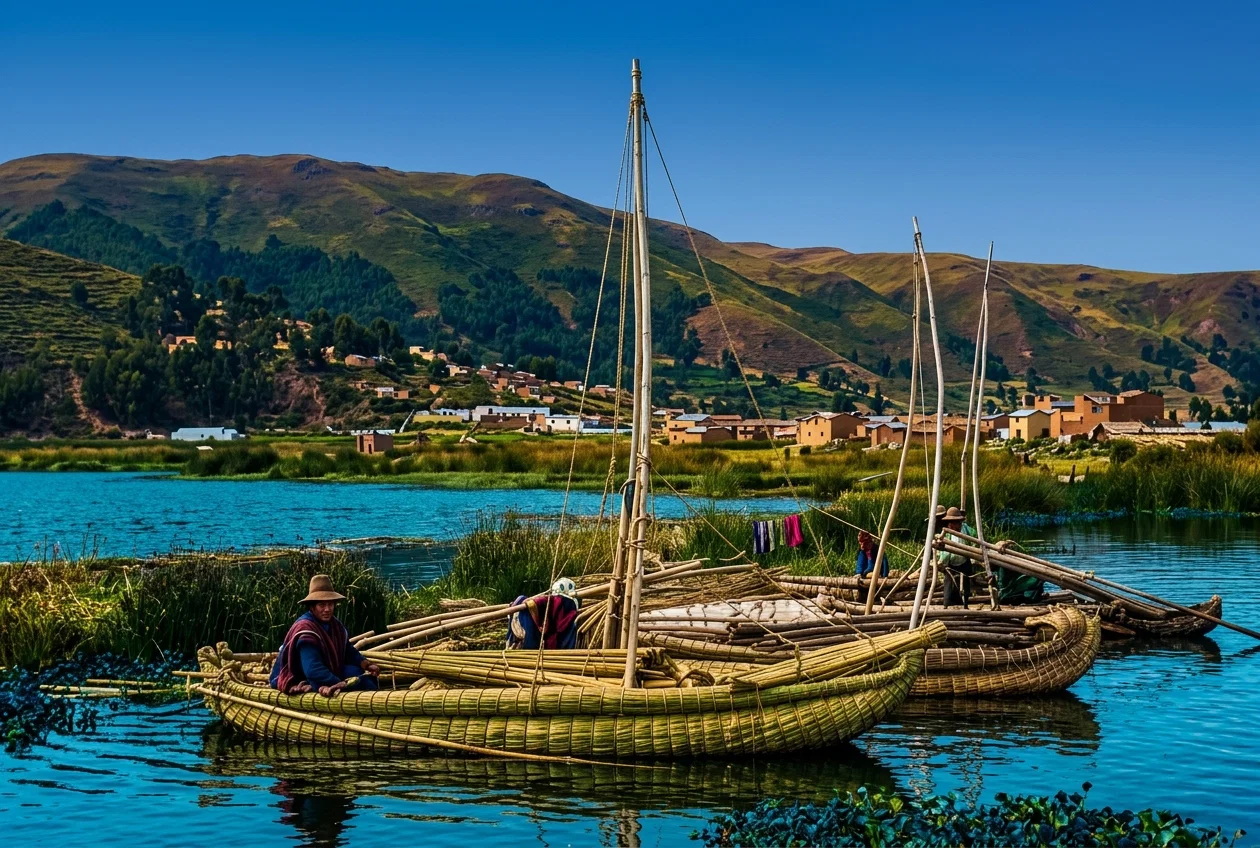
LAKE TITICACA, IN PERU, 12,000 FEET ABOVE SEA-LEVEL