Turkey Under the New Regime

4%

Review and Herald Publishing Association · Takoma Park Station, Washington, D. C. · Dec 3, 1908

FromReview and Herald, Vol. 85, No. 49.

Read the full edition

Turkey Under the New Regime

I doubt if the world understands at all adequately what a change has taken place in Turkey. Within the course of a few weeks it has passed from being the most absolute despotism to being one of the freest countries in the world, and the people have given themselves up to enjoying their newly acquired liberty to the utmost.
Newspapers have been greatly multiplied. It is stated that over two hundred newspapers have appeared here. I have no means of verifying the statement, but I seldom go to town without seeing a new paper. And the people on the steamers often have each three or four newspapers and magazines, which they read with great interest. Among these are several papers which abound in cartoons, and they show a keen sense of humor and great skill in hitting off the political situation. . . .

Some Innovations

Another activity of the public mind finds expression in a series of public gatherings in which music, theatricals, gymnastic exercises, and the like are followed by addresses on political subjects. Sebaheddin, the son of the late brother-in-law of the sultan, has been addressing a series of such meetings, and expounding his political views.
Another new thing is the appearance of the members of the royal family in public. The sultan himself has not yet ventured outside of the palace grounds, but his sons have appeared at the Moda Regatta and other public gatherings, and the heir to the throne, Prince Rechad, has shown himself in public repeatedly.
Incoming travelers are no longer vexed with useless restrictions. A Young Turk entering the country was reproved by the custom-house officials for offering to open his trunk for inspection, and the censorship of the custom-house has been abolished.
In the interior the tribal chiefs who have for many years levied their taxes upon villages, taken toll from caravans, and terrorized the people, have been subdued, for the most part. One of them is now being pursued by the troops. There is disorder in the government of the provinces, but there is a manifest determination on the part of the government to have order and good government. It shows an energy which promises well.

Policy of the Young Turks

One of the most striking features of this movement to those who have lived long in the country is the moderation shown by the Young Turks. The régime which has been overthrown was oppressive in the extreme, and all the people have suffered terribly from it. The Turks have often said, “We suffer more than the Christians.” Many have predicted a day of terrible retribution, when the old régime should fall into the hands of its victims. But there have been no reprisals. Officers of the army were killed in order to gain control of the army, a few spies fell into the hands of the people and were killed, the notorious Fehim Pasha was torn to pieces by the mob at Broussa; but most of the rascals have been held for regular trial, and the leaders of the new movement have firmly insisted that it is no time for vengeance or for the gratification of personal animosities; only one consideration can be admitted, and that is the good of the country. Their eyes are upon the future, not upon the past. This is wonderful. If one could have expected a reign of terror anywhere, here was the place to expect it, but it has not come.
The Young Turks have shown a practical wisdom in dealing with the various parties and in solving the questions which have arisen, which commands the admiration of all. A friend who is very well acquainted with the leaders in this movement said, the other day, “The most wonderful thing of all is the committees.” Properly speaking, there are no committees and no tangible organization. There are men who stand behind the present government, and practically guide and control it, but they are content to be unknown and to work in silence. They say, “It is the work of God;” “Do not congratulate us: thank God.”

Difficulties to Be Met

The difficulties which these men have to face are enormous. There is the difficulty of financing the government, which is aggravated by the fact that some of the provinces have understood liberty as meaning freedom from taxes. Then there is the difficulty of forming a program for the new régime. There have been two parties among the Young Turks: the Committee of Union and Progress, and the Party of Decentralization headed by Sebaheddin. As I said above, Sebaheddin has been explaining his program to popular audiences. His plan is to have local assemblies in the provinces, to which shall be relegatedmany of the functions which have been centralized in Constantinople under the old régime. There is nothing new in this proposition. Such assemblies now exist, although they have been robbed of their power. But Sebaheddin has been understood by Christians to favor such a method of representation as will make these assemblies wholly Christian in districts where the Christians are in the majority. Many Christians have hailed his proposals as a step leading toward autonomy for certain regions. Of late, however, Sebaheddin has announced that the two parties have united, and the Young Turks are agreed upon the plan to be followed. It is essentially this: that representation in the provincial assemblies shall be according to the numerical proportions of the different races in these provinces. This means that in Macedonia the Turks will be in the minority, in Asia Minor the Christians will be in the minority, in the provincial assemblies.

The Educational Problem

Another difficulty is the educational question. Strange as it may seem, one of the first questions to push its way to the front was that of the education of women. Women have taken a large part in the work of the Young Turks, by which they prepared the people and the army for this revolution, and they have kept the secret well. Now the women are demanding their share in the progress which all the people expect. They say that their husbands have hitherto denied them the right to education and to labor. They claim for themselves all that they see of good in the homes of European peoples. They ask to be educated so that they can train their children aright, and make the homes of their husbands well ordered and happy, and they demand admission into useful employments for women, as in other lands. Naturally, these claims throw consternation into the ranks of the old-time Turks, and they have produced reaction in some places, notably in Smyrna. Sebaheddin told the Mohammedan women who were present at one of his public conferences that their claims were right and just, and not contrary to the spirit and teachings of Islam; but he exhorted them to be quiet and patient—they would obtain satisfaction in time.
Another educational question is that of language. The Turks would make Turkish the language of instruction, at least in the higher schools, as it is the language of the land and of the government. The Christian communities, however, are very tenacious of their mother tongues. Probably the Turks will allow all these languages to be taught, but they will require such a knowledge of Turkish for holding office as will put a premium upon the schools where Turkish is best taught.
The Young Turks will undoubtedly put forth every effort to establish schools of their own, which shall be the equal of any schools in the land, and it has already become apparent that there are more well-educated men in the country prepared to teach such schools than was supposed. Under the old régime, knowledge was dangerous, and men hid it. Now it is coming to light. Some of the Young Turks advocate the sending of such men abroad to study the educational systems of other countries. A high official said the other day that they should look to America for help in organizing their educational system, and he especially praised the American schools of agriculture, which he said “would be very useful to us.”
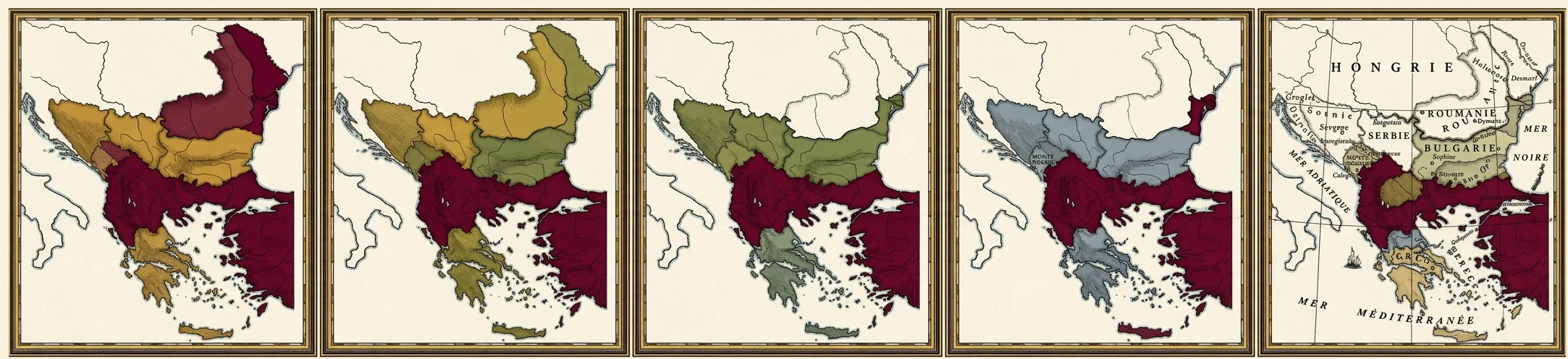
Turkey before 1812 1812 1878 (Treaty of San Stefano) 1878 (Treaty of Berlin) 1908

The Two Governments

There is another difficulty which the Young Turks have themselves created. There is now an abnormal state of things. Behind the government is another government, invisible but powerful. This invisible government hinders the actual government in the exercise of its functions. Sometimes it does this by direct interference, sometimes it is only the fear that the committee may interfere, which hinders the officials in charge; but official work is impeded; business also has suffered. Yesterday a man said, “We cry liberty, but we feel poverty. Liberty and poverty!” The Committee of Union and Progress are aware of this difficulty, and they are urging the officials to go ahead and discharge their functions without any fear of interference, and they are striving to do everything through the actual government as far as possible. But there will be a state of tension until the National Assembly has met, and put things in their normal course.
There are many problems connected with the election of this assembly, but they can not be treated in this article. We shall watch the acts of this assembly with intense interest.
Enough has been said to show that the situation in Turkey is a very difficult one, and I hope that I have also made it apparent that there are men here working with great wisdom and splendid self-abnegation for the best interests of their own land. It is a spectacle which ought to shame self-seeking and partizan politics out of sight. Unfortunately, these, too, are in evidence, and the Christian communities afford striking examples.

Questions to Be Settled

There is a different question brought to the front by these changes, and that is the question whether Islam can accord the rights demanded without being unfaithful to its own religious constitution. Can Islam, for example, satisfy the claims of its own women, in accordance with the teachings of the Koran? It is a question often debated whether women have souls. Much evidence can be found from Mohammedan writers to show that they understood the prophet to teach that women do not have souls.
Can Islam accord equality of privilege to Giaours [non-Mohammedans]? Historically, it is quite evident that it has not done so. Now the question has arisen, Is it right for her to do so, according to her own religious laws? I do not intend to express any opinion upon either of these points; but I wish to point out that the claims which have been made already by various writers that the constitution of Islam is even more liberal than the Young Turk party, afforded a strong evidence that Modernism has found its way into Islam as well as into the papacy. These claims are rather an evidence that the spirit of the times has influenced the thinking of modern Mohammedans than that Mohammed taught these principles. Liberty, justice, equality, fraternity, are splendid words; but it is open to doubt whether the Koran inculcates these great principles in the treatment of women or of subject races of Christians. It is a question of interpretation, and we ought to apply scientific principles in interpreting the Koran. Whatever answer Mohammedan scholars may finally give to this question, I do not believe that there will be any arrest of the march of the great ideas just named. It must be clearly evident to all that men are moving toward the light of truth in all lands; and when we look toward the sun, we forget the night.—C. Frank Gates, President of Robert College, Constantinople, in The Outlook.