The Federal Council of Churches

3%

Review and Herald Publishing Association · Takoma Park Station, Washington, D. C. · Dec 17, 1908

FromReview and Herald, Vol. 85, No. 51.

Read the full edition

The Federal Council of Churches

A BRIEF report was made last week of the opening of the first meeting of the Federal Council of the Churches of Christ in America, held in Philadelphia, December 2-8. In order to give a clear idea of the nature of this organization, a statement concerning its origin is necessary.
In November, 1905, there was held in New York City an inter-church conference on federation, at which general plans were discussed looking toward a union of such of the Protestant churches of America as were agreed upon fundamental doctrines. In that meeting, the following action was taken:—
In case the plan of federation is approved by two thirds of the proposed constituent bodies, the executive committee of the National Federation of Churches and Christian Workers, which has called this federation, is requested to call the federal council to meet at a fitting place in December, 1908.
The plan of federation became operative when approved by two thirds of the constituent churches; and as the approval of the required number was secured early in the present year, the federal council really came into existence then, and the meeting at Philadelphia was its first meeting.
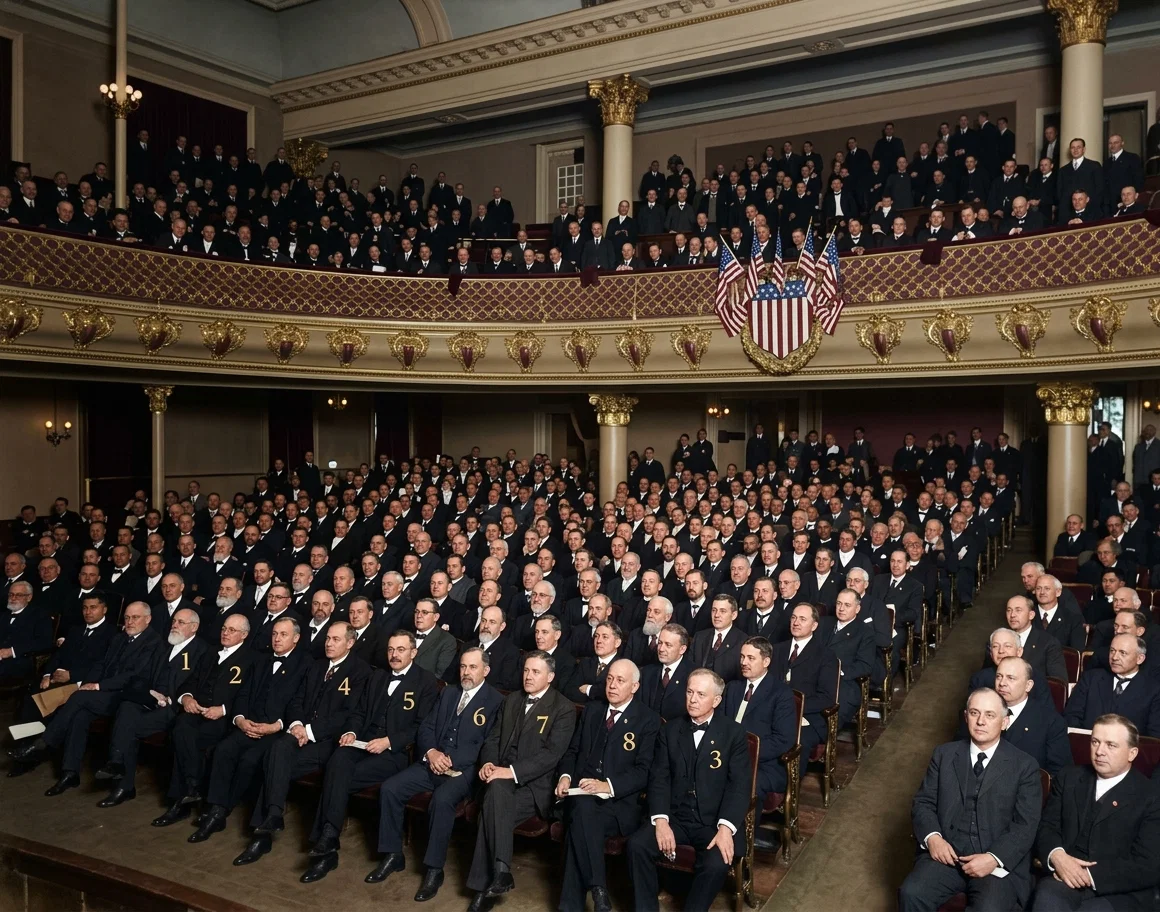
The council consisted of about four hundred fifty delegates, officially representing the following denominations:—
The Baptist Churches of the United States. The Free Baptist General Conference. The Christians (The Christian Connection). The Congregational Churches. The Disciples of Christ. The Evangelical Association. The Evangelical Synod of North America. The Friends. The Evangelical Lutheran Church, General Synod. The Methodist Episcopal Church. The Methodist Episcopal Church, South. The Primitive Methodist Church. The Colored Methodist Episcopal Church in America. The Methodist Protestant Church. The African Methodist Episcopal Church. The African Methodist Episcopal Zion Church. The General Conference of the Mennonite Church of North America. The Moravian Church. The Presbyterian Church in the United States of America. The Cumberland Presbyterian Church. The Welsh Calvinistic Methodist or Presbyterian Church. The Reformed Presbyterian Church. The United Presbyterian Church. The Protestant Episcopal Church. The Reformed Church in America. The Reformed Church of the United States of America. The Reformed Episcopal Church. The Seventh-day Baptist Churches. The United Brethren in Christ. The United Evangelical Church.
At the opening session of the council, the retiring president, Dr. William H. Roberts, made an address in which the general status of the organization was defined, and its aims and purposes were set forth. From this address we quote:—
It [the federal council] is not a body whose members are self-chosen, but one composed of delegates duly appointed by competent authority, and possessed of a representative character. This council stands officially for thirty denominations, eighteen millions of communicants, and a world-wide Christian work.
The church of Christ and the nation are vitally related each to the other, and the welfare of the nation depends upon the fidelity of the church to its trust. The question of questions for a nation is its religion, and that question this council will make effort to answer in a Christian manner.
We believe that the great Christian bodies in our country should stand together, lead in the discussion of, and give an impulse to, all great movements that make for righteousness. We believe that questions like those of marriageand divorce, Sabbath desecration, foreign immigration, modern industry, the moral and religious training of the young, indeed, all great questions in which the voice of the churches should be heard, demand their united and concerted action if the church of Christ is to lead effectively in the thorough Christianization of our country.
Another supremely important matter is the relation of the American churches and the American nation to the world for which Christ died, and which he lives to save, bless, and make perfect in holiness. It is a subject of felicitation that the attitude of our nation is largely a Christian one toward other peoples.
THE DELEGATES TO THE FEDERAL COUNCIL OF CHURCHES
Our world policies of the last few years, with their center at Washington, have been prevailingly Christian in their spirit. American diplomacy has won of late victories impossible to battle-ships. The essential spirit of our nation is that of Jesus Christ, and it is the duty of the American churches to make that spirit more Christian, to awaken yet greater national interest in the welfare of all earth's peoples, to provide men and means in increasing ratios for the work of spiritual salvation, and to hasten the coming of the day when the true King of men shall everywhere be crowned as Lord of all. And this council stands for the hope of organized work for speedy Christian advance toward world conquest.
A statement of the purposes requires a concise statement of historical facts. The meeting of this council, as suggested by its character, is an indication of that appropriate development which is true progress in the affairs of the kingdom of God. Different epochs are characterized by dominant ideas, differing, yet closely related to each other in the system of religious thought. The Protestant Reformation, for instance, emphasized the right of private judgment, and by so doing rendered inestimable benefit to mankind. It taught men to think for themselves, and developed in a notable manner individuality of character.
Rights of conscience and the independence of the individual have now been efficiently acknowledged for four centuries, and have become fundamental principles of the social and religious organizations of the modern world, especially in the United States. Thoughtful persons are realizing the need of combination and co-operation in religious work. The rights secured by the Reformation of the sixteenth century are a foundation, standing upon which Christians are assured of liberty of thought and action.
And the time has come when Christian free men should be prepared to act together for the welfare of their neighbors, their country, and their God. The interests of the individual no longer blind the eyes of believers to the need of mutuality in service.
From these statements, two conclusions may be readily drawn: (1) The problems to which the council proposes to give attention are nearly all such as can be solved only by means of legislation; (2) the council is a great “combination” whose influence is to be exerted as a unit in the accomplishment of its aims. In other words, this federal council of churches is to a large extent a combination for religio-political purposes. This is also clear from the following statement of one of the objects of this organization:—
To secure a larger combined influence for the church of Christ in all matters affecting the moral and social condition of the people, so as to promote the application of the law of Christ in every relation of human life.
In view of this explanation of purpose, we may fittingly call attention to the declarations in the Senate Mail Report communicated to the United States Senate, Jan. 19, 1829, and concurred in by that body:—
Extensive religious combinations, to effect a political object are, in the opinion of the committee, always dangerous. This first effort of the kind calls for the establishment of a principle which, in the opinion of the committee, would lay the foundation for dangerous innovations upon the spirit of the Constitution, and upon the religious rights of the citizens. If admitted, it may be justly apprehended that the future measures of the government will be strongly marked, if not eventually controlled, by the same influence. All religious despotism commences by combination and influence; and when that influence begins to operate upon the political institutions of a country, the civil power soon bends under it; and the catastrophe of other nations furnishes an awful warning of the consequence.
The report made to the council by its secretary, Dr. E. B. Sanford, is of interest as indicating the class of work which is likely to be undertaken by this great “combination.” He referred to three definite victories which had been gained through federation. First, the change in the divorce law of South Dakota. Concerning this change the secretary said:—
It gives me pleasure to announce in this presence that the instrumentality that gave the initiative and labored unceasingly until the victory of the ballot-box was won was the federation of churches of South Dakota. It was a victory won by the united churches of Christ in that commonwealth.
The second definite result reported was the passage of the anti-gambling law in the State of New York. Concerning this work, the secretary thus reported:—
At the request of the executive committee this matter was taken up by the National Federation of Churches in connection with the New York State and city federations. Literature explaining the entire situation was sent to every pastor in the State. The response to this appeal carried petitions to the Assembly at Albany, signed by thousands of voters. Various voluntary organizations had before this sought to arouse public sentiment, but now for the first time the forces of evil realized that the churches in a united way were back of this appeal for the righting of a great wrong.
In his message of December, 1907, Governor Hughes, a charter member of the executive board of the National Federation of Churches, sounded a clarion note and gave a splendid leadership under which the forces of righteousness, civic and religious, rallied to his support, and secured the victory that is now world famous.
The amelioration of the condition of the inhabitants of the basin of the Kongo was the third result reported. After referring to the combined action taken in the interest of this effort, and to interviews with the President of the United States and the Senate Committee on Foreign Relations, the report of the secretary continues:—
Within a week after these interviews a resolution was introduced in the Senate, and adopted by a unanimous non-partisan vote that gave the President power to take such steps as he might deem wise in co-operating with, or in aid of, any of the powers signatory of the treaty of Berlin for the amelioration of the condition of the inhabitants of the basin of the Kongo if inquiry revealed the truth of alleged cruelty. . . . The united action of Protestant Christianity in Europe and America has brought partial relief, and selfish greed, backed by imperial resources, was compelled to recognize a power for righteousness that is the hope of nations and of oppressed humanity.
The report of these successes was commented upon by the secretary in these words:—
This brief summary of office and executive work illustrates the power of federated action in winning victories where moral issues were involved—matters which, to quote the language of the letter missive that brought together the conference of 1905, “concern Christians of every name, and demand their united and concerted action if the church is to lead, effectively, in the conquest of the world for Christ.”
From the closing paragraphs of the secretary’s report we quote the following:—
The American church, in its evangelical fellowship, is represented here today as never before in the history of the nation. It is no exaggeration to say that the attention of the leaders of thought in the Christian world in all the divisions of its ecclesiastical life is turned toward this council. A body of men that represents to any extent a constituency that includes a church-membership of over seventeen millions and a family and individual constituency of more than half of the population of this nation of eighty millions, can but receive world-wide recognition from those who thoughtfully watch the trend of national and international affairs.
It is true that there were individual utterances in the council which indicated that there were some of the delegates who realized the impossibility of converting the world by securing better laws governing marriage and divorce, Sabbath observance, etc., but it was very clear that the official leadership of the council had a very definite conviction that the great victories to be gained were in the field of legislation upon moral subjects, and that it was in this way that the combined influence of such a large body could be used most effectively.
In illustration of the correctness of this estimate of the future work of the council, we quote the following statement made by Rev. E. T. Root, field secretary of the Rhode Island and Massachusetts Federation of Churches. In the discussion of one of the questions before the council, Mr. Root said:—
The churches must know and have on record the position of every voter upon all moral questions, and then it is prepared to act upon such questions.
When church leaders use their organization for such a purpose as this, they become a mere adjunct to a political party, and use their combined influence in a purely political way, for purely political purposes.
Of the various reports submitted to the council and the discussion thereupon, we will speak in a further report.