The New York of the East

8%

Review and Herald Publishing Association · Takoma Park Station, Washington, D. C. · Jan 7, 1909

FromReview and Herald, Vol. 86, No. 1.

Read the full edition

The New York of the East

H. W. MILLER
It has now been a little over six months since we located our publishing work in Shanghai, the city that is to China what New York is to America. Many centuries passed before China recognized this vantage-point as being a commercial center. Until about fifty years ago, Shanghai was simply a small district city, whose limits were confined within the wall surrounding it. Even then it was through the efforts of missionaries and a few business men, who had settled here, that it developed into a center of commercial importance. Since the population is composed almost entirely of emigrants from other parts of the empire and from abroad, it represents the commingling of numerous dialects, both foreign and Chinese. Since there seems to be no one dialect or nationality preponderating to any extent, every nationality conforms to its own customs of habit and dress, as well as its religious practices. It is not at all uncommon to see as many as fifteen different nationalities in passing down the street; and nearly all the religions of the world are represented in Shanghai.
The Japanese have their temples, the Indians their temples, and the Jews and Greeks their synagogues; other societies have their places for worship, and their club houses, some of which are as fine as are to be found anywhere.
Not only in this respect is Shanghai a very Babylon; for while missionaries laid the foundations of the city, it has now attained the reputation of being one of the most sensual and wicked cities on the face of the earth. It is becoming quite common to hear the missionaries located here say that “it is almost useless to spend efforts in missionary work in Shanghai, owing to the disgraceful example of foreigners;” and it is true that very little telling work is done for the people in Shanghai, although a number of missionaries reside here.
It is not an uncommon sight to see Chinese coolies supporting a drunken foreigner, or helping him into a jinrikisha, while another runs along by his side, steadying him, to keep him from falling out. Sometimes they go still further. About a week ago, two blocks from where we are living, on an open street a crowd of Chinese coolies surrounded an intoxicated foreigner, who was lying in his jinrikisha unconscious; they were going through his pockets, and had even taken off his shoes, when they were interrupted in their work by another foreigner.
While our chief reason for locating in Shanghai was that of commercial advantages and facilities to be found here for both the general business office and repository and the printing-office, still we have also organized a church missionary society, and are carrying on some regular missionary work for both the foreigners and the Chinese. Four hundred of the Naval Edition of the Signs of the Times were used by our church, most of this number being sold to foreigners. We are also receiving a large club of the regular Signs, and are planning to dispose of a large number of the Thanksgiving issue of the REVIEW. Some interesting experiences have attended the work of circulating these papers, and we trust that this work may serve the double purpose of warning the people and of gathering out the faithful among the foreigners of this city. We are also working the city with our monthly Chinese paper, which we find sells very readily; while Brother and Sister Parkins and Brother Mobbs are canvassing for ‘Daniel and the Revelation’ and ‘Desire of Ages.’ As a result of these lines of work, our presence has been made known in this metropolis of China, and we trust we may keep the light of truth ablaze. Some weeks ago, when registering ourchurch paper at the general office of the Chinese Imperial Post-office, it was with some surprise that I learned that our paper was the one hundred fifty-seventh native paper published in Shanghai, and that seventy-four papers were registered for transmission in China in foreign languages.
When it is remembered that ten years ago there were not more than five papers in Shanghai, all included, some idea can be obtained as to the advantages offered as a publishing center. There are several government schools here, besides mission universities and colleges, and public and private schools. So in drawing the best student class, some of which come from nearly all the eighteen provinces, Shanghai is exerting an influence that is penetrating into all parts of the empire.
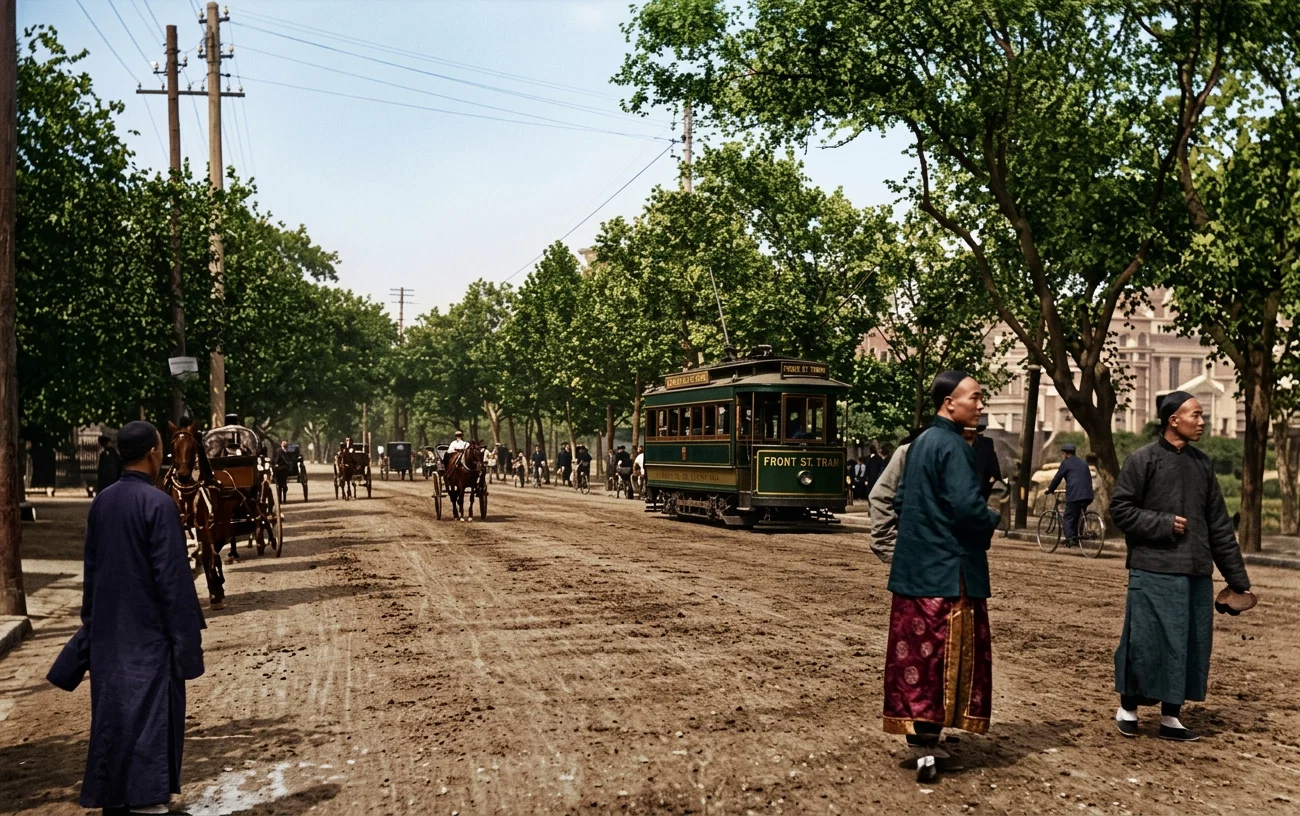
A street-car system has been perfected within the last few months, one line being over five miles in length. At its terminus are several large Catholic institutions, one of which is a meteorological bureau. While this is a private enterprise of the Catholic Church, they have gained such skill and precision that China is dependent upon this observatory for her weather-signals.
ALONG FRONT STREET, SHANGHAI
The government has therefore placed the Chinese Imperial Telegraph Line at the command of this bureau, and has made many concessions to the Catholics, owing to its obligations to them for their services in this work. What motive other than to gain political influence could prompt the Catholic Church to establish a meteorological bureau here? In visiting their institutions a short time ago, we were taken through the industrial department, and there saw native boys carving images of Christ, the Virgin Mary, and Peter,—work which doubtless seems to them little different than carving their idols of Buddha and other gods. They were also painting screens with the many scenes so commonly found in Catholic cathedrals. The work done by these boys would be hard to excel, in the opinion of a casual observer. One of their pictures represented two Chinese boys with a marked expression of piety kneeling down before the pope. In this room were two enlarged pictures,—one of the circuit judge for this district, the other of the general inspector of the Shanghai-Nanking Railway. These were doubtless there in order to gain political favor with the Chinese. In many ways as yet unrevealed to the Protestant world, the Catholics are working to grasp universal political power. Another thing very noticeable in their industrial department was the seemingly perfect control they had over these Chinese boys. There was not so much as a whisper to be heard, and it is further known that once a native becomes a Catholic, he remains a Catholic.
The Chinese native papers and the Chinese generally are now very friendly toward America, this feeling having been created by the return of the Boxer indemnity by the United States. The Chinese government has delegated one of its foremost statesmen, Tang Shao Yi, to return thanks to the United States; and it is hoped here that his stay in America may result in some steps toward effecting an alliance between the United States and China, in order that Japanese influence may be subdued in the far East. We are certainly living in eventful times, and everything seems to be pointing to the consummation of all things in the end of the world. But the work of warning these populous countries must be done, and every facility must be employed in giving the closing message.
Shanghai, China.