To Students Preparing for Work in China
9%

Review and Herald Publishing Association · Takoma Park Station, Washington, D. C. · May 9, 1907

FromReview and Herald, Vol. 84, No. 19.

Read the full edition

To Students Preparing for Work in China

(Continued)
It has been found that those who are good singers and distinct readers in English are also good singers and readers in Chinese. The same is true of writing, therefore all these talents should receive due attention.
Knowing the geography of Asia, and especially of China and Palestine, well before coming will not necessitate re-learning it here, where all the time will be needed for language study. Unless a good atlas is accessible, it would be well to send to our mission here for a map of China and its provinces (price, seventy-five cents). When the worker comes to these fields, he finds himself interested in other mission fields more than ever before; and in all cases where one has no atlas, it will be found a great satisfaction to be conversant with the position and location of all our missions, as well as to have a good thorough knowledge of the geography of the whole world. The sciences—such as physics, botany, zoology, and chemistry—are of value mostly, as simple illustrations can be drawn from them, also in educating the mind to make contrivances. However, an extensive knowledge of these subjects is not required. Perhaps the most interesting of the sciences is astronomy. To relate some of the wonders in the heavens is of intense interest to a people who believe the stars to be lanterns, the sun to be six hundred and sixty miles in circumference, and the moon six hundred and eighty miles, as was told me by a so-called educated Chinese teacher. Mathematics in China is mostly mental except what can be calculated with the abacus. The average boy of a civilized country, with only a common school education, is far in advance of the most educated Chinese student in this branch of study. In the three years we have been here, we have not been called upon once to solve a problem in algebra, geometry, or trigonometry. Our problems, which are many, can not be solved in this way, but only through a knowledge of the Chinese, their manners and customs. It is a surprising fact that students well informed in ancient and modern history, who can give detailed accounts of Babylonian and Assyrian history, kingdoms that have passed out of existence, are totally ignorant of the history of China, Japan, and Korea, countries containing nearly one third of the population of the world, and which are now coming into prominence as great powers. While some of the ancient history of these countries is mythical, still the history of the last century has been one of great moment to China, and worthy of a place in modern history. The important and essential facts of Chinese history are clearly set forth in a small book entitled “A Sketch of Chinese History,” by F. L. H. Pott, costing about one dollar. The reading of this book would commend itself to any one desiring to become better acquainted with the great political events which have led up to China’s present state, and it should be especially studied by those expecting to come to this land.
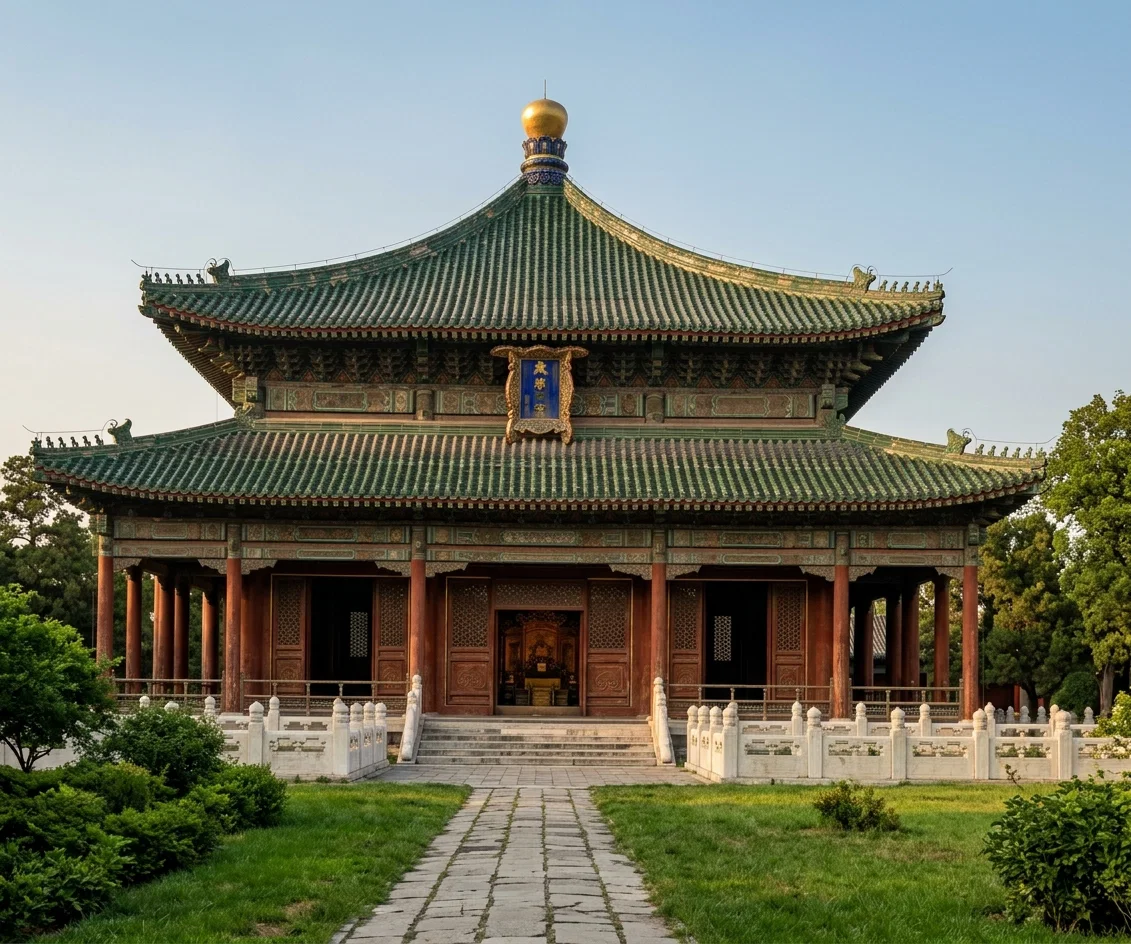
This building is located in the center of the examination halls of Peking, and contains the throne of the Emperor Kang Hsi, who was one of the greatest scholars among the emperors of the present dynasty, and reigned from 1662 to 1723. It was erected over three hundred years ago.
Those wishing to become acquainted with the characteristics and manners of the Chinese people will find A. H. Smith’s two books, “Chinese Characteristics” and “Village Life in China” (published by Revell, and for sale in nearly every bookstore), what they want. As yet, the best missionary books out are “Life of J. Hudson Taylor” and “Life of Pastor Hsi.” These can be greatly added to, and should any be interested in reading further, we shall be glad to furnish information.
A good knowledge of English facilitates learning this language, as learning Chinese is a slow process, and if it is necessary to look up the meaning of both the English word and the Chinese character in the dictionary, it becomes a very tedious process. Another subject, a good knowledge of which is of special value in a country like this, is bookkeeping.
Where native teachers, evangelists, and other helpers are associated with a foreign worker, he is constantly handling mission funds in disbursing and receiving remittances in large or small amounts, and is supposed to give a clear statement at the end of each month. It is also important that in a land where money has the complication it has in China, the missionary keeps an account of his private expenses so that he may be able to compare his expenses; and knowing where the greatest leak is, he can, in many cases, reduce this greatly.
As an illustration of the complex system of Chinese currency, we give the following: Money as received here is in drafts for either gold dollars or pounds. These are deposited at the bank and exchanged in taels (a tael is supposed to be an ounce of silver, but its actual weight varies in every city), ordinarily equaling about seventy cents gold; but the tael is not a coined piece, so that we must draw out a piece of silver weighing about four pounds, English weight, which contains fifty odd taels according to the foreign banks’ scales. This money is taken into the interior in these heavyshoes of silver, one hundred dollars gold weighing about twelve pounds. But this is too large a denomination to use, and so must be sold to a native bank for copper cash, which, like silver at a foreign bank, has no constant value, but is continually varying in price. On an average an ounce of silver sells for twelve hundred and fifty copper cash, which weighs about nine or ten English pounds. A dollar gold exchanged in copper cash weighs about twelve pounds. One hundred dollars would equal twelve hundred pounds. As reports are kept in gold, and the expenditure is in cash, a knowledge of bookkeeping will prove a time saver as well as a system of accuracy.
H. W. MILLER.
(To be concluded)