Our First Church in Burma

7%

Review and Herald Publishing Association · Takoma Park Station, Washington, D.C. · May 23, 1907

FromReview and Herald, Vol. 84, No. 21.

Read the full edition

Our First Church in Burma

G. B. THOMPSON
Soon after the close of the general meeting in Calcutta, I went with Elders Shaw and Miller, and Brother and Sister Burgess to northern India to assist in finding a location for a mission station in the hills of the Himalaya Mountains, to which our missionaries can go from the burning heat of the plains for a needed period of rest. We visited Dagshai, Simla, Solon, Kasauli, and Mussoori. We spent nearly three weeks in this trip. The weather was very cool in the hills, and heavy underclothing and overcoats were necessary. There was considerable ice and snow, the tops of all the mountains being covered. (Himalaya means the “abode of snow.”) The air was very invigorating, and it seemed that a person could regain his health as well here in these hills as in any other place.
The establishing of hill stations in hot and unhealthful countries I believe to be a wise step, as it will do much to advance mission work in such countries by providing a suitable place where the workers may go to regain their health and secure needed rest, without leaving the country. To carry on work effectively in India, as well as in other countries, those who come to labor must plan to learn a language and to remain permanently in the field. By changing to these hill stations from time to time this can be done. In large countries, like India, it will be necessary, perhaps, to plan for more than one such place, on account of the long distances of travel. The matter of locating the hill station was not permanently settled when I left, but negotiations were in progress.
On my return to Calcutta I held some meetings with the sanitarium family, studying the relation of our medical work to this message, and the important place the medical missionary can fill in this work. Dr. Menkel and wife are getting hold of the work nicely, and a good spirit pervades the institution. The patronage when I left was encouraging.
March 9 I bade the workers in Calcutta good-by, and sailed on the “Tara” of the British India Line for Burma. After a very pleasant voyage of three days across the Bay of Bengal, I reached Rangoon, and found Elder Votaw and wife and the other workers here well and of good courage.
I remained in Burma over two Sabbaths, holding meetings and visiting those who are interested in the truth. This is the land where Judson spent so many years of his life, and gave to the Burmese an excellent translation of the Bible, thus preparing the way for the last message. And it is encouraging to see how the message is taking hold here. A number of earnest, devoted souls have begun to keep the Sabbath, and others are deeply interested. Three who have embraced the truth here are already in the field laboring in the Burmese language. Most of those who have accepted the truth live in Rangoon and Maulmein, but we hear of some far tothe north, and of others to the south of this place.
On Sabbath, March 23, in the hall in Rangoon our first church in Burma was organized by Elder Votaw and the writer. Twenty-three persons were included in this organization. On Sunday nine persons were baptized by Brother Votaw amid the beautiful surroundings of the Royal Lakes near the city. Some of these baptized were not included in the organization of the church, but expect to unite, and will increase the membership to about twenty-six. The following-named persons were chosen as officers: Elder, H. H. Votaw; deacons, Brethren Maung Maung and David Hpo Hla; clerk, Anna Speer; treasurer, Carolyn Votaw. Following the organization the ordinances of the Lord’s house were celebrated, in which all took part. The Lord seemed especially near on this occasion.
This church is composed of an excellent class of converts. The message works the same in the hearts of the people in all lands. Tobacco using, chewing betel, wearing jewelry, etc., are prevalent among the Burmese, but they laid these things all aside in order to follow the Lord. If they continue to grow in grace, they will indeed be a real light in this dark land. The members of this church are fully instructed on all points of the message, and seemed to be as faithful in the payment of tithes as any church I have met.
Burma, I believe, is a fruitful field for the work of this message, and we should plan aggressive work here at once. This is a land of great resources. The people are of Mongolian type, and quite intelligent. They are liberal and willing to give of their means. Unlike India, Burma has no caste, and the women are as free as the women of any land. In this respect it is a much easier field than the peninsula of India. The land is filled with the gilded temples and shrines of Buddhism. Some of these have been erected at great expense. The number of images of Buddha is astonishing.
Including the Shan States to the north, Burma contains about 236,738 square miles, or about the same as the territory of the Lake Union Conference, and has a population of about ten million. Rangoon, the capital, is situated on the Rangoon River, one of the rivers which compose the mouth of the Irrawaddy River. About fifty years ago it was described as “a collection of mud huts in a swamp,” but it is now the third shipping port of the Indian empire, and contains a population of about three hundred thousand. The town is well laid out, has a good supply of water, electric lights, and a good line of electric street-cars.
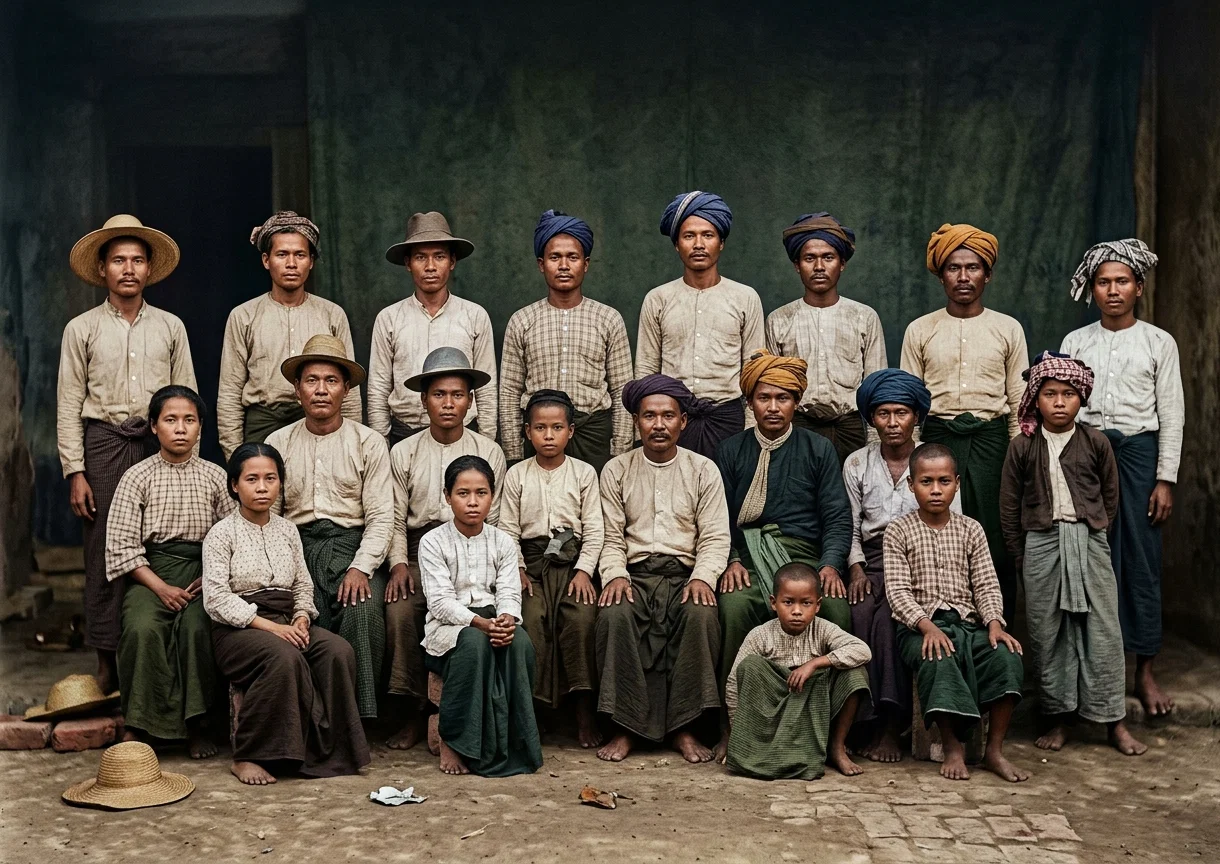
GROUP OF LABORERS FROM BURMA IN ATTENDANCE AT THE GENERAL MEETING IN CALCUTTA
Here, as elsewhere, more workers are needed. We have here at the present time Elder Votaw and wife, Dr. Ollie Oberholtzer, Sisters Bertha King and Daisy Jewett (who are canvassing at present), Sister Ruoff (who is giving treatments), and Brother Maung Maung, his sister Mah May, and David Hpo Hla, our three Burmese workers. These are all of good courage, and are planning to stay by the work. Some of those who have come to this field to work are making encouraging progress in the study of the language. But what are these among so many? While the climate is very hot, it is not, as a rule, unhealthful. We need workers to study the languages and prepare to carry the message in the native language to these millions who are waiting for it. This field is ripe for the message. The Karens, who form an important part of the population of this field, are calling for workers to come and teach them the message. The Karens, I am told, have a tradition that they once had the true light, but because of their sins it was removed from them. For this reason many of them are looking for light, and are ready to receive it. The language is different from that of the Burmese, and we should have a worker for this people without delay. India and Burma afford an excellent field for labor for our consecrated young people who are graduated from our various schools.
I am booked to sail March 28, on the “Cheshire” of the Bibby Line, via Ceylon, for Egypt. I have enjoyed much of the blessing of God during my visit to these fields, and have been impressed as never before with the great needs of India. To carry the gospel to three hundred million, shackled and benighted in heathenism, is no ordinary task. It can be done only through the bestowal of the Holy Spirit and apostolic power. God is greatly blessing the work in this land, and is preparing to do a quick work. Let the continual cry of all who love this message be, “Here am I, Lord; send me.”