The Kimberley Diamond Fields

6%

Review and Herald Publishing Association · Takoma Park Station, Washington, D. C. · Jun 6, 1907

FromReview and Herald, Vol. 84, No. 23.

Read the full edition

The Kimberley Diamond Fields

G. A. IRWIN
Kimberley contains a population of 34,260. It is the center of the diamond fields of South Africa, and the diamond-mining industry is what has made and still keeps it one of the most prosperous towns in all South Africa. In December, 1905, there were 17,260 natives and 3,192 Europeans employed in the Kimberley mines. All the mines in and about Kimberley were, in the days of Cecil Rhodes, consolidated into what is now known as the “DeBeers Mining Company.” This company owns and controls not only the mines now open, but thousands of acres of land at present lying waste. A very large proportion of the property in the city itself is under their control in some degree. The rights and privileges of the company seem to have scarcely any limit. Yet notwithstanding all this, the directors of the company pursue a liberal course, both toward the town and toward its own employees.
For the double purpose of protecting both themselves and the natives they employ, the company has gone to the expense of building and properly equipping large compounds. Each of these compounds encloses several acres of land, and has rooming capacity for from one thousand to three thousand natives. Each contains within its limits a store, stocked with provisions, clothing, etc. These supplies are sold to the employees on the same margin of profit as is charged by the outside dealer.
In addition to the store, there is a large, light, and neatly kept hospital for the accommodation of the sick and wounded. A physician and a medical matron, who give their whole time to this work, are supplied by the company. In case an employee loses a limb while doing his duty, the company pays for an artificial limb.
For its officers and white employees, the company built upon its own land a beautiful suburb to the city, known as Kenilworth. Large public vineyards and orchards were also planted. Hundreds of nice brick cottages were erected on commodious lots, which were planted to fruit and ornamental trees. Schoolhouses, churches, and other public buildings were built; in fact, everything necessary for comfort, convenience, and the pleasure of the employees was provided. The trees planted in this large area have made a marvelous growth, and this suburb, in contrast with the bare and desolate country around, seems like a miniature Eden.
On my visit to one of the large diamond mines, I was profoundly impressed by the great amount of work and expense incurred in mining and hoisting tons upon tons of earth and passing it through various processes and scores of machines, to get a few jewels. This diamond-mining business has reached such a degree of perfection through the scientific machinery and methods employed that not one single jewel goes out with the waste, even though it is no larger than a small pin-head. The analogy between the true Christian and the diamond itself and the necessary methods employed to release it from the rock and clay in which it is embedded, is so striking that I can not forbear giving some facts and details that will make the analogy clear to the reader.
In the first place, the diamond is formed by intense heat and pressure. In some instances the pressure has thrown the diamonds to the surface of the earth, where they may be found in gravel and sand-banks, and in river beds. But the greatest number are found deep down in the earth, imbedded in rock and tough, bluish clay surrounding the hole that gave vent to the intense heat and pressure that formed the diamond, and gave it its hardness and luster. This rock and clay is dug out with pick and shovel, and elevated to the surface by means of lifts, and dropped into small cars, which are hauled out to what is known as the farm, or floor, where it is dumped from the cars onto the ground.
Thousands of acres are thus covered from one to two feet deep. In this condition it is allowed to remain for months, exposed to the sun, rain, and other atmospheric conditions. The whole mass is stirred at intervals, so as to expose all parts to the sun and air. This is done in order that the action of the elements may pulverize, or so change the nature of this tough, rocky clay, that in the grinding and various other processes to which it is submitted later, the particles will separate and release the diamonds, and make it possible, through a multiplicity of stirrings, washings, shakings, and siftings, to obtain every genuine diamond contained in the clay thus manipulated. The last shaking and sifting machine, over which the diamonds and small pebbles of a similar size and weight are carried by the shaking of the machine, and the constant flow of a stream of water, is covered with a kind of grease that catches and holds every diamond, while the pebbles and some small stones, which look like diamonds, are carried on by the shaking and washing, and are borne away by the lift, and deposited in one of the great piles of waste that have accumulated around each mine, resembling the foot-hills around some gigantic mountain peak.
It is the golden oil that flows from the two olive-trees through the two golden pipes that catches and holds the true Christian in the last shaking, just as the grease catches and holds every real diamond as it traverses the last machine.
Just as the smallest diamond is caught and held by the grease, so, in the mighty sifting that is to take place among God’s people, not the least grain shall fall upon the earth. Amos 9:9. I could easily hold in the hollow of my hands all the diamonds obtained from a day’s work of one of the largest mines in Kimberley, yet their value in the rough was estimated by an expert to be six thousand pounds. The amount of dirt handled in obtaining this handful of jewels is beyond my power to describe other than by the use of the word “immense!” In the beginning of this mining industry in Kimberley, all the work of elevating the clay to the surface was done by hand, or by very rude hoisting devices. Yet in this way, clay and rock sufficient were removed to leave a hole right in the edge of the city eighteen hundred feet deep, and half a mile wide across the top. As I stood upon the brink, peering into the depths of this great hole, the force of the figure used in Isa. 51:1, 2, came to me with great vividness: “Harken to me, ye that follow after righteousness, ye that seek the Lord: look unto the rock whence ye are hewn, and to the hole of the pit whence ye are digged. Look unto Abraham your father, and unto Sarah that bare you: for I called him alone, and blessed him, and increased him.”
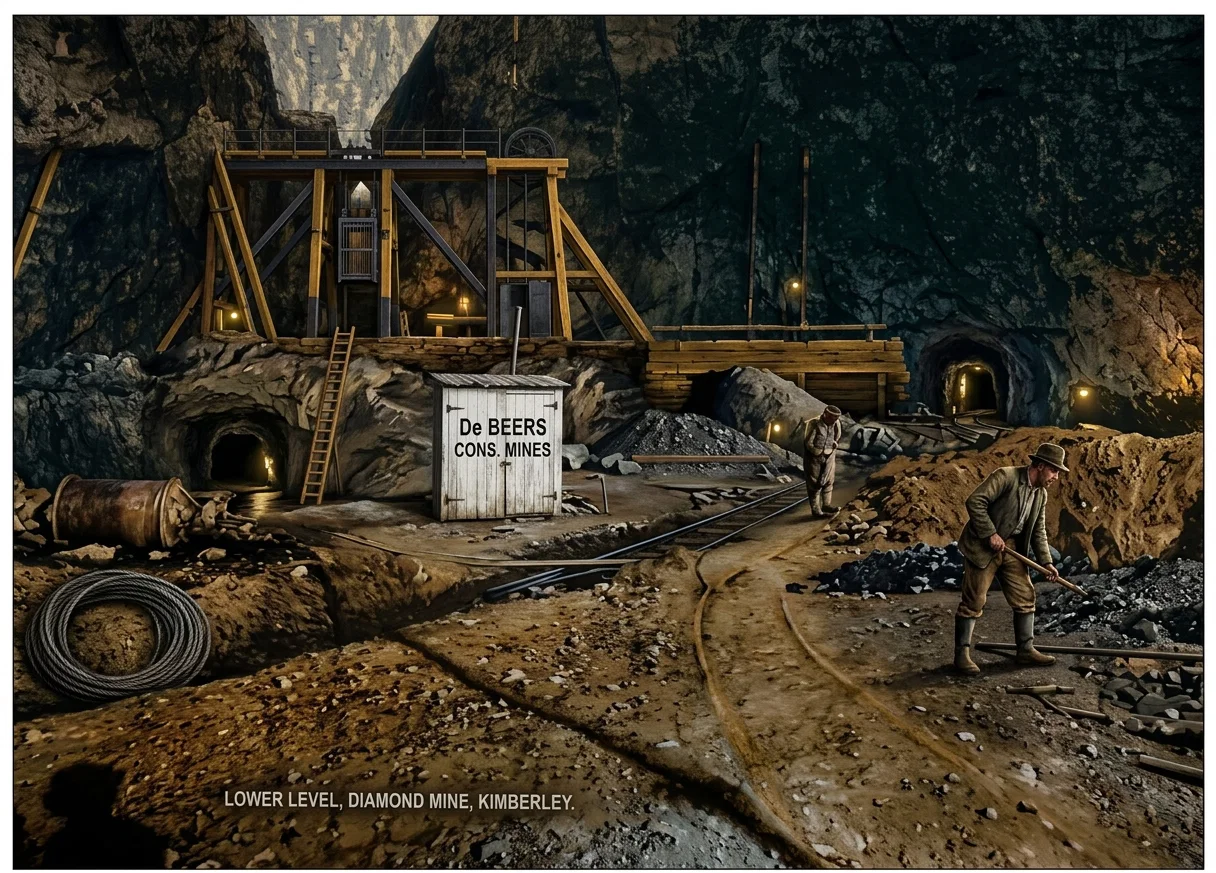
DOWN IN THE MINE
DOWN IN THE MINE
Many of God’s jewels of past ages, as well as in the present generation, have been buried very deep in heathenism and worldliness. As we stand to-day upon the very brink of eternity, and gaze into the dark pit of sin whence we have been digged, we can see that it has been alone by the mercy, goodness, and blessing of God that we have been rescued from such conditions and surroundings, and brought thus far on our journey. In comparison with the multitudes of people by whom they have been surrounded, God’s true people have always been few in number. In this last generation they are spoken of by our Saviour as “a little flock.” The number that will be redeemed from the earth through obedience to the principles and teachings of the third angel’s message will be in comparison to the population of the world as one to eleven thousand. It is a comforting fact to know that while God’s jewels are scattered here and there all over the world, among “every nation, and kindred, and tongue, and people,” he has provided a scheme, known as the third angel’s message, that will bring to the surface, and separate from the mass of rubbish and worldliness in which they have been imbedded, all the hidden jewels; and those on the surface, or only slightly covered, will be hunted, or fished out, as the Lord has promised in Jer. 16:16: “Behold, I will send for many fishers, saith the Lord, and they shall fish them; and after will I send for many hunters, and they shall hunt them from every mountain, and from every hill, and out of the holes of the rocks.”
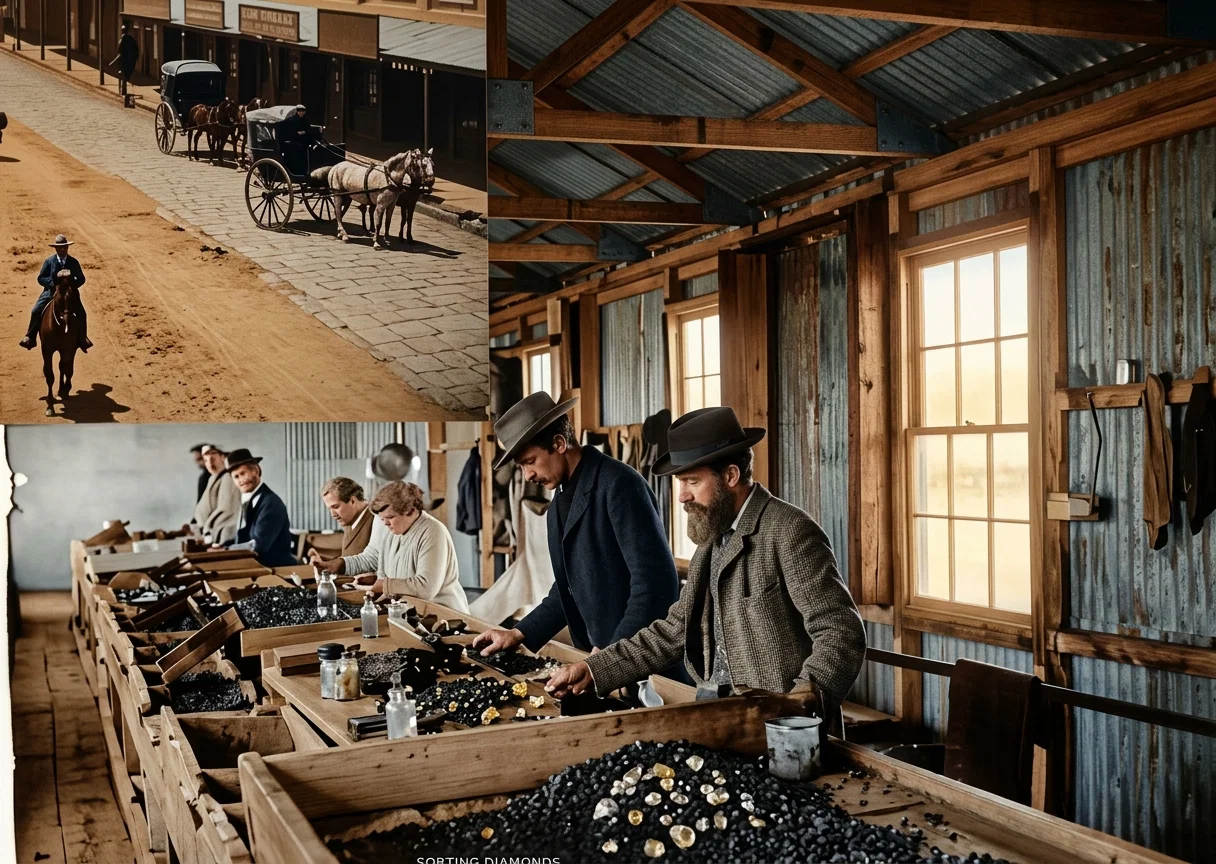
STREET IN KIMBERLEY
STREET IN KIMBERLEY
The finding of the diamonds, laborious and expensive though the process is, is not the end of the operation. Before they will shine and emit the luster that is in them, they must be cut, polished, and shaped. So with the Christian. The finding may have cost the sacrifice of men and means, and been accompanied by the tears, prayers, and heartaches of the hunters and fishers, yet before he can “shine as the brightness of the firmament” or “as the stars forever and ever,” he must be hewed and squared by the prophets, that he may be fitted for a place in the spiritual temple that God is erecting of human beings, who, as living stones, “polished after the similitude of a palace,” are to be the outshining of his glory. “The trials of life are God’s workmen, to remove impurities and roughness from our character. Their hewing, squaring, and chiseling, their burnishing and polishing, is a painful process; it is hard to be pressed down to the grinding wheel. But the stone is brought forth prepared to fill its place in the heavenly temple. Upon no useless material does the Master bestow such careful, thorough work. Only his precious stones are polished after the similitude of a palace.” Of those who submit to this polishing process, as does the inanimate diamond, the Lord has said, “And they shall be mine, saith the Lord of hosts, in that day when I make up my jewels; and I will spare them, as a man spareth his own son that serveth him.”
SORTING THE DIAMONDS.