The Struggle for Religious Liberty in Peru
5%

Review and Herald Publishing Association · Takoma Park Station, Washington, D. C. · Feb 14, 1907

FromReview and Herald, Vol. 84, No. 7.

Read the full edition

The Struggle for Religious Liberty in Peru

EDUARDO F. FORGA
The fourth article of the Constitution of Peru says, “The Nation professes the Apostolic Roman Catholic religion; the State protects it, and does not permit the public worship of any other.”
One of the most evident results of the working of this law, so contrary to the true nature of religion, is strikingly apparent in Peru,—that with respect to the Christianity of that nation. It is difficult to say whether it is Christianity paganized or paganism Christianized. Moreover, since the foundation of the republic, noble spirits have not been lacking to fight against this obscuring religion, a characteristic relic of the medieval ages and of inquisitorial Rome.
Many notable Peruvians have been prominent in this combat, men of continental renown, as Vigil, Casós, Gonzáles Prada, and a considerable number of young men, who with their moral courage and patriotic ardor, have been the glory of their country.
Though the hour had struck in the march of time for the sun of religious liberty to shine on unfortunate Peru, clericalism continued to thrust itself forward throughout the country. Proud of her omnipotence, the church gloried above all in that Arequipa, the second city of Peru, with her convents, monasteries, religious institutions, etc., was “the Rome of Peru,” and one of the fortresses of the papal system in South America.
I was born in March, 1871, in that citadel of darkness. Having returned to my native land in March of 1896, after spending twelve years in educating myself in Switzerland and Germany, I resolved to do whatever I could for the liberty of my country and the good of South America. The study and reflection of many years had fully convinced me that the great moral, social, and economical unprogressiveness of the Peruvian nation in general, and the anarchic state of Spanish American republics, were first due to the evil influence of Romanism, which changed a religion of liberty, truth, and love—as that taught by Jesus—into a system of oppression, falsehood, and hypocrisy, and for so many centuries caused the anti-christian union of church and state. When I returned to Arequipa, the power of the clergy was still so great that a Bible colporteur was imprisoned before he could sell a half-dozen copies, and later was escorted to the railway station, and obliged to leave the place. Under such difficult circumstances, I did not know how to begin oppositionagainst Rome and take up the defense of liberty of thought and conscience.
Having received the title of Mining Engineer in Germany, I accepted a position as the director of a mine in the Andes, and in my spare moments began the translation into Spanish of a great number of articles against the plague of alcoholism, and also wrote in favor of modern hygiene, hydrotherapy, and especially vegetarianism, in order to gain the confidence of the people. Since 1898 nearly one hundred thousand tracts and pamphlets have been distributed throughout Latin America, the greater part having been reproduced in Peru, Chile, Bolivia, Argentina, Uruguay, Mexico, Cuba, and Spain.
Influenced by this propaganda, the government of Peru organized in 1903 a “National Anti-alcoholic Congress.” This was well represented from all parts of the country in the convention held at Lima during the entire month of February. As delegate from the municipality of Arequipa, I took an active part in the work of the association, and pleaded for the law of religious liberty.
During these years the Catholic cause was bitterly opposed by La Patria and El Ariete, the organs of the Radical Center and of the Liberal Party, two doctrinal political groups composed of patriots, intellectuals, and those of the working classes.
It seemed that the ruin of the clerical power in Arequipa was divinely decreed. A Catholic merchant and banker was very closely connected with the clergy. The priestly confessors of the church had accustomed their spiritual flock to deposit their small earnings with this good son of the holy mother—the Catholic Church. Influenced by the advice, hundreds, and perhaps thousands, left their small earnings with the happy merchant and good believer. However, it came to pass that he became bankrupt. Panic ensued, hundreds were reduced to beggary, and it was rumored that some trickery had been resorted to. For this reason Catholicism received a deadly wound in southern Peru.
Another event not less fatal occurred about the same time. A few years ago there was a citizen who had been president of a Catholic congress held in Peru, and who had the reputation of being one of the most conspicuous figures of the clerical party. He became a minister of state. As he had urgent need of funds for a particular business, and not having them at hand, he took money from the safe of the department, with the probable intention of replacing it later. This unscrupulous action came to the ears of the public, and the president, fearing that the indignation of the people might involve him in the fraud, turned him over to justice. This leader of the Catholics was imprisoned, thus causing great loss of prestige to the Roman Church throughout the entire republic.
After these blows had fallen, in 1904 it seemed necessary to dedicate all my energies to the work of reform, not because of the lessened vigor of the Liberal and Radical parties alone, but because they were both confounding the outrages of the Catholic Church with Christian principles, and as they fought, they spread anti-religious and atheistical ideas among the people.
In July I published the first pamphlet denouncing the great evils which the absolutism of the Roman Catholic Church has brought upon the unhappy Peruvian people, because of the union of church and state. It was necessary to make the public see that they, in conjunction with the government, should undertake a decided fight for religious liberty and the separation of church and state.
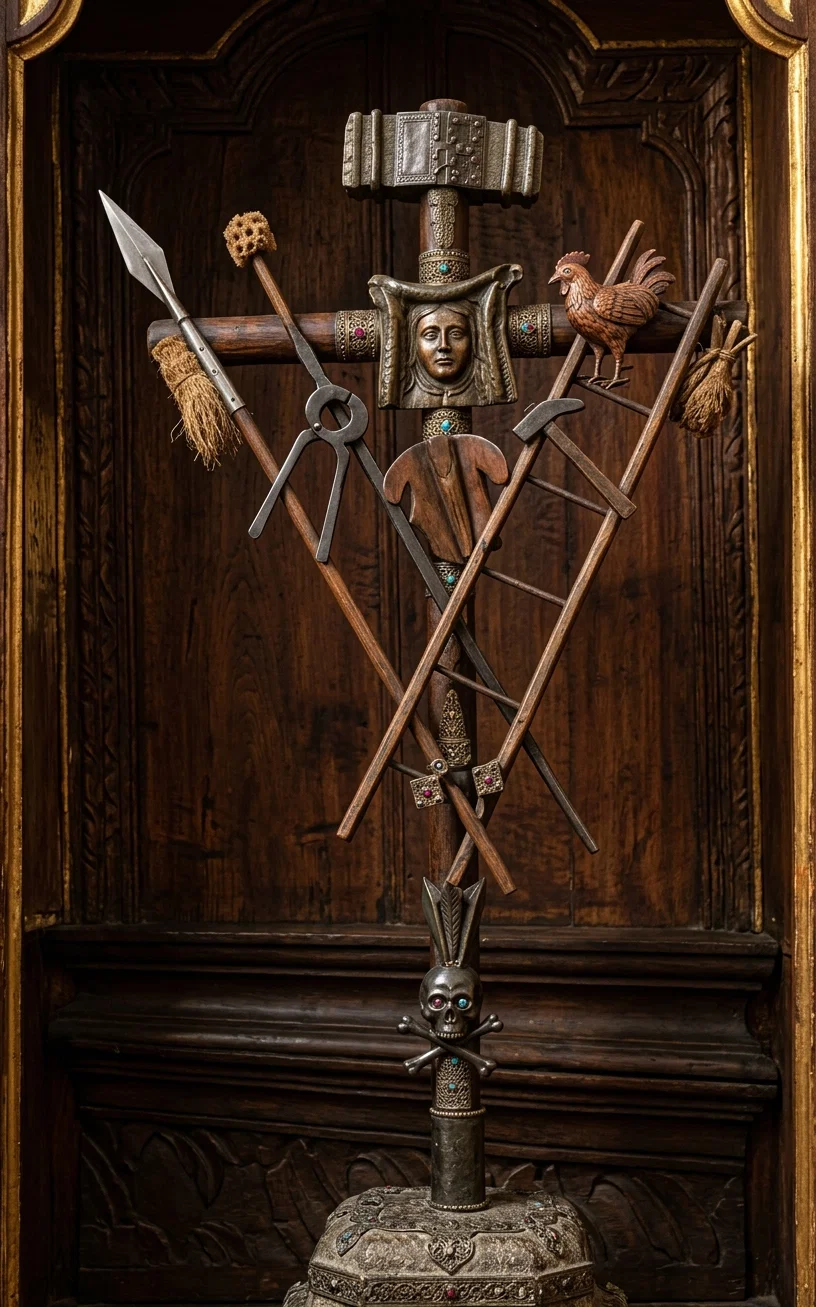
A ROMAN CATHOLIC CROSS IN PERU
An edition of one thousand copies, which had been announced in three thousand leaflets of free circulation, was sold in three days, producing a sensational effect. The clergy thundered in the pulpit and press. They preached and published such things as these: “He who blasphemes the name of God shall be killed;” “all people shall stone him.” A Catholic weekly which was edited by a nephew of the bishop, cited canon laws of the church with passages like the following, which should be applied to me because they were in force according to his opinion: “He shall be fastened some day to the door of the church with his hands tied behind his back.” “He shall be marked with a hot iron on his lips.” “His tongue shall be perforated.” “He shall be lashed publicly through the city.” “Then a gag shall be applied to the criminal. He shall be brought through the city tied to an iron.” “Nail his tongue.” “Cut out his tongue.” “Let him be fined one hundred ducats, and further banish him from the country.” But the best advice which the good agents of the Catholic Church could give to the fanatics was “to kill” me.
I answered those attacks by a second enlarged edition of the pamphlet, and with other leaflets, which were distributed throughout the city by the thousand.
In spite of the anger of the priests, in September of that year I helped to found the first evangelical church. The clergy did all they could to dissolve the new organization, and incited the faithful to throw stones at the windows of our place of worship, and forbade Catholics to sell anything to the members of the new church, or to buy of them, neither were they to give them occupation. All this was in vain, for they were protected by the hand of the Lord, and sheltered by public interest, and to-day the church is prospering.
The fight continued with thousands of tracts and monthly pamphlets. During this time and several months preceding, colporteurs of the British and Foreign Bible Society were selling large quantities of Bibles and New Testaments in the town.
The Catholic Church, having been unable to arouse the fanatical zeal of the people to kill me, and having failed to frighten me with their threatenings and persecutions, denounced the pamphlet which attacked the state church. The ecclesiastics used their entire influence on the judicial authorities, and compelled an order of imprisonment against me. The political power, which was called to carry out this order, declined because they represented a patriotic and semi-liberal government, and understood that my efforts were for a better civilization, and that the people would be wrought up at seeing me imprisoned, and thus the danger of a revolution would be increased.
Although practically a prisoner in my own home, I worked along the same lines with my literature, and published a monthly review called La Reforma (The Reformation), which was intended for the educated classes, likewise other tracts in editions of from four to ten thousand for the middle classes. The publications were sent regularly to the president, the ministers of state, senators, representatives, prefects of the departments and provinces, municipalities, public libraries, to the directors of the political parties, to the press, and to private citizens. We have about fifty agencies scattered throughout the principal cities of the republic, and some in Chile, Bolivia, Ecuador, and Colombia, where our literature is for sale and free distribution. The work of the central office and the agencies of La Reforma was a work of love, the money contributed being used for printing. Many friends, and even Catholic ladies, made gifts to support the work.
Arequipa, Peru. (To be concluded)