Two New Conferences

7%

Review and Herald Publishing Association · Takoma Park Station, Washington, D. C. · Feb 14, 1907

FromReview and Herald, Vol. 84, No. 7.

Read the full edition

Two New Conferences

L. R. CONRADI
GERMANY, the home of the Reformation, is more and more proving the most fruitful field in Europe for the last great reform movement. Although it took us years to get any kind of start (as it was not until 1898 that the first conference could be organized), yet since that time the work has made rapid strides.
In 1901 Germany was divided into the East German Conference and the South German Mission, the West German Conference being regarded as the original organization. In 1902 the South German Mission became the South German Conference. In 1903 God's blessing had so been with the East German Conference that it was found best to organize out of its territory the Prussian Conference; and there had been such growth in western Germany that Rhenish Prussia could be formed into a separate conference. In 1905 the German Union District, taking in Hamburg-Altona and Friedensau, was severed from the West German field. Now, at the close of 1906, the Silesian Conference has come into being by once more dividing the East German Conference, and the North German Conference has been formed out of territory formerly belonging to the West German field—giving us eight distinct organizations in the German empire, with a total membership of about five thousand.
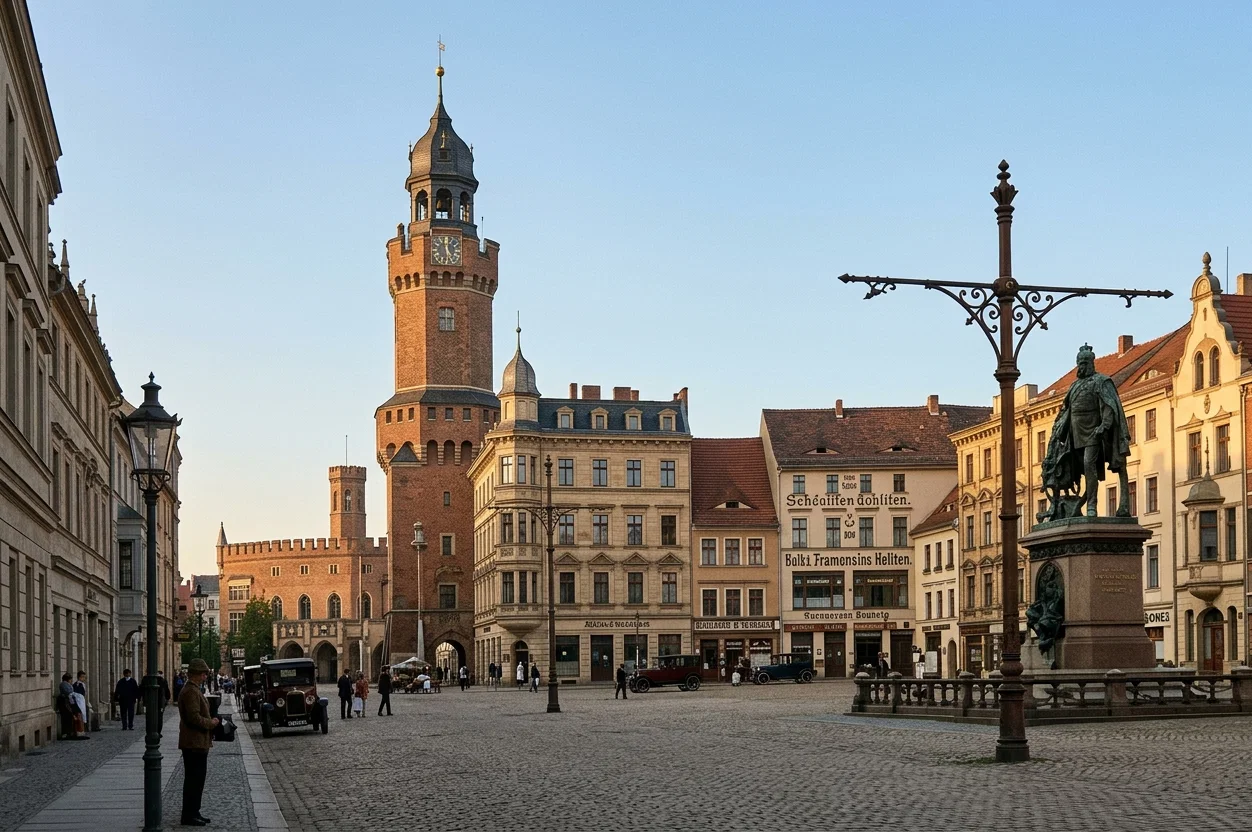
Goerlitz, Germany. Upper market with chief of police building and statue of Emperor William I. In first building to the right, our meetings were held.
To effect the organization of the Silesian Conference, we met December 13-16, at Goerlitz, a city of eighty-five thousand inhabitants. The provinces of Silesia and Posen comprise the territory of the Silesian Conference, and these two provinces have a membership of three hundred and forty, and a population of nearly seven millions.
Elders Frauchiger, Obländer, Schilling, and the writer, accompanied by the German Union Secretary, were present at this meeting. Best of all, the blessing of the Lord was with the ninety delegates, and there was harmony in all our deliberations. The brethren felt very anxious to do what they could to advance the Lord's work. Although their membership is not large, and they have a great field, yet they voted unanimously to give a second tithe to the union, as all the other German Conferences do. They willingly raised about eighty dollars toward the material fund for the “Ministry of Healing” in German, promising to begin right then and there to circulate that book in behalf of our philanthropic work. The accompanying cut shows where the meetings were held.
Elder J. H. Schilling was unanimously chosen president of the new conference, and he will be assisted by one ordained minister, two licentiates, five Bible workers, and fifteen canvassers. The largest church in this field is at Breslau (one hundred and five members), a city of nearly half a million inhabitants.
Goerlitz is near the old Moravian settlement of Niesky, their leading colony, where they have their mission school and preparatory college, as well as their deaconess' home. In their advanced course for missionaries I found but twelve students at the time I visited the place. The town has about twenty-five hundred inhabitants, perhaps two thirds of whom are Moravians. I noticed that the United Brethren Association, among other things, carried on an extensive trade in cigars and tobacco. Judging from what I saw, I thought that the old Moravian spirit seemed to be departing, although their income for missions is still about two hundred thousand dollars per annum.
December 20-23 the general meeting for the North German Conference was held at Harburg, about three miles from Hamburg. Harburg is a manufacturing city of fifty-six thousand inhabitants.
As just organized, the North German Conference is comprised of the provinces of Hannover (excepting the southern part), and Schleswig-Holstein (excluding Altona), the two Mecklenburgs, Oldenburg, and the two free cities of Bremen and Lübeck (with a population of nearly five and a half millions) cut off from the West German Conference. There are nearly four hundred members in this field now.
Although it was near Christmas time, yet about eighty delegates came together, and the Lord's good Spirit was present at the meeting. Elder L. Mathe was chosen president of this new conference, which, like the other German Conferences, pledges two tithes to the union for use in the union mission fields. About the same sum was raised here as at the Silesian meeting toward the material fund for the German “Ministry of Healing,” and they at once began circulating this book. The largest church is Hannover-Minden, with ninety-six members. In the field are two ordained ministers, three licentiates, five Bible workers, and twenty-one canvassers.
The separation of these two new conferences dates from Jan. 1, 1907, so that the tithe will flow into the old treasuries until that date, and the work in the new fields will be audited by the old committees for the year 1906. The East German Conference still retains one thousand members, being by far the strongest conference in the union. In western Germany there are now six hundred members. Thus far every such separation has proved a strength to the old, as well as to the newly organized, field. When we remember that there are sixty-two millions of people in Germany, it will be seen that eight organizations are none too many, and we do not doubt but that as time goes on, further division will be necessary. We are thankful to God that from year to year we not only can organize growing churches, but also that he is so blessing us that we can form new conferences. May the Lord still give us greater blessings.
Hamburg.