Samoa

8%

Review and Herald Publishing Association · Takoma Park Station, Washington, D. C. · Feb 24, 1916

FromReview and Herald, Vol. 93, No. 10.

Read the full edition

Samoa

JOSEPH E. STEED
The Samoan group consists of nine islands. They are very mountainous, but are well wooded with various tropical trees. The three largest islands are Savaii, Upolu, and Tutuila. The latter, with a few very small adjacent ones, belongs to the United States.
The population of what is now British Samoa is about 40,000 natives, 400 whites, and 500 half-castes. In American Samoa there are about 6,780 natives, 179 whites, and 292 half-castes. Besides these there are 2,200 Chinese coolies who do the most of the work on the plantations, and about 500 other islanders who work at places of business in Apia.
The climate of Samoa is very variable and moist, the rainfall for the last five years averaged 126 inches. The most pleasant time of the year is during the winter, or dry season, from May to November, when the southeast trade winds prevail.
The gospel was first brought to this group by Messrs. Williams and Barff, of the London Missionary Society, with some Tahitian teachers, in the year 1830. Early in the year 1891 the “Pitcairn” visited Samoa on her first voyage. In 1896 Dr. F. E. Braucht began work in a medical institution at a place called Matautu, removing afterward to a new institution at Apia, where he worked for a number of years. Other workers were added, among them Delos Lake, W. E. Floding, Dr. Vollmer, Dr. M. G. Kellogg, and others; but on account of the trying nature of the climate, they had to leave, one after another, until Samoa was without a worker bearing the last message.
At the Australasian Union Conference council of 1907, it was decided that my family and I should reopen the work in Samoa. It was through trust in Him who had called us that we consented to pick up the broken threads. During the two years spent in that field at that time, we were able by the help of a young man and a young woman, who have since spent some time in our Australasian Missionary College, to have quite a number of tracts translated into the Samoan language, and now through their help at the college printing press, we have a nice monthly paper called the Tala Moni, which literally means “Tell Truth.” With this literature we are enabled to give the truth to the many people in this group, and also to other small groups near by. On account of failing health the writer had to return to the people we loved so well. Once again our trust is in him that he will supply our every need according to the riches of his grace. While looking at the evidences of the closing work and at the prevailing wickedness of these dark lands, our hearts go out to our heavenly Father for wisdom to do his work in a way that will glorify him.
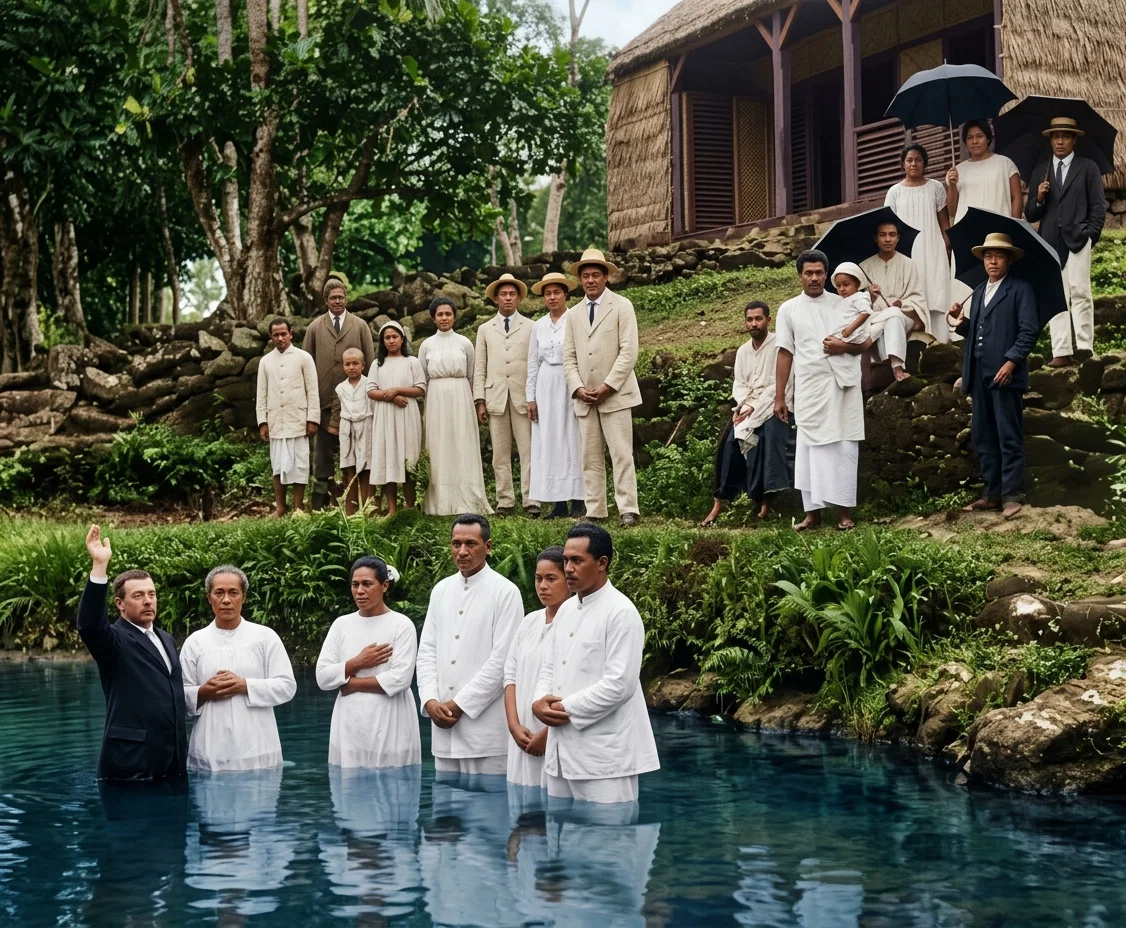
BAPTISMAL SCENE IN SAMOA
This land is teeming with sickness. Visiting from place to place, our hearts often ache as we seem so powerless to help these needy people. Much of this condition is brought about by their sinful habits, and many, if healed, would return to their old ways. Notwithstanding all that the enemy would use to discourage us, we have the precious promise that there will be some from this land who will stand on the sea of glass, and our work is not without many encouraging features.
During our absence from the field, Brother H. T. Howse has been carrying on the work, and is now at a place called Saluafata, where we expect soon to have a training school to prepare some of these islanders to carry this message to their own people. Now that we have literature, we are able to do much more for the spiritual welfare of the native population. Our Tala Moni has an issue of one thousand a month, and is much help in reaching this people. The result has been that quite a good interest has sprung up in different places. With the assistance of our new “Bible Readings,” we have had much inquiry after the truth, and for a time we were well employed holding studies with the natives. When we reached this experience, we saw that we needed a meetinghouse. The Lord opened the way for us to obtain a piece of land and to build, and we now have a nice place that we can call our own, in which we can hold our meetings, with land enough to meet any growing demands that may be made for the work in this part of the field.
We are glad to be able to say that the outcome of this interest has given us an addition to our church of ten native members, some of whom are already taking the burden of carrying the message to their own people. It would be interesting, perhaps, to the readers to know something of what it meant to one man and his wife who took their stand for the truth and were baptized. This man was a high chief of his village, a position which meant much to him.
Many of the heathen customs brought down through the ages, and condoned by the other missions of today, must be abandoned when men and women take their stand with us in this last message. We have been told that a chief would never join this church, because he would not give up those things that are condemned by our church. Among the many evils that this man had to renounce were the keeping of a taupou, that is, a virgin, that must entertain his guests by dancing almost nude; the making of feasts for every occasion, and often for the dead, in which the pig plays a prominent part, as also the large supply of kava (a drink that is made from the root of a very pungent plant), which is called the royal drink of chiefs, the making of which is a very important part of the occasion; and smoking, as a chief usually has a good bed of tobacco. You will see from this how interestedwe were in watching this man while studying the Word of God on the question of health, and our interest was increased when, the study over, Brother Howse and I walked out of the rear of his house, and the first thing we came to was a bed of tobacco, then a bed of kava, then over a wall were the pigs. We prayed that he would be able to stand the test, and the Lord granted our petition. This chief had to give up his name, Mana, which means “power,” and take another name given him in his youth, Faimalo, which means “make a kingdom.” He is the man shown in the picture as just about to be baptized. Our prayer is that God will bless the good work begun. When this man went back to his home, he took thirty Tala Monis to give away, thus seeking to win others to the truth.