1. How is the bondage of Israel in Egypt described? “The children of Israel sighed by reason of the bondage, and they cried, and their cry came up unto God by reason of the bondage.” Ex. 2:23. Compare with James 5:1-4.
2. Who heard their groaning? “God heard their groaning, and God remembered his covenant with Abraham, with Isaac, and with Jacob.” Ex. 2:24.
3. What did God say to Moses? “Now therefore, behold, the cry of the children of Israel is come unto me; and I have also seen the oppression wherewith the Egyptians oppress them. Come now therefore, and I will send thee unto Pharaoh, that thou mayest bring forth my people the children of Israel out of Egypt.” Ex. 3:9, 10.
4. In giving Israel his law, how did God describe himself? “I am the Lord thy God, which have brought thee out of the land of Egypt, out of the house of bondage.” Ex. 20:2.
5. What fault did God find with the way in which Israel came to celebrate her fasts and seasons of worship? “Behold, in the day of your fast ye find pleasure, and exact all your labors. Behold, ye fast for strife and debate, and to smite with the fist of wickedness.” Isa. 58:3, 4.
6. What does God set forth as the acceptable fast to him? “Is not this the fast that I have chosen? to loose the bands of wickedness, to undo the heavy burdens, and to let the oppressed go free, and that ye break every yoke? Is it not to deal thy bread to the hungry, and that thou bring the poor that are cast out to thy house? when thou seest the naked, that thou cover him; and that thou hide not thyself from thine own flesh?” Verses 6, 7.
NOTE.—All this shows that God loves liberty, and hates bondage and oppression.
7. What was Christ’s mission to this world? “The Spirit of the Lord is upon me, because he hath anointed me to preach the gospel to the poor; he hath sent me to heal the broken-hearted, to preach deliverance to the captives, and recovering of sight to the blind, to set at liberty them that are bruised.” Luke 4:18.
NOTE.—The Gospels show that a large part of Christ’s time, even on the Sabbath, was devoted to relieving the oppressed and distressed.
8. By what scripture is the equality of rights clearly shown? “Thou shalt love thy neighbor as thyself.” Lev. 19:18.
9. What rule of conduct has Christ laid down in harmony with this command? “Whatsoever ye would that men should do to you, do ye even so to them.” Matt. 7:12.
NOTE.—Selfishness, then, must be uprooted from men’s hearts before they will recognize the equal rights of their fellow men.
10. Who alone can cleanse men’s hearts from selfishness? “Neither is there salvation in any other: for there is none other name under heaven given among men, whereby we must be saved.” Acts 4:12. See also 1 John 1:9.
11. Who alone, then, can give men real freedom? “If the Son therefore shall make you free, ye shall be free indeed.” John 8:36.
12. What is present where the Spirit of the Lord is? “Now the Lord is that Spirit: and where the Spirit of the Lord is, there is liberty.” 2 Cor. 3:17.
The Powers That Be
13. Who should be subject to civil government? “Let every soul be subject unto the higher powers. For there is no power but of God.” Rom. 13:1.
14. By whom are the powers that be ordained? “The powers that be are ordained of God.” Same verse.
15. What does one resist, who resists civil authority? “Whosoever therefore resisteth the power, resisteth the ordinance of God: and they that resist shall receive to themselves damnation.” Verse 2.
NOTE.—“That is, they who rise up against government itself, who seek anarchy and confusion, who oppose the regular execution of the laws. It is implied, however, that those laws shall not be such as violate the rights of conscience or oppose the law of God.”—Dr. Albert Barnes, on Rom. 13:2.
16. What do the Scriptures indicate as the proper sphere and legitimate work of civil authority? “Rulers are not a terror to good works, but to the evil. . . . If thou do that which is evil, be afraid; for he beareth not the sword in vain: for he is the minister of God, a revenger to execute wrath upon him that doeth evil.” Verses 3, 4.
17. For whom is law made? “Knowing this, that the law is not made for a righteous man, but for the lawless and disobedient.” 1 Tim. 1:9.
18. How are Christians admonished to respect civil authority? “Put them in mind to be subject to principalities and powers, to obey magistrates, to be ready to every good work.” Titus 3:1. “Submit yourselves to every ordinance of man for the Lord’s sake: whether it be to the king, as supreme; or unto governors, as unto them that are sent by him for the punishment of evil-doers, and for the praise of them that do well. . . . Honor all men. Love the brotherhood. Fear God. Honor the king.” 1 Peter 2:13-17. “For for this cause pay ye tribute also; for they are God’s ministers, attending continually upon this very thing. Render therefore to all their dues: tribute to whom tribute is due; custom to whom custom; fear to whom fear; honor to whom honor.” Rom. 13:6, 7.
19. In what words does Christ show that there is another realm outside of Caesar’s, or civil government? “Render therefore unto Cæsar the things which are Cæsar’s; and unto God the things that are God’s.” Matt. 22:21.
20. To whom alone did he say worship is to be rendered? “Thou shalt worship the Lord thy God, and him only shalt thou serve.” Matt. 4:10.
The Hebrew Captives in Babylon
21. What decree did King Nebuchadnezzar once make respecting worship? “To you it is commanded, O people, nations, and languages, that at what time ye hear the sound of the cornet, flute, harp, sackbut, psaltery, dulcimer, and all kinds of music, ye fall down and worship the golden image that Nebuchadnezzar the king hath set up: and whoso falleth not down and worshipeth shall the same hour be cast into the midst of a burning fiery furnace.” Dan. 3:4-6.
NOTE.—This decree was in direct conflict with the second commandment of God’s law which forbids making, bowing down to, and serving images. It was religious, idolatrous, and persecuting in character.
22. What answer did the three Hebrew captives, Shadrach, Meshach, and Abednego, return when asked by the king why they had not fallen down and worshiped the golden image, as he had commanded?
“Shadrach, Meshach, and Abednego, answered and said to the king, O Nebuchadnezzar, we are not careful to answer thee in this matter. If it be so, our God whom we serve is able to deliver us from the burning fiery furnace, and he will deliver us out of thine hand, O king. But if not, be it known unto thee, O king, that we will not serve thy gods, nor worship the golden image which thou hast set up.” Verses 16-18.
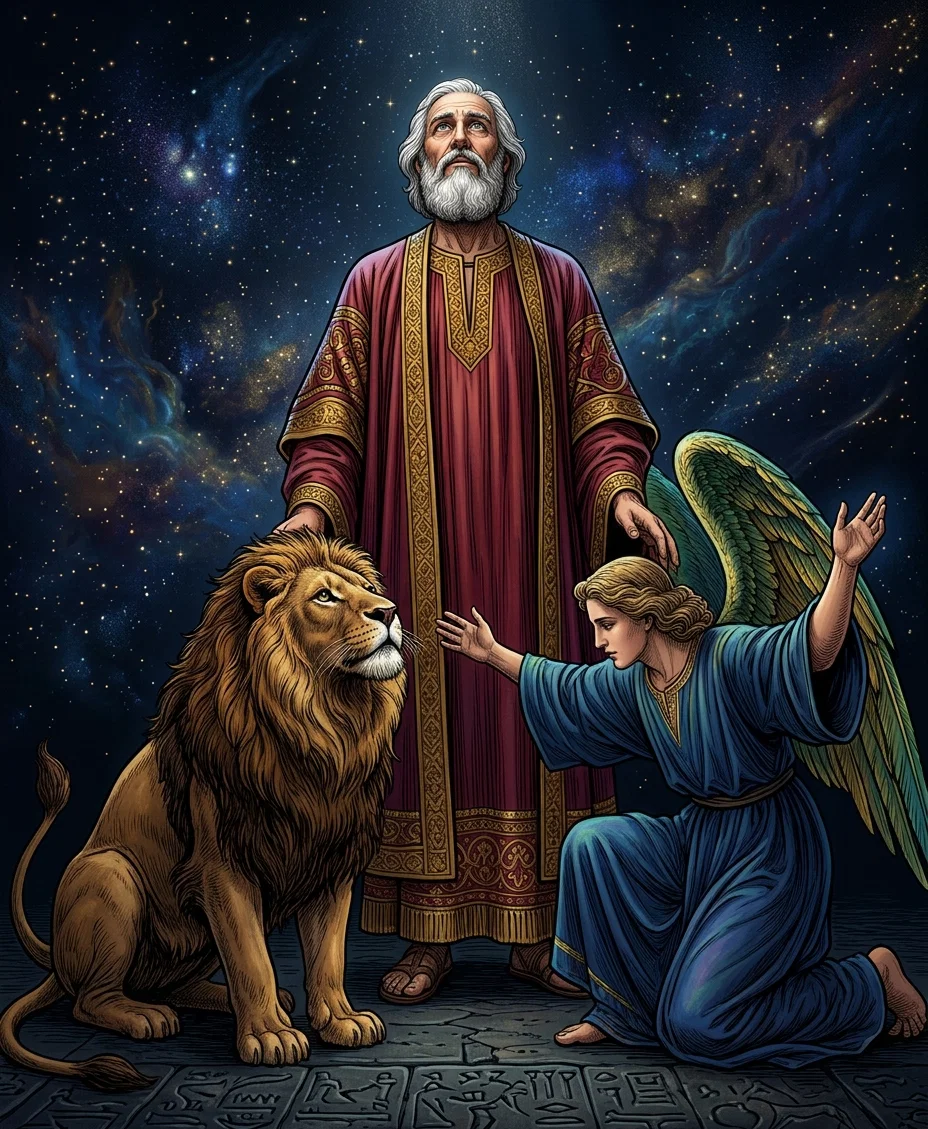
23. How only did the envious princes and rulers under King Darius conclude that they could effect the downfall of Daniel? “Then said these men, We shall not find any occasion against this Daniel, except we find it against him concerning the law of his God.” Dan. 6:5.
24. To this end, what decree did they prevail upon the king to make and sign? “Whosoever shall ask a petition of any God or man for thirty days, save of thee, O king, he shall be cast into the den of lions.” Verse 7.
NOTE.—Unlike the decree of Nebuchadnezzar, this decree forbade the worship of the true God, and was therefore in direct conflict with the first commandment, which forbids the worship of any other than the true God. Like it, however, it was religious and persecuting in character.
25. How did Daniel regard this decree? “Now when Daniel knew that the writing was signed, he went into his house; and his windows being open in his chamber toward Jerusalem, he kneeled upon his knees three times a day, and prayed, and gave thanks before his God, as he did aforetime.” Verse 10.
Christ’s Apostles and the Civil Power
26. Before leaving his disciples, what command did Christ give them? “Go ye into all the world, and preach the gospel to every creature.” Mark 16:15.
27. What counter-command did the Jewish Sanhedrin soon afterward give them? “They called them, and commanded them not to speak at all nor teach in the name of Jesus.” Acts 4:18.
28. What reply did Peter and John make? “Peter and John answered and said unto them, Whether it be right in the sight of God to hearken unto you more than unto God, judge ye. For we cannot but speak the things which we have seen and heard.” Verses 19, 20.
29. For continuing to preach Jesus, what did the Jewish rulers do to the apostles? “Then the high priest rose up, and all they that were with him, (which is the sect of the Sadducees,) and were filled with indignation, and laid their hands on the apostles, and put them in the common prison.” Acts 5:17, 18.
30. What did an angel of God then do? “The angel of the Lord by night opened the prison doors, and brought them forth, and said, Go, stand and speak in the temple to the people all the words of this life.” Verses 19, 20.
NOTE.—Here once again is demonstrated the fact that men have no right to interfere with the free exercise of religion, and that when the laws of men conflict with the law and Word of God, we are to obey the latter, whatever the consequences may be. God himself has set the seal of his approval to such a course. John Bunyan was imprisoned for twelve years for daring to preach the gospel contrary to law.
31. When the apostles were called before the council again, what question did the high priest ask them? “Did not we straitly command you that ye should not teach in this name? and, behold, ye have filled Jerusalem with your doctrine, and intend to bring this man’s blood upon us.” Verse 28.
32. What reply did the apostles make? “Peter and the other apostles answered and said, We ought to obey God rather than men.” Verse 29.
NOTE.—“Obedience is to be rendered to all human governments, in subordination to the will of God. These governments are a recognized necessity, in the nature of the case, and their existence is manifestly in accordance with the divine will. Hence the presumption is always in favor of the authority of civil law, and any refusal to obey must be based on the moral proof that obedience will be sin. . . . It is still true that obedience to human law often involves sin against God and man. There are cases so clear that no one can question the duty to refuse obedience. In all times and in all lands such cases have arisen.” “It is too obvious to need discussion that the law of God, the great principle of benevolence, is supreme, and that ‘we ought to obey God rather than men’ in any case of conflict between human law and the divine.”—“Moral Philosophy,” by James H. Fairchild, pp. 178-181.
Individual Accountability
33. What is religion? “The recognition of God as an object of worship, love, and obedience.”—Webster. Other definitions equally good are: “The duty which we owe to our Creator, and the manner of discharging it.” “Man’s personal relation of faith and obedience to God.”
34. In religious things, whom alone did Christ say we should recognize as Father? “Call no man your father upon the earth: for one is your Father, which is in heaven.” Matt. 23:9.
35. When tempted to fall down and worship Satan, what Scripture command did Christ cite in justification of his refusal to do this? “Then saith Jesus unto him, Get thee hence, Satan: for it is written, ‘Thou shalt worship the Lord thy God, and him only shalt thou serve.’” Matt. 4:10. See Deut. 6:13; 10:20.
36. To whom alone, then, is each one accountable in religious things? “So then every one of us shall give account of himself to God.” Rom. 14:12.
NOTE.—With this agree the words of Washington: “Every man who conducts himself as a good citizen, is accountable alone to God for his religious faith, and should be protected in worshiping God according to the dictates of his own conscience.”—Reply to Virginia Baptists, in 1789.
37. To whom, then, as servants, are we responsible in matters of faith and worship? “Who art thou that judgest another man’s servant? to his own master he standeth or falleth.” Rom. 14:4.
38. Where must all finally appear to render up their account? “We must all appear before the judgment seat of Christ; that every one may receive the things done in his body, according to that he hath done, whether it be good or bad.” 2 Cor. 5:10.
NOTE.—Inasmuch, then, as religion is an individual matter, and each individual must give account of himself to God, it follows that there should be no human constraint nor compulsion in religious affairs.
Sabbath Legislation
39. Who made the Sabbath? “In six days the Lord made heaven and earth, the sea, and all that in them is, and rested the seventh day: wherefore the Lord blessed the Sabbath day, and hallowed it.” Ex. 20:11.
40. To whom does the Sabbath belong? “The seventh day is the Sabbath of the Lord thy God.” Verse 10.
41. To whom, then, should its observance be rendered? “Render to Cæsar the things that are Cæsar’s, and to God the things that are God’s.” Mark 12:17.
NOTE.—When men make Sabbath laws, therefore, they require Sabbath observance to be rendered to the government, or, presumptively, by indirection, to God through the government, which amounts to the same thing.
42. In religious things, to whom alone are we accountable? “So then every one of us shall give account of himself to God.” Rom. 14:12.
NOTE.—But when men make compulsory Sabbath laws, they make men accountable to the government for Sabbath observance.
43. How does God command us to keep the Sabbath day? “Remember the Sabbath day, to keep it holy.” Ex. 20:8.
44. What does he indicate as one of its purposes? “Six days shall work be done; but the seventh day is the Sabbath of rest, an holy convocation; ye shall do no work therein: it is the Sabbath of the Lord in all your dwellings.” Lev. 23:3.3
45. Seeing, then, that the Sabbath is holy, is to be kept holy, and is a day for holy convocations, what must be its character? It must be religious.
46. What, then, must be the nature of all Sabbath legislation? It is religious legislation.
47. When the state enacts religious laws, what is effected? A union of church and state.
48. What has always been the result of religious legislation, or a union of church and state? Religious intolerance and persecution.
Who Persecute, and Why?
49. Because Jesus had not kept the Sabbath according to their ideas, what did the Jews do? “Therefore did the Jews persecute Jesus, and sought to slay him, because he had done these things on the Sabbath day.” John 5:16.
50. Why did Cain kill Abel? “This is the message that ye have heard from the beginning, that we should love one another. Not as Cain, who was of that wicked one, and slew his brother. And wherefore slew he him? Because his own works were evil, and his brother’s righteous.” 1 John 3:11, 12.
NOTE.—The following comment upon this passage by M. de Chesnais, a Catholic priest of New Zealand, is well put: “If you would read the Word of God, you would find that from the beginning all good people were persecuted because they were good. Abel was slain by his brother because he was good, and Cain could not endure the sight of him.”—Kaikoura (New Zealand) Star, April 10, 1884.
51. Commenting upon the treatment of Isaac, the son of Sarah, by Ishmael, the son of the bondwoman, what principle does the apostle Paul lay down? “As then he that was born after the flesh persecuted him that was born after the Spirit, even so it is now.” Gal. 4:29.
52. What other instances of persecution mentioned in the Bible demonstrate the correctness of this principle?
a. Esau, who sold his birthright, persecuted Jacob, who avowed his loyalty to God. Gen. 25:29-34; 27:41; 32:6.
b. The wayward and envious sons of Jacob persecuted Joseph, who feared God. Genesis 37; Acts 7:9.
c. The idolatrous Egyptians persecuted the Hebrews, who worshiped the true God. Exodus 1 and 5.
d. The Hebrew who did his neighbor wrong thrust Moses, as mediator, aside. Ex. 2:13, 14; Acts 7:26, 27.
e. Saul, who disobeyed God, persecuted David, who feared God. 1 Samuel 15:19, 24.
f. Israel in their apostasy, persecuted Elijah and Jeremiah, who were prophets of God. 1 Kings 19:9, 10; Jer. 36:20-23; 38:1-6.
g. Nebuchadnezzar, while an idolater, persecuted the three Hebrew captives for refusing to worship an idol. Daniel 3.
h. The envious and idolatrous princes under Darius, persecuted Daniel for daring to pray to the God of heaven. Daniel 6.
i. The murderers of Christ persecuted the apostles for preaching Christ. Acts 4 and 5.
j. Paul, before his conversion, persecuted the church of God. Acts 8:1; 9:1, 2; 22:4, 5, 20; 26:9-11; Gal. 1:13; 1 Tim. 1:12, 13.
NOTE.—The history of all the religious persecutions since Bible times is but a repetition of this same story,—the wicked persecute the righteous. And thus it will continue to be until the conflict between good and evil is ended.
53. Who does Paul say shall suffer persecution? “Yea, and all that will live godly in Christ Jesus shall suffer persecution.” 2 Tim. 3:12.
54. What is essential to extensive religious persecution? Ecclesiastical control of the civil power, or a union of church and state.
55. Under what terrible deception did Christ say men would persecute his followers? “These things have I spoken unto you, that ye should not be offended. They shall put you out of the synagogues: yea, the time cometh, that whosoever killeth you will think that he doeth God service.” John 16:1, 2.
56. What does Christ say of those who are persecuted for righteousness’ sake? “Blessed are they which are persecuted for righteousness’ sake: for theirs is the kingdom of heaven. Blessed are ye, when men shall revile you, and persecute you, and shall say all manner of evil against you falsely, for my sake. Rejoice, and be exceeding glad: for great is your reward in heaven: for so persecuted they the prophets which were before you.” Matt. 5:10-12. See Rev. 2:10; 6:9-11.
57. What divine precepts received and obeyed would do away with all oppression and persecution? “Thou shalt love thy neighbor as thyself.” Matt. 22:39. “All things whatsoever ye would that men should do to you, do ye even so to them.” Matt. 7:12.
58. What does love not do? “Love worketh no ill to his neighbor: therefore love is the fulfilling of the law.” Rom. 13:10.