Religious Liberty

3%

Review and Herald Publishing Association · Takoma Park, Washington, D. C. · Jun 8, 1916

FromReview and Herald, Vol. 93, No. 28.

Read the full edition

Religious Liberty

By W. A. Colcord

Principles Too Little Understood

One of the most dangerous evils threatening our times is the growing demand for religious legislation. This demand is being urged more and more, and in some instances governments are beginning to yield to it.
Many are led to believe that the remedy for the present widespread irreligion lies through human legislation. Few seem to realize that the use of force in religion is inconsistent with the gospel of Christ, and that in the end religious legislation means religious persecution.
There needs to be a better and more general understanding of the great principles underlying human rights and liberties. Principles which, if universally understood and adhered to, would insure peace on earth and good-will among men, ought not to be ignored nor forgotten.
The principles of liberty are living, ennobling principles. They are recognized or disregarded wherever people live and governments exist. The people of all nations either enjoy the blessings of freedom, or feel the oppressive hand of intolerance and persecution.
To keep these principles fresh in the minds of the people is the only sure way of securing the blessings accruing from them, and perpetuating these blessings to the race. It is because these principles are allowed to be forgotten, and false ideas to spring up and take their place, that they are disregarded. A field, in order to yield fruit, must be cultivated; only weeds, thistles, and thorns thrive without cultivation. It has not yet ceased to be true that “eternal vigilance is the price of liberty.”
Religious liberty is safe only while a knowledge of its principles is familiar to the people. It is to this fact that are due the laws of toleration and religious freedom in many of the modern governments of Europe, America, and elsewhere. Through the great struggles of the past for freedom, the people of these lands became familiar with the principles, and public sentiment demanded their recognition and expression in the laws of the land.

Religious Liberty Endangered

But the histories of these great struggles are but little read, and less studied and talked about, by the masses of today. Few possess or read the works which chronicle these great conflicts for civil and religious liberty. They are not in large demand at the present time. These moral battles, upon the result of which so much depended, and which bequeathed to succeeding generations liberty of conscience and freedom of thought and expression, are not being fought over in the minds of the people today. The great underlying principles which actuated them, and carried them through to a glorious and successful issue, have largely faded from the memory of the present generation; and again the cloud of religious oppression, ever ready to overshadow and sweep away the dearest rights of man, hangs with threatening aspect over the world. Again demands are being made in different lands for legislation in religious things. Organizations have been formed, and dangerous movements are on foot, calling for the enactment and enforcement of laws which will make religious observance compulsory, and failure to comply a crime punishable by the state.
We hear of such organizations as the National Reform Association, the Christian Endeavor Association, the International Reform Bureau, the American Sabbath Union, the Lord’s Day Alliance, and the Sunday Rest League, all church organizations, and all having one object, that of establishing and enforcing religion by law.
All these also are professedly Protestant organizations; but in this work which they are undertaking they are departing widely from the great Protestant principles of religious freedom and separation of church and state. In fact, to gain their object and secure the laws which they desire, they are linking hands with that power which through the Dark Ages claimed the right, and still claims the right, to make use of the civil power for religious ends, and whose history is stained with the blood of many martyrs.
All Christian laws and usages, they hold, should be placed upon “an undeniable legal basis in the fundamental law of the land”; religion, they say, should form a part of the state educational system; and the Sunday should be protected, and its observance enforced, by law.
Although there are many individuals who make no religious profession, all, it is said, should be required to conform to the prevailing religious customs of the land. Although aware that there is not perfect agreement concerning religious beliefs and practices even among those who profess religion, the majority, they say, should rule in religion,—rule, not by the power of argument and persuasion, but by the power of law and compulsion. The state, they hold, should “protect” religious institutions, particularly the Sunday sabbath, by requiring all to observe them. They desire that the state shall become the subservient instrument of the church, and do its bidding.
This, in brief, is their theory. Reformation by law is their policy. To this end they hold mass meetings, conduct conventions, lobby legislatures, circulate petitions, campaign States, use the boycott, and scatter their literature. And because of the political influence which they are able to exert through the churches and through various church organizations, they are making themselves felt in legislative assemblies. Men are found there, or if not found, are sent there, to introduce and champion their measures. Already within the last few years, acting under pressure from this source, the Congress of the United States has passed several Sunday-closing measures; and others of a like nature are being urged and demanded. The most determined efforts are being put forth to get the national government thoroughly committed to a course of religious legislation.

What the Movement Means

Many connected with this movement are doubtless honest, earnest, conscientious men and women. They are seeking to better existing conditions and to inaugurate a needed religious reform. But they do not understand the character of the movement in which they are engaged, nor perceive to what it will lead. In asking that religious observances shall be made compulsory, they do not see that they are working upon wrong principles. Neither Christ nor his apostles ever once appealed to the state to enforce their teachings. When any religion becomes a religion of civil law, it ceases to be a religion of love. True religious reforms are accomplished, “not by might, not by power, but by my Spirit, saith the Lord of hosts,” Zech. 4:6.
The church proclaims her lack of love and divine power wherever she seeks to carry on her work by coercion and the power of the state. While retaining the form of godliness, she denies the power thereof. 2 Tim. 3:5. The early church derived her marvelous power, not from politics, but from Pentecost. She made her way in the world, and gained her greatest victories, in the face of opposition and adverse laws. But when she became united with the Roman Empire the empire fell, and the church lost her purity and power and became a bitter persecutor.
So the success of the present movement for religious legislation means the uniting of church and state, the subversion of civil government, the decline of piety, faith, and genuine religion, and the end of civil and religious freedom. If it succeeds, the rights of conscience will be invaded, religious persecution will be revived, and, in the face of oppression, men will again have to choose whether they will obey God or men.
Any movement, however mild and Christian at first in appearance, which seeks to advance religion by religious legislation, will, when fully developed, manifest the same intolerance and oppression that have prevailed in past ages. Human councils then assumed the prerogatives of Deity, crushing under their despotic power liberty of conscience, and freedom of speech and action. Imprisonment, exile, and death followed for those who opposed their dictates. If this principle shall again be legislated into power, the fires of persecution will be rekindled against those who, like Daniel and his companions, will not sacrifice conscience and the truth in deference to popular errors. History will be repeated.
Connected with this movement may be reforms which the people need; but this only makes it the more dangerous and deceptive. Error mixed with truth is the most dangerous form of error. In the forbidden fruit “good and evil” were combined.
The true character of proposed measures for religious legislation may be carefully concealed, or be justified by arguments apparently sound and convincing; but if the evil principle is there, evil results must surely follow their enactment. Any teaching contrary to the religion or religious practices thus established would be considered “dangerous heresies,” and “heretics” treated as in the past, when church and state were united, and ecclesiastical establishments had their way.
Already some organizations connected with this movement are employing paid spies, or detectives, to go about on Sunday to see who are not observing the day, and to act as witnesses in prosecuting such under existing Sunday laws. How long the rights and liberties of the people would be respected should such an element gain control of the civil power is not difficult to see.
One branch of this movement, the International Reform Bureau, of Washington, D. C., has gone so far as to have literature advocating “more Sunday legislation” published by the government of the United States as government documents, which it has been sending out under the government franking system, free of cost. To what length it would go if permitted may readily be conjectured.

The Basis of True Freedom

So long as there is no religious legislation, every individual is left free to worship, or not to worship, when, where, and as he chooses. But the moment law is applied, this freedom is gone. Some one’s rights are invaded. And although all but one were favored by the law, and this one’s rights were infringed, this would be an unanswerable argument against it. Christ was crucified on the pretext that it was better that “one man should die” than that the whole nation should perish. John 11:47-50. Religious rights is not a question of numbers. The rights of the few are as sacred as those of the many.
It is hard for men to learn that the same rights which they claim for themselves they are in duty bound to extend to others, however widely they may differ from them. Men may be quick to recognize and claim their own rights, while they utterly ignore and trample upon the rights of others.
No man himself desires to be coerced by others as to what he shall believe and practice; and no one ought therefore to assume or claim the right to coerce another in this respect. The liberty which each desires for himself he should freely grant to others. For each to demand his own rights is not the basis of true liberty. Each must recognize and respect the equal rights of others, before freedom is insured. This is the golden rule of life: “Whatsoever ye would that men should do to you, do ye even so to them.” This is the true panacea for all bigotry, intolerance, and oppression.
The state exists to protect rights, not to invade them. The church is ordained of God to convert and save men, not to persecute, fine, and imprison them. The whole principle of religious persecution is contained in the plea that religious observances ought to be enforced by the civil power. God is never honored by disregarding God-given rights. And as such, no body of men has the right to dictate by law what the religious faith or practice of any other man or body of men shall be.

Important Questions

Shall the principles of religious freedom be kept alive, or shall we let them die? After reaching an age of light and liberty, shall we go back again to an epoch of darkness and oppression? Shall our children be taught the blessings and the value of the rights and liberties so long enjoyed, or shall they grow up in ignorance of them? Shall the rising generation hear first the clear, logical voice of freedom and truth, or the ingenious sophistries which justify intolerance and persecution? Shall religious bigotry be allowed to rear its hideous head again over the world, and be no protest made, no note of warning given?
God made man to be free. From the beginning, the enemy of God and man has sought to make men the slaves of men. The carrying out of this policy, at the basis of which is selfishness, the root of all slavery and sin, has caused a large share of all the misery, vice, and wars of the world.
In every home, in every church in the land, the principles of religious liberty should be taught, together with the history of the great struggles of the past for freedom. All should know at what cost our liberties have been purchased.
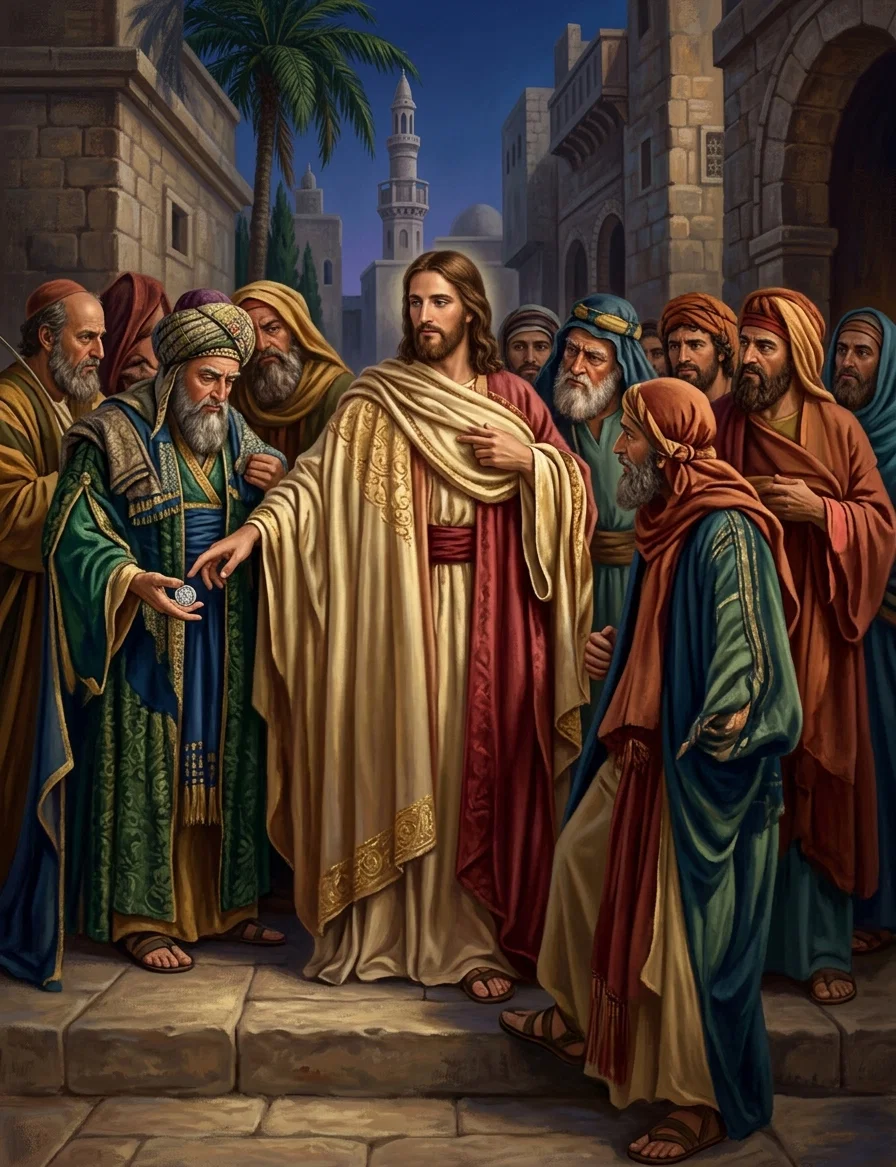
There is need of a general awakening in regard to the dangers which threaten to overthrow human rights, and take peace and prosperity from the earth. There is need of setting forth again the great fundamental principles of civil and religious liberty. The teachings of the Bible concerning natural, God-given rights of man, and the rightful province of the state and the church, need to be defined again in the light of Christ’s words: “Render therefore unto Cæsar the things which are Cæsar’s; and unto God the things that are God’s.”
“RENDER THEREFORE UNTO CÆSAR THE THINGS WHICH ARE CÆSAR’S; AND UNTO GOD THE THINGS THAT ARE GOD’S”