BECAUSE Sunday is an institution of the church, and is therefore religious.
Because legislation in reference to a religious institution is religious legislation, and the passing of such laws is a long step toward the union of church and state.
Because, as James Madison says, “there is not a shadow of right in the general government to intermeddle with religion. Its least interference with it would be a most flagrant usurpation.”
Because, as expressed in the protest which gave rise to Protestantism, “in matters of conscience the majority has no power.”
Because Sunday laws mean enforced idleness, and idleness fosters intemperance, vice, and all other crimes.
Because, while frequently urged as temperance and other reform measures, their real and ultimate object is the compulsory observance of the day.
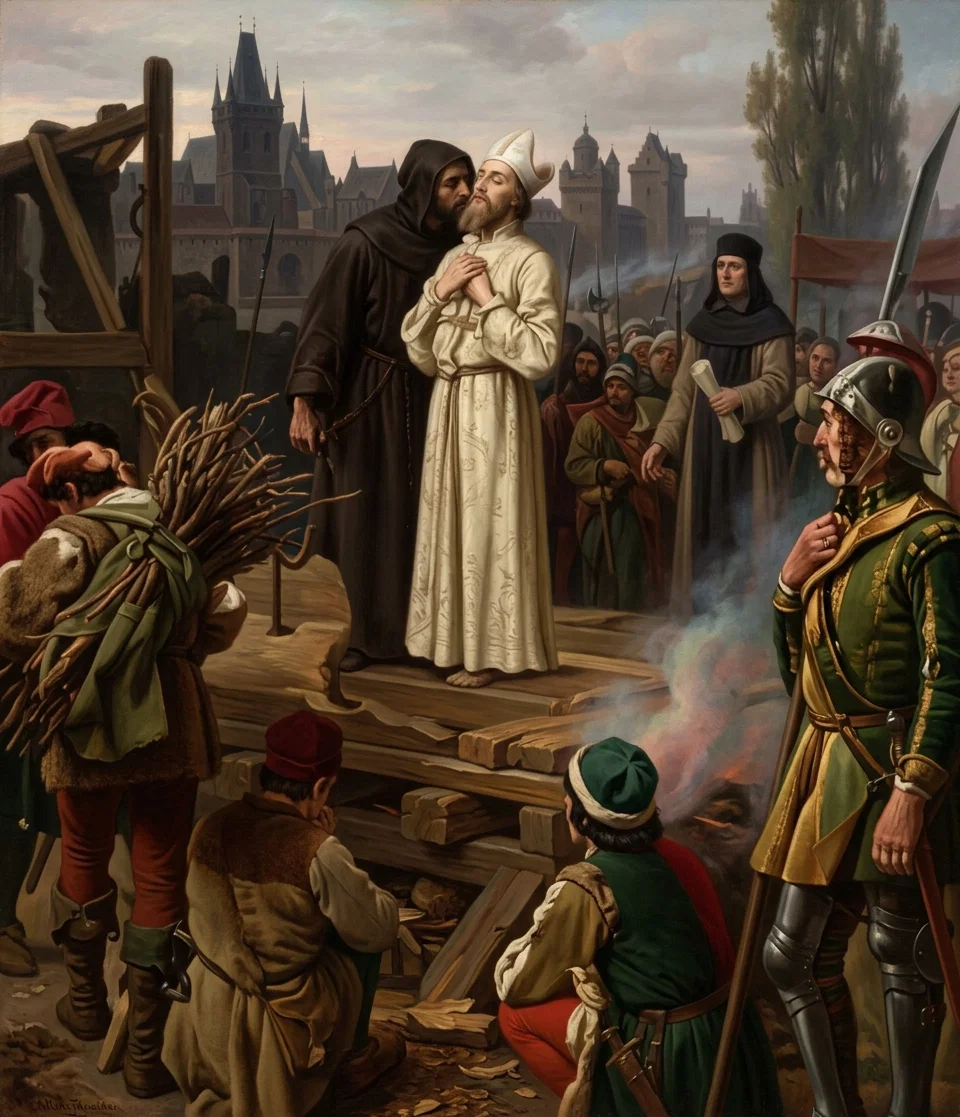
THE MARTYRDOM OF JOHN HUSS
Because, although professedly in the interest of the laboring man, such laws really enslave all labor. The assumption of the right to forbid honest labor on one day of the week involves the right to forbid it on any or all days of the week.
Because, as Neander informs us, they were the means through which church and state were united in the fourth century; and instead of preserving the Roman Empire, they contributed largely to its downfall.
Because they interfere with the religious freedom even of those who regard Sunday as the Lord’s day.
Because their whole tendency is to make men hypocrites instead of Christians.
Because they are both un-American and unchristian.
Because they require that men shall render to Caesar that which belongs to God.
Because, as stated in the Memorial of the Presbytery of Hanover to the Virginia General Assembly, in 1776, “the duty which we owe to our Creator, and the manner of discharging it, can be directed only by reason and conviction, and is nowhere cognizable but at the tribunal of the universal Judge.”
Because it is the very genius of Christianity to grant to every man the right to believe the gospel or not to believe it, to obey the divine law or not to obey it; and what the Author of Christianity has granted, no authority has the right to abridge or take away.
Because they deprive a considerable and respectable portion of the Christian community—the observers of the seventh day—of one sixth of their rightful working time.
Because they make criminals of a class of citizens against whom no criminal charges ought to lie.
Because they make criminal on Sunday acts which on any other day of the week4are considered perfectly lawful and right. Honest toil and innocent recreation and amusement, while not consistent with proper Sabbath observance, are not crimes on any day. Crimes are not determined by the day of the week upon which they are committed.
Because Sunday laws are contrary to the principles of the gospel and of good government, and are in direct conflict with the law of God. They enforce a rival to the Sabbath appointed by Jehovah. If it is wrong for the state to enter the domain of religion and enforce the Sabbath observance of the day divinely appointed, it cannot be right for it to enter this domain and enforce the Sabbatical observance of a day not thus appointed.
Genealogy of Sunday Laws
[The following statements are not direct quotations, but merely statements of fact in the form of quotations.]
YOUNGER STATES OF AMERICA: “In Sunday legislation we have followed the example of the older States.”
OLDER STATES: “In Sunday legislation and judicial decisions we have followed the example of the oldest States.”
OLDEST STATES: “In the matter of Sunday legislation we have followed the example of the original colonies.”
ORIGINAL COLONIES: “In the matter of Sunday legislation we have followed the precedents and example of old England, which had an established religion and a church-and-state system.”
OLD ENGLAND: “In the matter of Sunday laws and religious legislation, they are the relics of the Catholic Church, incorporated among us when that church was the established church of the empire. When Henry VIII, about 1544, renounced allegiance to the Pope, we retained, and are still cherishing, these legal relics.”
CATHOLIC CHURCH: “Sunday laws and religious legislation were incorporated in our church by the craft, flattery, and policy of Constantine and the ambitious bishops of his time, together with the decrees of the popes and councils of later date, by which we transmitted the ‘venerable day of the sun,’ the ‘wild solar holiday of all pagan times,’ into the Christian Sabbath, in honor of the resurrection.”
PAGANISM: “With us, Sunday observance originated in sun-worship, the day on which the Almighty began his work of creation, and on which light was created, the day, the first in the week, being dedicated by us to the greatest, the brightest, and the most luminous visible object in the heavens, the sun.” See Rom. 1:21-25; Eze. 8:15, 16.