The Success of Islam

6%

Review and Herald Publishing Association · Takoma Park Station, Washington, D. C. · Jul 13, 1916

FromReview and Herald, Vol. 93, No. 35.

Read the full edition

The Success of Islam

F. H. LOASBY
Looking back to the time when Mohammedanism, spreading out from its seat in Arabia over vast stretches of territory, crossed over from Africa into Europe itself, only to be stopped by an almost superhuman—shall we say entirely superhuman?—effort, with its eyes of conquest still fixed on the great capitals of Christian Europe, many think, “That is history; that was the time of Charles Martel and the Battle of Tours!”
But what about today? The people in the homelands perhaps seldom realize what gigantic strides Islam is making. Like a great, swelling tide it is rolling over the fields where Christianity should already be established.
We should never forget that Islam is practically supreme in the very countries—yea, in the very spots—held sacred to the memory of the Son of God himself; places watered with the tears of Christian saints. Christianity itself is an Oriental religion, and naturally one would think its seat and stronghold ought to be where the Crescent is firmly fixed today. But Christianity has not been true to itself. Mohammedanism, at least outwardly, is true to itself, and its followers are in dead earnest.
Whence comes the success of Islam? A book might be written on the subject. I merely append a few of my own personal and daily observations. My Mohammedanmoonshee refuses to read books for the prescribed examination course, because they are opposed to certain teachings of the Koran. Does the European merchant cease to send manufactured idols to India for the “heathen” to worship? or whisky and cigarettes to ruin the same “heathen’s” soul and body?
While interviewing a native officer regarding some land a few days ago, his aged uncle, when the time of prayer came, solemnly spread his prayer mat in one corner of the ten-by-twelve room, as was his custom; and, undeterred by the presence of strangers, went through the usual movements and genuflections, which are not few.
One Mohammedan owner of a small bakehouse near by keeps an ebadat gah, or prayer place, on the premises, so that his workmen may attend to their devotional exercises. This is quite a common practice. “Comparisons are odious,” we say; but how many “successful” business men in Europe or America ever trouble their heads about the spiritual welfare of their employees?
A Mohammedan clerk, perhaps, goes out to Africa in the employ of the British government. He is not there long until he begins preaching, and soon there is a small body of people who are believers of that faith which most men have always found easy to accept. This is the scene everywhere we go. In the bazaar, on the train, on the steamship, in the courtyards of government offices (where prayer places have been provided), you will see the Mohammedan, at the appointed time, oblivious to all around, engaged in his devotions.
These are only a few of the small things, and some people term them “externals;” but the fact remains that it is these ideas of constant and untiring effort, whether small or great, that have placed the Mohammedan religion in the lands where it is today.
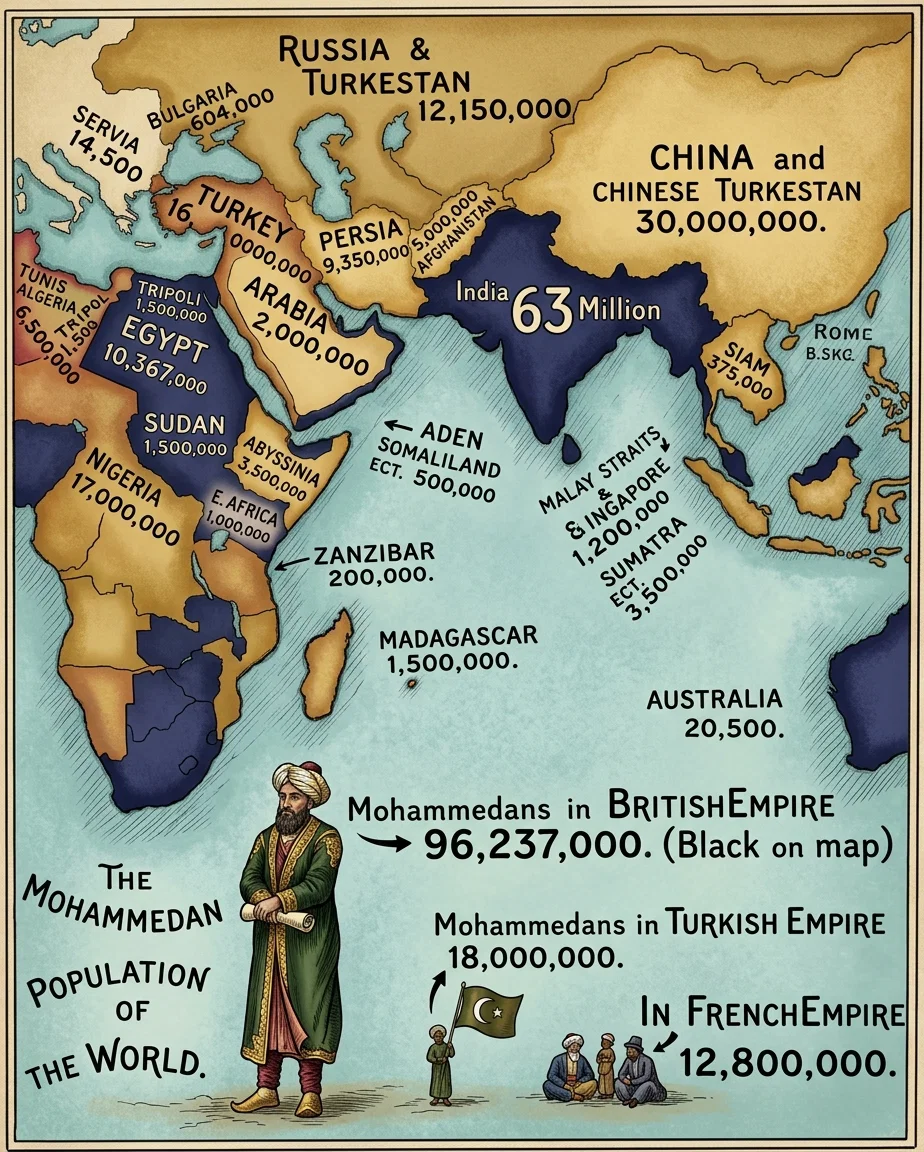
Some idea of the spread of Islam will be gathered by glancing at the accompanying map. Man’s supreme belief that he is doing the right thing, develops a force which no power on earth can overthrow. And the Mohammedan has that belief in his religion.
We in India are concerned with the problems of India; and one of India’s greatest problems, to the missionary, is that of Islam. Great Britain is the greatest Mohammedan power in the world, for there are a far greater number of Mohammedans in the British Empire than in any other country or empire in the world. Of the 96,000,000 Mohammedans in the British Empire, 63,000,000 are in India.
When it became apparent that Turkey was to enter the great war on the side of the enemies of the British government all eyes were turned toward India, for obvious reasons. The question was, “What will be the attitude of Moslem India?” Doubts in the matter were soon set at rest by the astonishing and universal response of Mohammedan India. Indian princes and rulers, often at the head of their own state troops, offered their services. Men and means poured in from every part of India. Train after train brought thousands into Bombay, the “Gateway of India.” Fine specimens of manhood, surely! such a galaxy of color and collection of “might” as that we dream of when we read of the great preparations for war by Xerxes the Persian, but now furnished us in this time of the world’s greatest war.
What will be the situation at the close of the war? One thing is certain, all India expects something. Among other demands for improved conditions, is a cry that is already assuming a loud voice, and that is, a better educational system, so that the native shall have free access to schools—“more educational advantages.”
(To be continued)
Drawn by F. H. Loasby
MAP GIVING MOHAMMEDAN POPULATION OF THE WORLD
Drawn by F. H. Loasby MAP GIVING MOHAMMEDAN POPULATION OF THE WORLD