General Meetings in Austria and Spain

9%

Review and Herald Publishing Association · Takoma Park Station, Washington, D. C. · Dec 21, 1911

FromReview and Herald, Vol. 88, No. 51.

Read the full edition

General Meetings in Austria and Spain

L. R. CONRADI
FROM September 12 to 28, the writer visited Vienna, Paris, and Barcelona. Our meeting in Vienna was held first. Brethren J. G. Oblander, J. F. Huenergardt, and the writer were present to assist in the meetings. The growing work of Austria was represented by fifty delegates, and a large attendance of our brethren in general. The membership has increased during the last twelve months from 188 to 372. The tithe has been nearly tripled. In spite of the many difficulties that our work incurs, and the great restrictions, the message steadily advances.
From Jan. 1, 1912, this important field will be divided into three different fields: Bohemia, with a population of nearly 7,000,000; Moravia-Silesia, with nearly 3,000,000 inhabitants; and the remainder, including the rest of Austria outside of Galicia, will contain about 10,000,000 people. The membership is quite evenly divided among the three fields. Here, as elsewhere, the great lack is workers; and here especially we must have native workers, on account of the restrictions.
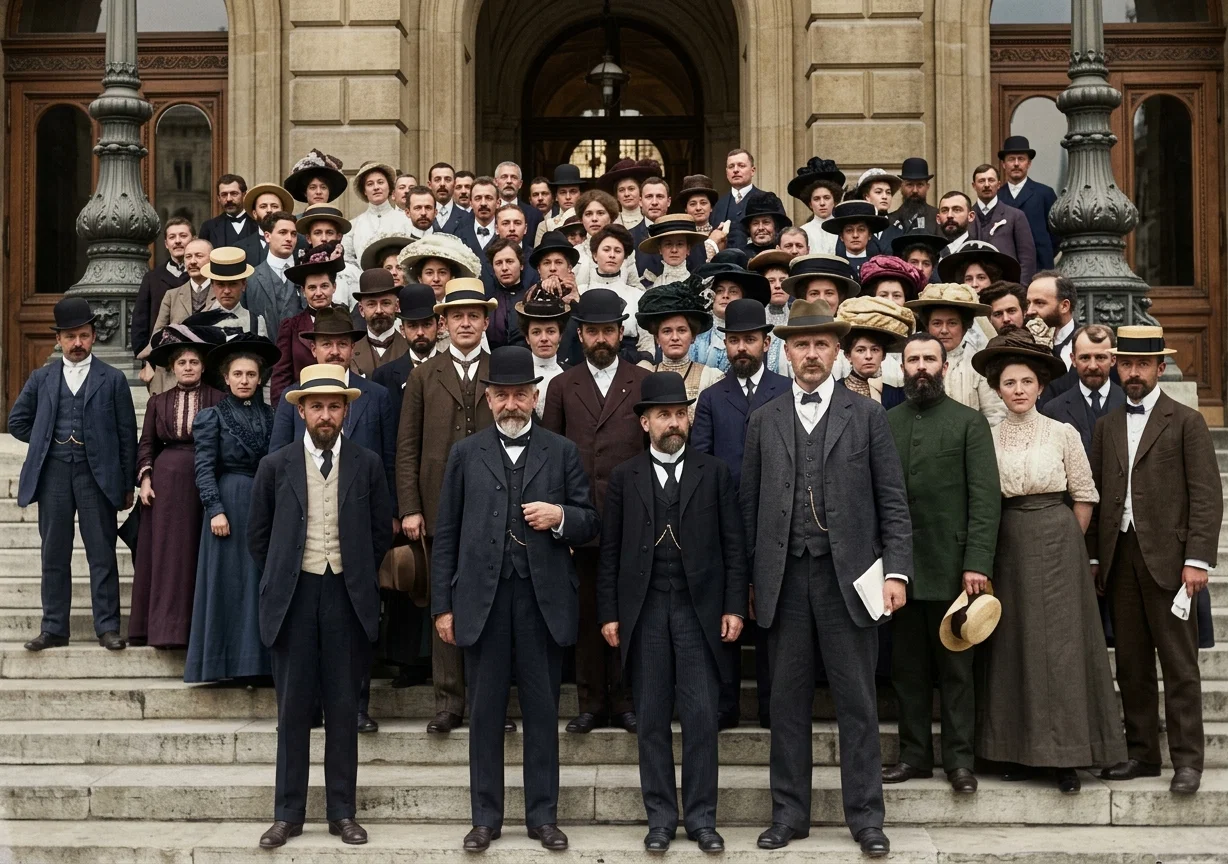
All we could give to these large divisions was fifteen gospel workers, and each division has only one minister, the superintendent. Brother Reihlen was ordained to the ministry. Over $400 was voted for the mission fields beyond. We surely ought to remember Austria in our prayers, that the Lord may send forth more laborers into this needy field. The accompanying illustration shows a number of our Austrian members in front of the Vienna city hall.
AUSTRIAN BELIEVERS (CITY HALL, VIENNA)
At the French capital, I spent several days with Brethren L. P. Tieche and E. Robert in counsel. From here Brother Tieche and I proceeded to Barcelona. There were constant rumors of revolution in Spain, but, thank the Lord, when we reached the place, somewhat late, we found convened the largest meeting we ever had in Spain, and an excellent spirit prevailing. Of our ninety members, something like sixty had come together, and all our workers were present. Brother John Brown and Brethren W. G. and Frank Bond did all they could to instruct the workers and to encourage them. Brother E. Borle had been here for some time to investigate again the possibilities of our printing Spanish literature in this city, or its suburbs. Barcelona is a city of half a million, and is a most important seaport, having the best of connections with every part of the world. All publications which are shipped into Spain are subject not only to high duties, but also to a very severe press censorship, so that it is almost impossible for canvassing work to be carried on if it is dependent upon publications from without.
Our six Spanish canvassers in the field had thus far sold mostly our papers and tracts; but when Brother Brown came, he at once took up the work with big books, and found the prospects as promising in Spain as they are in Mexico. One of the first orders he took was secured from the governor.
We are sadly in need of some large books, printed in the country itself. But all can readily see that if we print these books only for Spain, we shall have to print small editions, and the books will be necessarily expensive. But if we can cooperate with our brethren in other Spanish-speaking fields and print larger editions of some of the books, they, as well as we, will reap the benefits.
When we take into consideration that Spain alone has a population of 19,000,000,—nearly equal to the Spanish population of South America,—we can at once see the importance of doing all we can to put the work in this hardest of all Spanish-speaking countries upon the most favorable basis. The highest of all considerations is not the employment of our people, nor the growth of business; it is the salvation of souls; and with this in view there is but one thing to do,—to commence the publishing work in Spain. The more countries shut themselves in by high tariffs to protect their own trade in the ever-increasing competition, the more they look down upon anything that comes from without. The difficulty of selling our books in Catholic countries is greatly increased where these publications must be imported.
The Spanish field had twenty-four additions during the first half of 1911. It will soon have its first one hundred members, and the canvassing force must be strengthened. We enjoyed this meeting with our Spanish people very much, and we are sure that brighter prospects are before the field.