Little Russia

5%

Review and Herald Publishing Association · Takoma Park Station, Washington, D. C. · Jan 18, 1912

FromReview and Herald, Vol. 89, No. 3.

Read the full edition

Little Russia

J. T. BOETTCHER
ACCOMPANIED by Elder John Perk, I have made my first extended visit among the Russian villages of this interesting field.
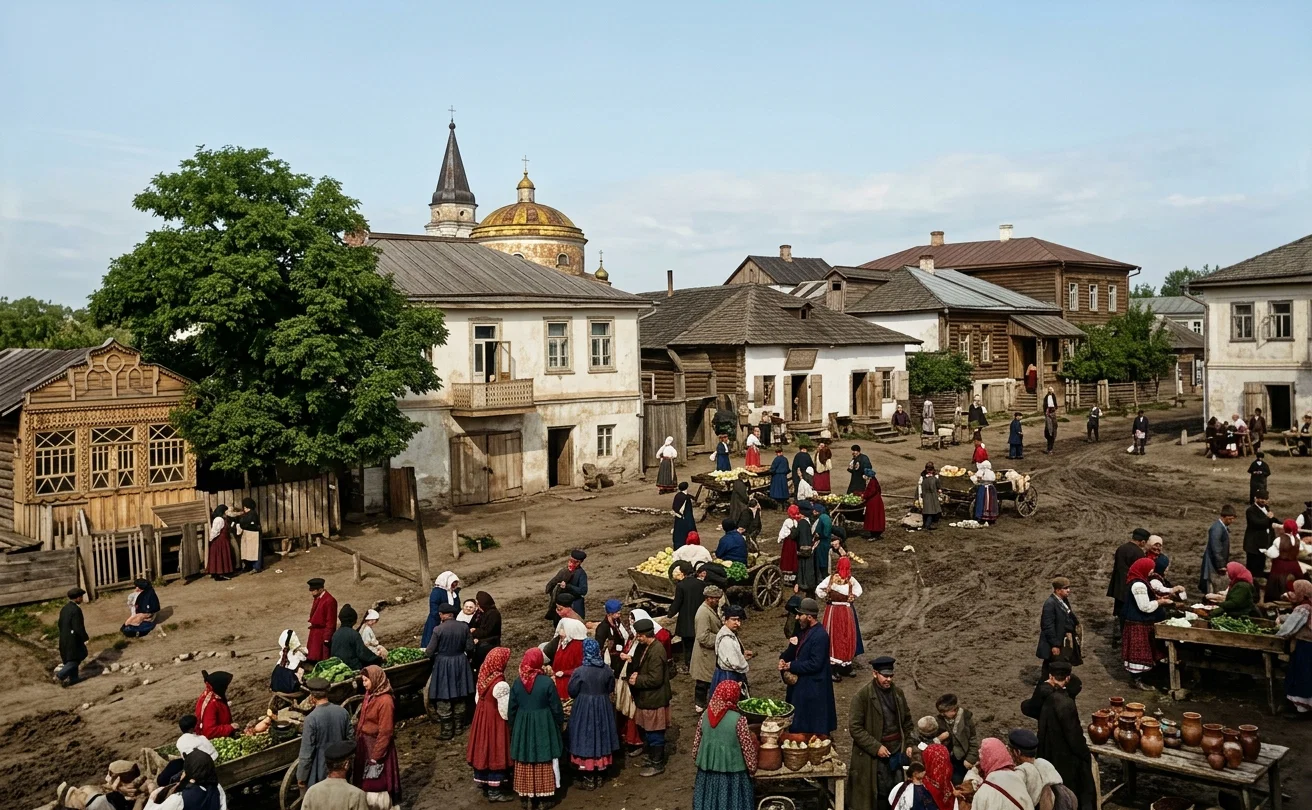
SUNDAY MARKET IN BOGOSLAW, LITTLE RUSSIA
Fifty years ago most of the Little Russians were vassals, and the effects of this kind of slavery still cling to them. They are free, but nothing has been done to better their condition. It is reported that many even wept upon learning of their freedom, as they did not know what to do or how to care for themselves. Is it not the same with Christ’s kingdom? The fact that we are free will not help us unless we know how to accept of the pardon, and grow in grace.
These people are so poor, and lead such miserable lives, that one wonders how they exist at all. They have no beds, and during my whole trip I did not see a single commode or chest of drawers for clothing. A cook-stove they do not know, doing all their cooking in a sort of oven. The utensils used are simply large earthen mugs, which they push into the oven by means of an iron fork. Thus the food is stewed rather than cooked.
In every-day life very little cooking is done, the bill of fare consisting largely of bread and salted cucumbers. Their only table furniture is wooden spoons; grains, potatoes, and all solid foods are taken with the fingers from one common dish.
The family in whose house the meeting is held is generally expected to furnish food to all who attend. Whether the people come from far or near, after the meeting all are invited to eat. The hospitality of the people is exemplary: they give the best they have, and generally enough of it.
The houses have clay floors, which are strewn with cut grass and flowers, or sometimes hay. The walls are very plain, and aside from a picture of the czar, have no decoration. Sometimes, however, a strip of wall-paper is laid lengthwise across the ceiling.
When the house was too small, we held our meetings in the barn. Seats were seldom provided; but if there were any, they were occupied by the men, while the women remained standing, perhaps each one holding a child in her arms. These people are accustomed to stand in a meeting, for in the Russian Orthodox churches there are no chairs.
One is astonished, however, to see with what interest they listen to the preaching of the Word of God. Perhaps this is due to the fact that most of them can neither read nor write. In one small meeting I asked how many could not read, and twenty-five raised their hands.
What can be done to help these poor people? There are very few schools, only now and then one. The children grow up with the cattle, out in the fields. They herd the cows, sheep, geese, and swine, and thus pass away the time. I thought to myself, What a great blessing it would be if one could only go out into the fields and teach these children. But no one is allowed to build schoolhouses, and teach the children. In Africa this can be done, but not here. God himself must work for these poor little ones, and show us the way; for they too must learn of a loving Saviour who died for them.
At one place where we were holding an evening meeting and the young people of the village were present, the police came and drove them all out. They were so frightened that they almost fell over one another as they hurried away. Only our own people were allowed to remain. The meeting had to wait until our passports had been examined, and noted down, and the officer satisfied. But we had already held one meeting in the afternoon of that day, which was attended by so many that neither the house nor the barn would accommodate theaudience, so we held it in the open air under the trees. The people sat down in groups and listened to the Word of God. Had the police appeared then, they would have driven the people away and put us in prison. But our God and Father kept them away. We risk much because we know that it is God’s cause.
In our work here we are often forcibly reminded of the experiences of the early Christians. But God helps us in these experiences. He is strong and mighty, and we fear nothing but sin.
Our people have a very hard time indeed. They are closely watched lest they may hear something new. For instance, Brother Perk had written to one of our churches, telling them of our coming visit. As there is no post-office in the village, all the mail is sent to some place of business. I have seen villages of more than seven thousand inhabitants, without even a mail-box, and miles away from a post-office. Such was the case in this village. In the store where the mail is received, it is read before being delivered. Thus it became known that we were coming, and the police were informed and persecution began. It is not expected nor desired that these people should come in contact with the outer world. I can now understand why it is that our people so often fail to get the papers and other reading-matter sent to them.
A newspaper is unknown in this part of the world. We can hardly understand how difficult it is to get the truth before a people like this. All instruction must be given orally. Yet it is remarkable how well they can repeat what they have heard. One tells another, and in a short time the whole village knows the news. In this way, too, the message of truth goes. What they have understood they remember, and they sit and talk together for hours. They have plenty of time.
We have learned of another village where more than two hundred persons are keeping the Sabbath of the Lord, and we are planning to send a worker to teach them.
The Lord blesses the work of his servants. We have thus far baptized twenty-six, and organized another group of eight, thus taking into the church over thirty new members. The tithes and offerings also are increasing. The work is growing, and Brother Perk is not able to answer all the calls that come for help. Brother and Sister Swiridow are at work in Charkow. Brother Gontar has had to leave Uman because no one would rent him a lodging. Another worker is sick, and a fourth in prison, though by the grace of God the latter’s prison sentence has been somewhat shortened.
During the second quarter, the membership of this field was 605, but for the third quarter it will be about 650.
I am thankful to God for his guidance and protection. We know, too, that we are remembered by those in the home land, at the throne of grace.
Riga. Russia.