On Thursday last we commenced our teachers' school at Malamulo. We plan to continue it two months before sending our boys out again to teach in the village schools. We believe that during this time the Lord will help us to prepare for the great work that stands like a mountain before us.
A few of the teachers of last year seem to have fallen out by the way, but we hope to have sufficient to occupy all the schools which were in operation last year.
As I look at the mission church record, and, in fact, at everything connected with the mission, I can realize how much hard, faithful work has been done by the workers in this land. I pray that we who are now connected with this mission may have your prayers that the work may be carried on in God's own way.
On the church record there are ninety-seven names. Some of these persons have been connected with the church seven and eight years, and although many have been drawn away into the world's whirlpool, yet we have courage to labor on because we have a good company of faithful native workers, and also because Jesus is the “captain of the host of the Lord.”
Eight persons were baptized in 1905, and five of these are among our most faithful workers. One of these is Moses, who spent his early life in slave-trading. Now he is helping to catch men and women for Christ. One of the eight reports a class of twenty-five persons who have been in the candidates' class for baptism for three years. We hope to have them ready for baptism when Pastor Porter visits us in May.
Our Sabbath meetings are well attended, and all listen with much interest to the instruction. Brethren S. M. Konigmacher and G. A. Ellingworth, and I take turns in preaching at the after-meetings. Brother Ellingworth and I have to use an interpreter, but Brother Konigmacher is very fluent in the Chi-mang’-anja, and preaches without any difficulty.
The farm work is very disappointing this year, as we are so short of labor and can not cultivate all our crops. The work is all done with native hoes, and consequently it is a slow process. We hope to get some farm implements soon, and make use of our oxen another year.
We have recently lost nine head of cattle through the tsetse, and others are sick. We have abandoned the kraal for the present, and have built temporary structures for the cattle on higher ground. These measures will, we hope, prevent any more cattle from being infected. It makes our hearts sore to see the fine cows dying one by one, when we can do nothing for them.
We are all in good health and are enjoying the work. At present the roses and flowering shrubs are in bloom, and as there are plenty of trees all around us, this place is really beautiful. Fruit, too, is plentiful and good.
We are glad that permission has been granted us to enter Portuguese territory, and we would like to open stations both to the east and to the west of Nyassaland. But one condition of entry is that the workers first pass an examination in the Portuguese language, and we have no one here who can do that at present.
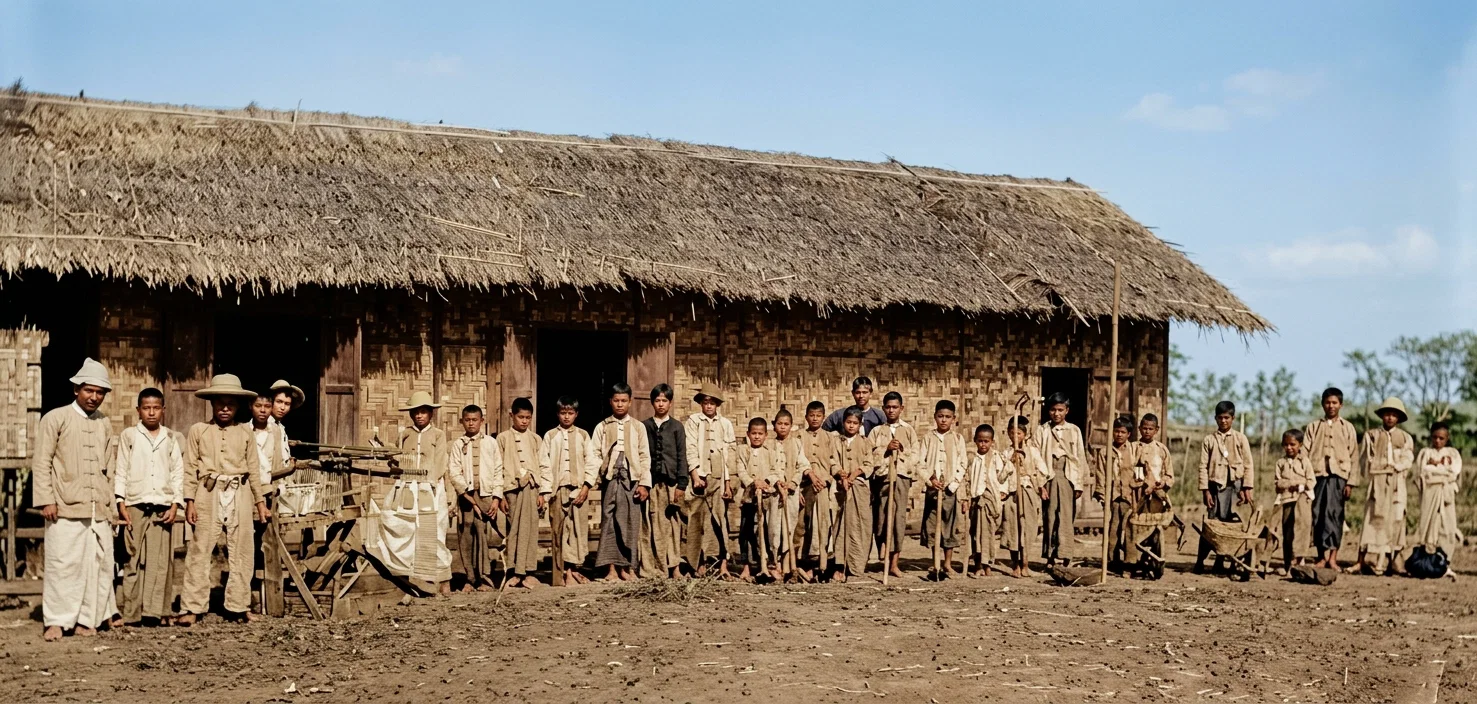
MEIKTILA INDUSTRIAL SCHOOL, BURMA
How much we need your prayers for God's help. As we think of these thousands of people living in gross darkness and superstition all around us, and of our slow, feeble efforts to reach them, we exclaim, How can we, by our present methods, finish the work in this generation? and the answer seems to be, God only knows.
And so, while difficulties are ahead, the outlook is encouraging, and by the help of God and your prayers, we mean to press on with the work.