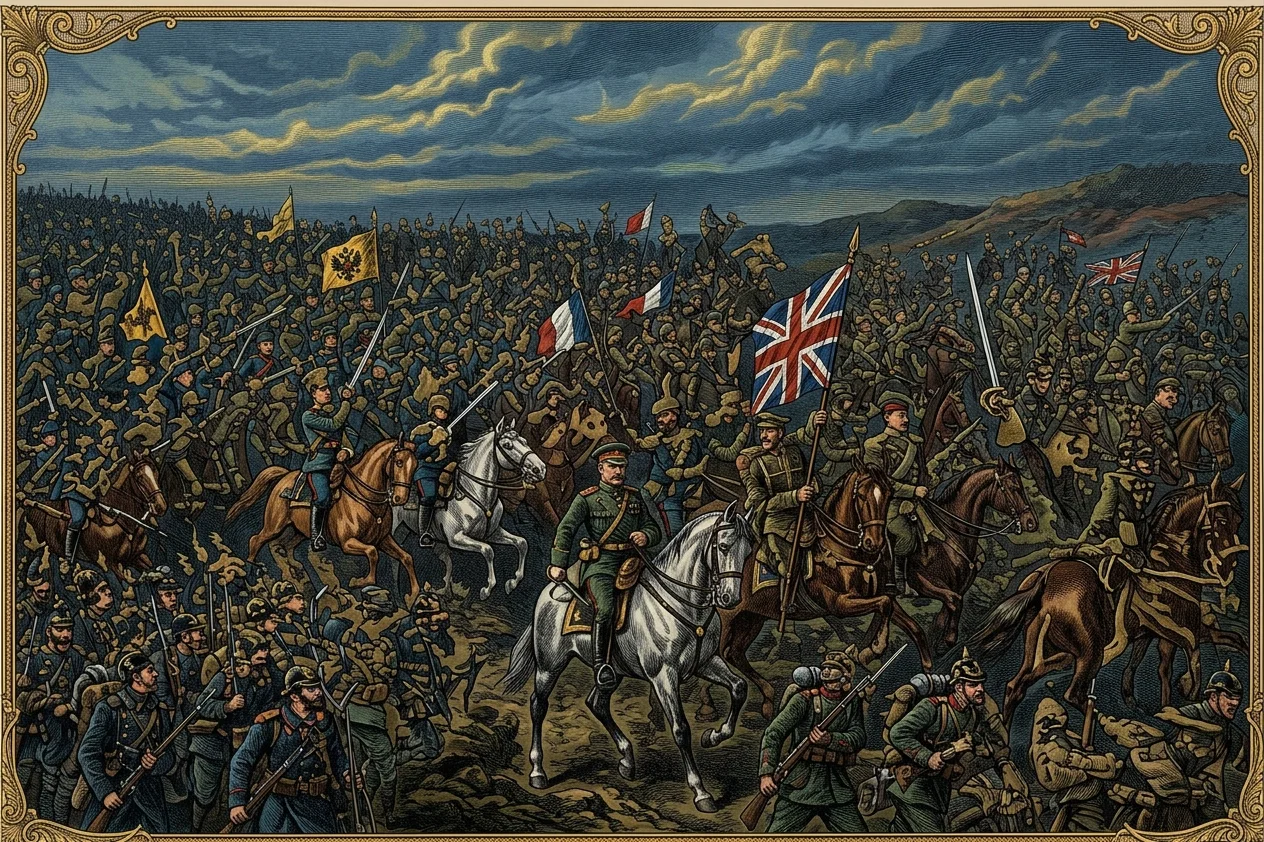
The great war of the centuries is now being waged. Not within the history of the world have such gigantic forces of men and armament been pitted against each other on the field of mortal combat as are now engaged in the European conflict. At the time (August 12) United Germany and Austria are opposed to the combined forces of Great Britain, Russia, France, Belgium, and Servia. Other powers have declared their neutrality; but as the conflict deepens and complications arise, these, too, may be drawn into the strife.
Practically all Europe is a great armed camp, a veritable battle field of contending armies. Before the beginning of actual hostilities, when efforts were being made to bring about a settlement of differences between Austria and Servia, Sir Edward Grey declared that if these efforts were ineffectual, “the greatest catastrophe which can befall the concert of Europe will result, and its consequences will be incalculable.”
The Conflict of Mighty Forces
Mighty forces are drawn up in battle array. Never has the world witnessed such an alignment of contending human elements. This is evident as we consider the strength of the armies engaged in the struggle for supremacy.
The fighting strength of six nations engaged in this terrible conflict is given as follows:—
Fighting Strength of Nations Engaged in Terrible Conflict
Country
Peace strength
Reserves
War strength
Total of others available for war—underaged
Germany
870,000
4,430,000
5,200,000
1,000,000
Russia
1,200,000
3,100,000
5,200,000
5,200,000
France
720,000
3,280,000
4,000,000
1,000,000
Austria
360,000
1,010,000
1,000,000
3,000,000
Servia
52,000
320,000
361,000
150,000
England
254,500
476,500
730,000
2,000,000
Totals
3,556,500
13,425,500
17,291,000
12,550,000
Compared With the War of 1815
It has been nearly a hundred years since Europe faced a similar situation.
In 1815, when Napoleon engaged in his final struggle for European supremacy, there were pitted against the French emperor Austria, Russia, England, Holland, and Prussia. Napoleon commanded an army of 360,000 men. The forces arrayed against him amounted to 660,000 men. That indeed was a mighty conflict, a struggle of gigantic forces. But compared with the present conflict, it almost sinks into insignificance. In the present struggle the troops of Germany and Austria on a war footing comprise a total of 7,200,000 men. The forces arrayed against this dual alliance, those of Russia, France, England, and Belgium, make up a fighting army of more than 10,000,000 men. And these armies are like no armies which have ever preceded them, are drilled and skilled in the science of war. They are supplied with the most modern and effective fighting machines and battle equipment.
Says ex-Pres. William Howard Taft of the present war:—
“Nothing like it has occurred since the great Napoleonic wars; and with modern armaments and larger populations, nothing has occurred like it since the world began. It is a cataclysm. . . . The future looks dark indeed, but we should not despair.”—Independent, Aug. 10, 1914.
Opposing Forces on the Sea
But the large number of soldiers is by no means the only important factor in the equation. There must also be considered the immense navies opposing each other on the high seas. The following comparison shows the relative naval strength of Germany and Austria compared with England, France, and Russia:—
Comparison of the Navies
Dual Alliance
Triple Entente
Germany
Austria
England
France
Russia
Superdreadnoughts
…
…
14
…
…
Dreadnoughts
21
3
15
*5
5
Predreadnoughts
20
12
40
*22
5
Cruisers (all types)
43
12
125
*31
12
Destroyers
129
…
226
*85
*
Torpedo boats
*47
85
*100
*200
*
Submarines
*26
…
*85
*80
*
Other classes
…
*
*
*
*
Crews and reserves
143,500
15,500
140,000
114,000
60,000
Exact figures not obtainable.
Total personnel—Dual Alliance, about 159,000; Triple Entente, about 314,000.—Washington Post, Aug. 6, 1914.
The Battle in the Air
And there must be taken into account not only the equipment of these nations on land and on sea, but in the air as well. Alfred W. Lawson, editor of Aircraft, makes the following comparison of the aerial strength of the powers engaged in this controversy:—
Comparison of the Aerial Fleets of European Powers
Number of dirigibles
Gas capacity in cubic feet
Aeroplanes
Government expenditures in 10 years
Germany
30
17,000,000
1,000
$100,000,000
Austria
7
2,000,000
400
16,000,000
France
20
12,000,000
1,100
$60,000,000
Russia
18
9,000,000
800
40,000,000
Great Britain
7
1,000,000
400
15,000,000
Totals
45
22,000,000
2,700
$115,000,000
France, Russia, and Great Britain approximate.
The aerial fleets of these nations form no unimportant factor in their operations. As never before through the aid of these airships, may the movements, position, and strength of the contending armies be determined.
“An Immeasurable International Catastrophe”
In the conflict of these mighty forces, who can forecast the outcome? Peasants and princes, kings and people, wealth and science, brawn and muscle, inventive skill and genius, all the forces of education, talent, and ingenuity, are cast into the balance. Well indeed does Mr. Asquith, the British premier, declare that Europe today faces “an immeasurable international catastrophe.” In what condition will the nations emerge from it? What international boundaries will be obliterated? What changes will be made on the map of the world? What will be the cost in wealth and blood and human life, in ruined hopes and blasted ambitions, in heartaches and poignant grief, and wearing, grinding misery? God pity men in their blindness and madness!
The Creation of National Debts
A backward glance at some of the great wars of history will enable us to measure more accurately all that is involved in the present conflict. The last ten years have witnessed an unprecedented increase in expenditure for offensive and defensive purposes. Ac-
cording to Edgar Crammond in the November (1913) number of the Nineteenth Century and After, “the debt of practically every nation has either originated or been built up by the processes of war.” This writer gives the following immense sums of money which have been consumed in some of the great wars of the last century:—
THE HOUR OF GOD'S JUDGMENT IS COME
War
Year
Cost
Crimean
1854
$1,700,000,000
Italian
1859
300,000,000
American Civil War—Northern army
1861–65
1,700,000,000
American Civil War—Southern army
1861–65
1,700,000,000
Franco-German
1870
1,000,000,000
Turko-Russian
1877
1,000,000,000
China-Japanese
1894
190,000,000
Spanish-American
1898
1,395,000,000
South African
1899–1902
1,300,000,000
Russo-Japanese
1904–05
2,515,000,000
Balkan War
1912–13
1,210,000,000
Taxing the Industries of Europe
These wars have created great national interest-bearing debts, which add to the burden of taxation, and drain to the utmost limit the resources of the people.
The Literary Digest for Nov. 29, 1913, presents the increase in the national debts of the leading nations of the world from 1902 to 1912 in the following figures:—
Increase in National Debts for Ten Years
1902
1912
France
$5,857,000,000
$6,284,000,000
Russia
3,414,000,000
4,553,000,000
Great Britain
3,885,000,000
4,486,000,000
Japan
902,000,000
1,242,000,000
German Empire
600,000,000
1,178,000,000
German states
2,688,000,000
3,736,000,000
British India
1,103,000,000
1,475,000,000
Italy
2,561,000,000
2,707,000,000
United States
925,000,000
1,048,000,000
When it is realized, as stated by Mr. Crammond, that these debts have originated and been built up almost wholly by the processes of war, we can form some conception of the fearful expense into which the war spirit plunges the nations.
The Cost of the Present War
The war chest, or reserve fund, of the German Empire for war purposes was recently increased to $90,000,000, and this Dr. Riesser, the well-known German economist, estimates will cover the expenditure of war for only the first six weeks of active engagement. The British Parliament has voted to provide $1,025,000,000 for present emergencies, and this is only the beginning. This amount will doubtless be duplicated by the other great powers engaged in the conflict.
The cost of the present war will depend of course upon its length, its outcome, and all the issues involved. Statisticians, however, venture tentative estimates. Says the Christian Observer of Aug. 5, 1914:—
According to figures issued last week by the statistician of the University of Paris, war between the nations comprising the Triple Alliance—Germany, Austria-Hungary, and Italy—and those comprising the Triple Entente—Great Britain, France, and Russia—would cost approximately $54,125,000 a day. These figures are based on the assumption that 20,000,000 men would be called to arms, of whom at least one half would be sent into action.
The Death Toll of Human Life
But if the monetary cost of war is great, the cost of human life is immeasurably greater and of far more consequence. A recent writer presents the following figures as the death toll of some of the great wars of modern times:—
War
Lives
American Revolution (American loss)
30,000
England and France
1,000,000
War of 1812
2,000
Russia and Turkey (two wars)
300,000
France and Austria
63,000
United States and Mexico (loss to United States)
2,000
Civil War in America
500,000
Franco-Prussian
200,000
Spanish-American (loss to United States)
2,910
Boer War
25,700
Russo-Japanese
555,000
Balkans (two campaigns)
348,000
Total
4,019,510
The Alarm and Horror of War
But these figures represent only the number killed in battle. To this sum add the tens of thousands dying of wounds, of the rigors of prison life, of disease and famine and pestilence, and the picture is complete,—no, not wholly,—for there must come into the account the awful loss of life, the suffering, and the general havoc, ruin and desolation which the blighting scourge of war entails even upon noncombatants. No pen or brush can picture the horrors of merciless warfare.
Long years ago the prophet of sorrow was given a vision of these dreadful scenes in earth's history. Looking down through the ages, he saw the terrible destruction that would befall the nations of men, and this was his sad lament:—
“I am pained at my very heart; my heart maketh a noise in me; I cannot hold my peace, because thou hast heard, O my soul, the sound of the trumpet, the alarm of war. Destruction upon destruction is cried; for the whole land is spoiled: suddenly are my tents spoiled, and my curtains in a moment.” Jer. 4:19, 20.
Hopes of the Powers From the Present Crisis
The Washington Post of July 31, 1914, gives the following summary of what the nations of Europe hope to achieve from the present conflict:—
The ambitions of the European powers in the present crisis are:—
Austria—Annexation of Servia and union of all southern Slavs under the Hapsburg crown; extension of dual monarchy to Aegean Sea.
Germany—Postponement of the “Slav peril” for a generation; in case of a general war, extension of German commercial interests with only Great Britain as a formidable rival.
Russia—Extension of empire to the Carpathians on the southwest, possibly the seizure of Posen and East and West Prussia; occupation of Constantinople; establishment of Russia as undisputed dominant power in eastern Europe.
France—Removal of German menace; the lessening of the terrible expense of unusual military competition with her neighbor; opportunity to develop her North African empire; recovery of lost provinces of Alsace and Lorraine.
Great Britain—Maintenance of balance of power in Europe; maintenance of British commercial and naval supremacy; preservation of her colonial possessions.
It is inevitable that the pursuit of these plans and policies must bring the nations of the Old World into strong and mighty competition; and whenever favorable opportunity for advantage presents itself, into open and armed conflict. This mad, wild struggle for the supremacy can only end as the conflict of the nations is surely bound to end, in the great battle of Armageddon just before the coming of the Lord, in which not only the nations of Europe, but all the nations of earth will be engaged.
Is It Armageddon?
Considering the magnitude of this conflict and its far-reaching results, many have wondered if it were the last great war of the age, the battle of Armageddon, which is to take place just before the second coming of Christ. Repeatedly has it been denominated as such by newspaper writers. We are not left in doubt regarding this question. The battle of Armageddon does not take place until after the close of probation. It will occur under the sixth of the seven last plagues, and will be preceded by the drying up of the River Euphrates, a symbol of the Ottoman Em-
pire. See Rev. 16:12–16. This is not the battle of Armageddon.
What Do These Things Mean?
What then is the meaning of this great struggle of the nations? What does it portend? Does it indicate where we are on the stream of time? It does indeed. The present-day strife, the wars and commotions, the national rivalries and animosities, indicate that we have reached the time when great and important events are to take place. Many prophecies of the Scripture testify to the truthfulness of this statement. Christ in his great prophetic discourse declares that in the last days “nation shall rise against nation, and kingdom against kingdom: and there shall be famines, and pestilences, and earthquakes, in divers places.” Matt. 24:7.
“And there shall be signs in the sun, and in the moon, and in the stars; and upon the earth distress of nations, with perplexity; the sea and the waves roaring; men’s hearts failing them for fear, and for looking after those things which are coming on the earth: for the powers of heaven shall be shaken. And then shall they see the Son of man coming in a cloud with power and great glory.” Luke 21:25–27.
We have reached the time of the distress of nations. Trouble from without and from within, perplexing problems of commerce and industry, the stern struggle for existence on the part of the <figure-placeholder/> laboring masses and the spirit begotten in their hearts by their hard lot,—these are some of the things which are bringing distress to the nations of earth at the present time. Men’s hearts are failing them for fear. They view with alarm the growing unrest and disquietude. They listen with apprehension to the mutterings of the coming storm in our industrial and political life, which sometime is bound to break into an overwhelming deluge.
THE MARSHALLING OF THE NATIONS
We may not know the day nor the hour when our Lord will come. The exact time has not been revealed (Matt. 24:36), but we may recognize the signs of the coming day. God would not have us remain ignorant so that the day of his visitation would come upon us as a thief in the night. 1 Thess. 5:1–8. He exhorts us, “Watch ye therefore, and pray always, that ye may be accounted worthy to escape all these things that shall come to pass, and to stand before the Son of man.” Luke 21:36.
War Preparations Foretold
The vast and feverish preparation for war which the nations have been making for the last three decades have been clearly foretold, and all this war preparation is a sign of the coming of the day of the Lord. Declares the inspired penman:—
“Proclaim ye this among the Gentiles. Prepare war, wake up the mighty men; let all the men of war draw near; let them come up; beat your plowshares into swords, and your pruninghooks into spears; let the weak say, I am strong. Assemble yourselves, and come, all ye heathen, and gather yourselves together round about: thither cause thy mighty ones to come down, O Lord. Let the heathen be wakened, and come up to the valley of Jehoshaphat; for there will I sit to judge all the heathen round about. Put ye in the sickle, for the harvest is ripe: come, get you down; for the press is full, the fats overflow; for their wickedness is great. Multitudes, multitudes in the valley of decision: for the day of the Lord is near in the valley of decision. The sun and the moon shall be darkened, and the stars shall withdraw their shining. The Lord also shall roar out of Zion, and utter his voice from Jerusalem; and the heavens and the earth shall shake: but the Lord will be the hope of his people, and the strength of the children of Israel.” Joel 3:9–16.
How fully and graphically do we see this divine prediction fulfilled in the situation which exists throughout the world at the present time. And we cannot mistake its significance. Centuries ago the Lord, through his holy prophets, declared that these conditions would be found in the last days, and that they would constitute a sign of the end of all things. We have reached the time in earth’s history when these conditions exist. It is not a mere coincidence. It is an exact and literal fulfillment of the divine prediction. Surely we cannot escape the inevitable conclusion to which this fulfillment must lead us.
The Nations Are Angry
But far transcending in importance the changes among the nations of men in the closing days of earth’s history are the momentous events connected with the end of all things. When the pent-up fury of the nations is finding vent in deadly strife and bloody warfare, the time will come for the Lord to put forth his hand in judgment and in mercy,—in judgment upon the ungodly, in mercy for the deliverance of his servants. The prophet says:—
“And the nations were angry, and thy wrath is come, and the time of the dead, that they should be judged, and that thou shouldest give reward unto thy servants the prophets, and to the saints, and them that fear thy name, small and great; and shouldest destroy them which destroy the earth.” Rev. 11:18.
Note particularly the phraseology of this divine prediction. It says “the nations were angry,” suggesting that there would come a time in earth’s history when all the nations of the world would be filled with a desire to go forth to slay. When in all the history of mankind has that been exemplified so fully as at the present moment? Our Saviour declares that when we shall see certain things taking place on the earth, we may know that his coming is near, even at the doors. Matt. 24:33.
These things which we see taking place before our very eyes at the present time bring to us the message, “The coming of the Lord draweth nigh.” They stand as precursors of the end of all things, signs of the great day of God Almighty, indications of the coming of him whose right it is to reign—the Prince of Peace. Blessed event! Blessed to those who have come to know the peace of God in this earth, and who desire to enjoy it throughout the endless ages of eternity!
What Does It Mean to You?
Dear reader, what will the coming of Jesus mean to you? Where do you propose to spend eternity? Will you be found so filled with the spirit of this present world, so identified with its interests, so dominated by its purposes, that you will be counted as dross in that testing time? Or will you become so acquainted with Christ as your Saviour, so filled with his companionship, that you will meet him with rejoicing when he comes? He calls you today to give yourself to him. He has given his life for your salvation. He loves you with an everlasting love. He invites,3“Son, give me thine heart;” “today if ye will hear his voice, harden not your heart;” “acquaint now thyself with him, and be at peace.” Peace in the midst of the present strife and turmoil, peace throughout eternity,—this is the heritage of the child of God. To this satisfying, enduring peace he invites you by his Spirit.
“And the Spirit and the bride say, Come. And let him that heareth say, Come. And let him that is athirst come. And whosoever will, let him take of the water of life freely.” Rev. 22:17.