April 6. About 7 A. M. this morning we began to ascend the Shin Lung rapid, which we passed in about half an hour. Now we are over the worst of the rapids, in fact the captain tells us that the others are of no importance. We are indeed glad, for we have seen no less than thirteen wrecks thus far. Nearly all these were boats that were11going downstream. We had hoped to reach Wan-hsien today, but the wind is not favorable. We have not made over twenty-six miles today.
April 7. We arrived at Wan-hsien about 12:30. This city is beautifully situated on the left bank of the Yang-tze-kiang. It is the finest city that we have yet seen in Szechuan. In the evening we anchored at 9 P. M. at a small place called Yang Ho Gi. We have made only thirty miles today.
April 8. About 5 P. M. today we passed a place called Hsi Giai. This is a district that is infested with robbers, owing to the fact that four counties meet here, and, as the magistrate of one county has no jurisdiction over the other counties, the robbers when chased by the police simply cross to another county and are safe. Such is the system that China is still using.
We anchored about three miles above Shi Bao Dzai (Precious Stone Refuge). This is a very interesting place, for here is a massive rock, the top of which is crowned with a series of temples. The only way to get to these temples is to climb the many flights of steps in the nine-story wooden tower which reaches to the top of the rock. This is the most striking thing we have yet seen. The place was originally one of the cities of refuge where the people could hide from any danger that might threaten the community.
We found on climbing this hill that all the idols in the temples had been thrown down and destroyed by the soldiers during the revolution. While at this place our evangelist sold twenty copies of the Chinese paper.
April 9. Today I have an attack of malaria, the first since leaving I-chang. It makes me feel tired, but I am glad it is not severe.
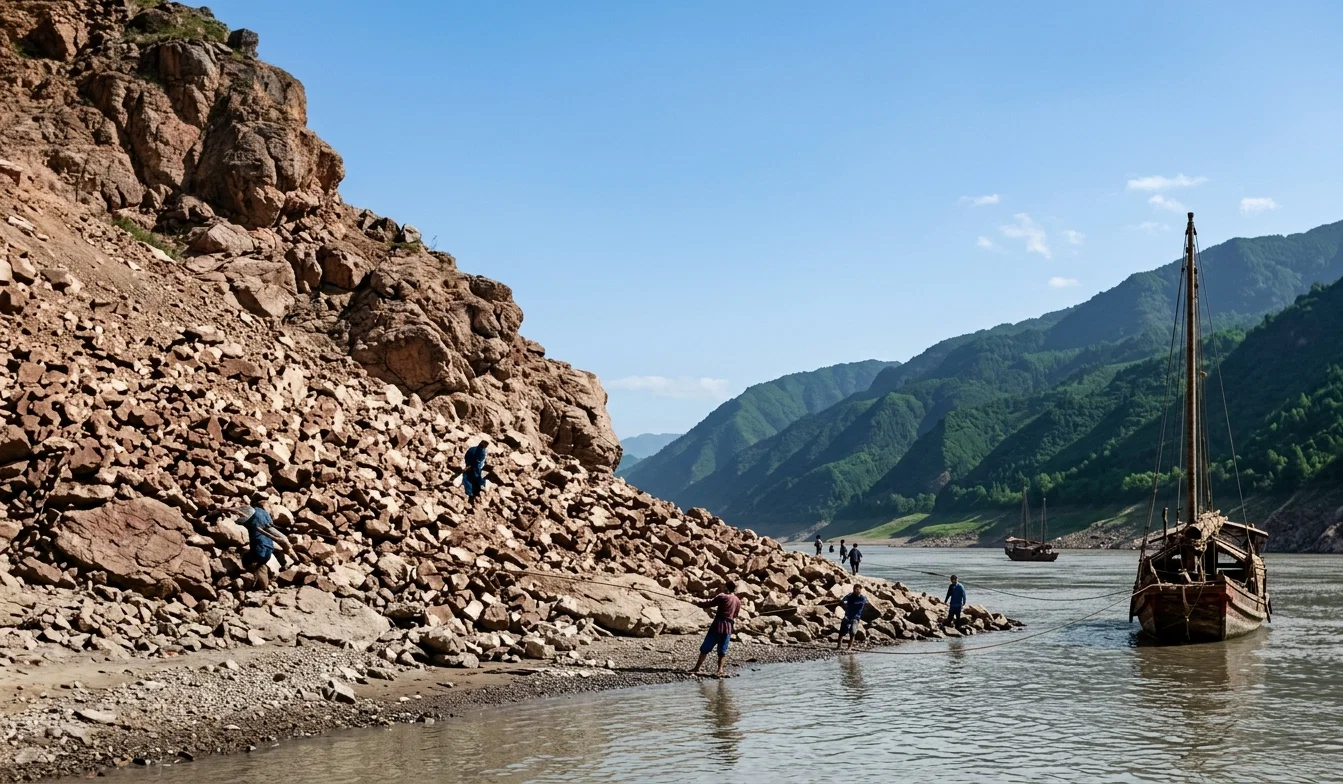
Our boat with men pulling it past a rocky point.
Since leaving the Shin Lung rapid, the river along these stretches is as quiet as a mountain lake. Now and then there is a small rapid, but they are not dangerous. In many places we see Chinese searching for alluvial gold, and the river is now called the Gin Sha, or Golden Sands. However, owing to the crude methods used, they do not make much money from their mining, although they work very hard in their search for gold. Thank God we are in search of better gold, and our prayer is that he will give us the persistence of the Spirit needed to lead Chinese people in finding the souls that are to our Heavenly Father more precious than gold, which will some day perish.
April 10. Friday evening we anchored at a busy market town, called Gao Gia Djen. Here we stayed over Sabbath. How thankful our weary trackers must be for the Sabbath rest. Friday evening was spent in a social meeting held by our second evangelist, Shi Yung Gwei. He brought out some helpful thoughts in the course of his remarks, and my soul was stirred as I listened to his earnest prayers.
April 11. Today we had our Sabbath school on the boat, and then entered the market town, and from the steps of an old temple, now used as a school, we spoke to more than two hundred people. The Lord gave us liberty, and we had good attention. While the evangelist was speaking, I entered the school and asked the teacher's permission to speak to the students. This was given, and I found that there were forty boys and twenty girls in attendance. After concluding my remarks I asked them to repeat John 3:16 after me, which they willingly did. May God's Spirit care for the seeds of truth sown in these young hearts.
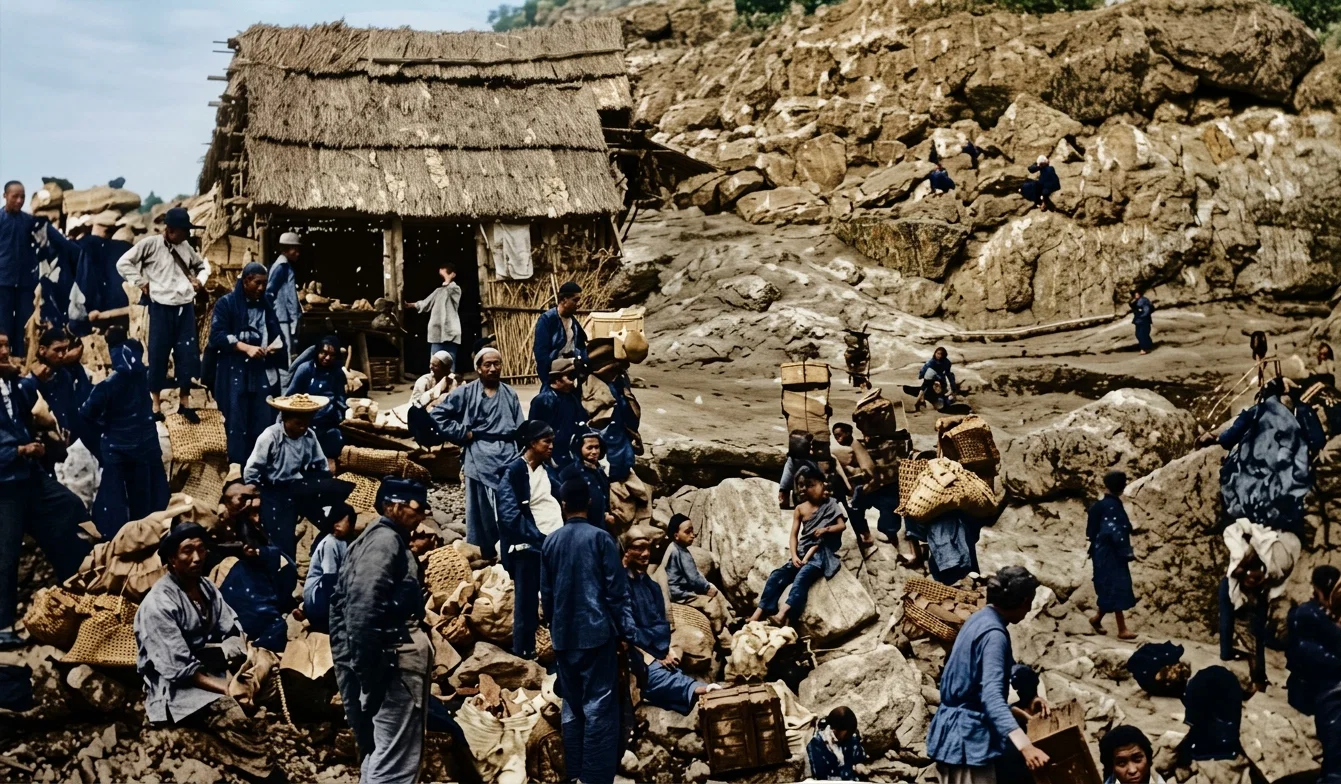
Removing our goods after the experience at the Tsin Tan rapid from the boat to a point above the rapid. (The experience here shown is told on page 13 of Review, July 23.)
April 12. We left our Sabbath resting place early. Our trackers are in fine spirits and are the most willing lot of men that I have ever had in China. We hope to reach Chung-king this week. Then we shall get our mail, and have a change in our diet. Our bread is now seventeen days old. It has got moldy several times, but we have held it over the flame of the fire until the mold was burned off. This was our only method, for our oven did not arrive in I-chang in time for us to take it along with us. We are also running short of provisions. However, we have nothing to complain of; for our God has been very good to us.
We reached Feng Tu Hsien about noon. A little below this city is a picturesque mountain about five hundred feet high, which is literally covered to the top with temples and large trees. We spent about an hour looking at the place. Some of these temples are very old, and some of the monuments are said to have been erected more than a thousand years ago. There are more than twenty large-sized temples on the mount. The gods of these temples are said to control the fires of hell. Perhaps in the remote past this place was visited by an earthquake, which may account for the idea that it is the door to the lower regions.
A very peculiar form of worship is noticed in one temple. There are nine large serpents, carved out of wood and painted, hanging from the beams, which receive special worship.
The goddess of mercy is shown in another temple, with a thousand hands and eyes, which represent her ability to see and help those in need. Here, and in other temples, we see thousands of carved feet hanging from the beams of the temples. These have been placed there by women who are said to have been cured by the goddess.
Before the king of Tartarus, Yen Lo Wang, were numerous representations of eyes, hands, arms, feet, hearts, lungs, etc., which had been placed there by those who had been healed in any particular organ by his satanic majesty.
We finally climbed to the top of the last temple, and there saw two celebrated worthies of the Han dynasty seated at a table playing chess. The story is that one of them gave the woodchopper boy, who is intently watching the game, something in the form of a date stone, and the boy became oblivious to time and watched the12game for over two hundred years. At last one of the worthies touched the boy and suggested that he return home. On coming to himself he found that his clothes had rotted away, and that his hatchet was consumed with rust. And further, on returning to his home he found that no one knew him. Thus you see the Chinese also have a Rip Van Winkle.
April 13. We anchored tonight a little above Fu Chow.
April 14. We anchored below the fine pagoda at Chang So Hsien. A few miles below this city we see a Chinese coal mine that is being worked according to Chinese methods. The Chinese miners wear no clothing except a cap, to which they attach a lamp. They have cars with iron wheels, but the cars run on wooden rails. They obtain a good quality of soft coal.
April 15. At evening we reached a town called Mu Tung. We are now within thirty miles of our destination.
April 16. We arrived at the custom station, which is ten miles from Chung-king, about 4 P. M., and by 6:30 we anchored at Chung-king. The long journey of 1,500 miles is now over. It has taken over five weeks to make the journey from Shanghai to Chung-king, Szechuan. That is, it takes longer to go from Shanghai to Chung-king than it would take to go from Shanghai to New York. And yet all say that we have made a quick trip from I-chang to Chung-king. From Mackenzie and Company, a firm which handles nearly all the foreign goods shipped to these parts, we learn that during the month of April they had eight thousand taels' worth of goods damaged, and three thousand taels' worth totally lost by wrecks on this river. (A tael equals about sixty cents.) Fortunate indeed is he whose boat escapes all the perils of this rock-bound river. Personally we realize that our safe journey is due to the fact that we have a God that is mighty to save.