“I AM praying, blessed Saviour,
To be more and more like thee;
I am praying that thy Spirit
Like a dove may rest on me.”
“How long have you been praying for this precious gift, Maggie, dear?” asked Aunt Lizzie.
“You mistake, auntie,” replied Maggie. “I was not praying—only singing.”
“But what were you singing, dear?”
Maggie’s face flushed as she replied, “O, I never pay any attention to the words of a hymn! They do not mean anything to me.”
“But, Maggie,” persisted Aunt Lizzie, “such a prayer as you were singing should mean something to you.”
“Well,” said Maggie half angrily, “I should like to know what would be the use of my paying any attention to such words, or praying either. My life is a failure; my hopes are blasted; I have nothing I really desire; and I should like to see another girl who has as hard a time as I. I did make out to graduate from the high school, and now I wonder I ever did that.”
Aunt Lizzie, closing her sightless eyes, said sweetly, “I fear you are too rebellious. You are not trusting, are you?”
“Aunt Lizzie, you don’t know what it is to be deprived of everything as I am. All your life has been so even; nothing ever seems to trouble you.”
Lizzie Leslie sighed half unconsciously as she replied: “Maggie, tomorrow I will tell you something that only one person in the world besides myself has ever known; and I pray that it will be a help to you.”
Maggie Leslie was a very impulsive girl of twenty. Until within the past two years she had lived in a luxurious city home, with no thought of anything but a gay life among her young associates. But in Mr. Leslie’s case, as in many others, riches had taken wings, and he had been obliged to move to a small farm—all that had been saved from his once handsome property. Mrs. Leslie’s health had given way just before the financial difficulty, and upon Maggie fell the trial of housekeeping and the care of the invalid mother. Had she possessed a Christian spirit, her homely duties might have been a source of real happiness to her; but her disappointment seemed greater than she could bear, and she was continually thinking and talking of her trials.
She had received no religious training, and since leaving her old home could see nothing to hope for. Aunt Lizzie was her father’s only sister. But little was ever said concerning her earlier life, only that her blindness had come upon her while she was in college, as a result of too close application to study. But her lovely life and beautiful Christian spirit were admired by all her acquaintances. A few days before her conversation with Maggie, she had come to make a short visit; and noticing Maggie’s fretfulness and almost ungovernable temper, she had resolved at the first opportunity to speak with her on the subject, and the opportune time had just come.
The following afternoon, when the noonday work was finished and the invalid mother made comfortable, Maggie and Aunt Lizzie walked to the shady grove near by. Sitting in its refreshing coolness, Aunt Lizzie asked, “Maggie, have you ever heard much said concerning my younger life?”
“No, auntie, nothing in particular, only that you became blind while in college, but that you were always so resigned that people marveled. To me it seems that your life has been free from the trials that so many have—even if you are blind.”
“Maggie, I am going to tell you today the story of my life, and a secret that has been hidden for more than thirty years,—my heart story,—for I feel it may benefit you. While very young, I became greatly interested in a people who sat in darkness, and I longed to go to them and tell them that a Light had sprung up. As I grew older, and took the vows of God upon me, I saw that I had no time to play with shadows, or to enter into the vain and careless pleasures of the world. So I decided to prepare myself for missionary work, and, knowing that a physician would have entrance into many homes where no one else could go, I decided to take a medical course first. I had already been graduated from our academy, and my indulgent parents willingly sent me away to a distant city to enter the medical department of a university. At this time I was about twenty-two years of age. God only knows how my whole being was stirred as I thought of my future work. I was engaged to be married to a young physician who expected to go to the same missionary field, and my hopes seemed the brightest.
“While I was in the medical school, your Uncle Ray attended the law department in the same university, and we kept house together. I was doing my third year’s work, and was to be graduated in a few months. It was Ray’s second year. During a part of the first year he had been very studious; but near its close he had fallen into the company of some who were very dissipated. The next year he was less inclined to study, and more given to spending his time with wild associates, and I saw with a breaking heart that he was drifting away.
“When I gently remonstrated with him, he would grow very angry, and I would tremble to witness his violent outbursts of temper. One night he returned from a wine supper at a late hour, and, being somewhat under the influence of liquor, he grew very angry at a remark I made, and seizing a heavy inkstand, threw it at my head. It struck me squarely in the eyes. I fell to the floor in a faint; and when I recovered consciousness for a few moments, Ray was bathing my head. We were alone, for he was too frightened to call any one. Thoroughly sobered, he said excitedly, ‘Lizzie, dear, I was afraid I had killed you.’ And then in an agony of remorse he continued: ‘Do you feel better? Can you, will you, forgive me? And, O Lizzie, if you won’t tell of this, I will never get so angry again!’ I tried to speak, but after a vain attempt, I sank into unconsciousness. After some time, so I was afterward told, I again became conscious of my surroundings, and saw I was in my bed, and a physician and some frightened women were doing what they could for me. Violent pains began in my head; delirium came on, and for days I was in a very critical condition. In my delirium I would constantly27moan, ‘No, I won’t tell! No, I won’t tell!’
BROTHER AND SISTER LIEU AND FAMILY, KIANGAU (CHINA) MISSION EVANGELISTS.
‘During my illness, Ray did not write to our parents, knowing that he was the cause of my suffering, and hoping each day that I would be better. But the optic nerve, which is the nerve of special sensibility of the eye, had been injured by the blow, and in a short time total blindness was the result.
‘Maggie, only our Father knows my terrible grief and disappointment when I found that the sweet dream of my life work was ended; but during the night hours, alone with my God, I could gain a victory which would enable me to be calm the next day. Ray was almost beside himself with grief, and finally I said, ‘Ray, if you will solemnly promise me to reform, I will keep back the real cause of this great affliction.’ He promised; and when we returned to our home, no one knew of my deep heart anguish, and my friends have always thought my blindness was the result of overstudy.
‘Especially was my heart bereft when the young man who was in a few months to call me his wife, wrote me that ‘under the painful circumstances’ of course he would expect to be released from his promise to me. But at last I could grasp the precious words, ‘My grace is sufficient for thee,’ with a new meaning, and my life has been a life reconciled to God’s will, and almost continually I hear these beautiful words ringing in my ears:—
“A little while for patient vigil keeping,
To face the storm and wrestle with the strong;
A little while to sow the seed with weeping,
Then bind the sheaves and sing the harvest song.”
“And, Maggie, dear, your Aunt Lizzie is waiting to sing the harvest song. You are so young, my child, I want you to learn the true life, that you may be prepared to wrestle with the strong.”
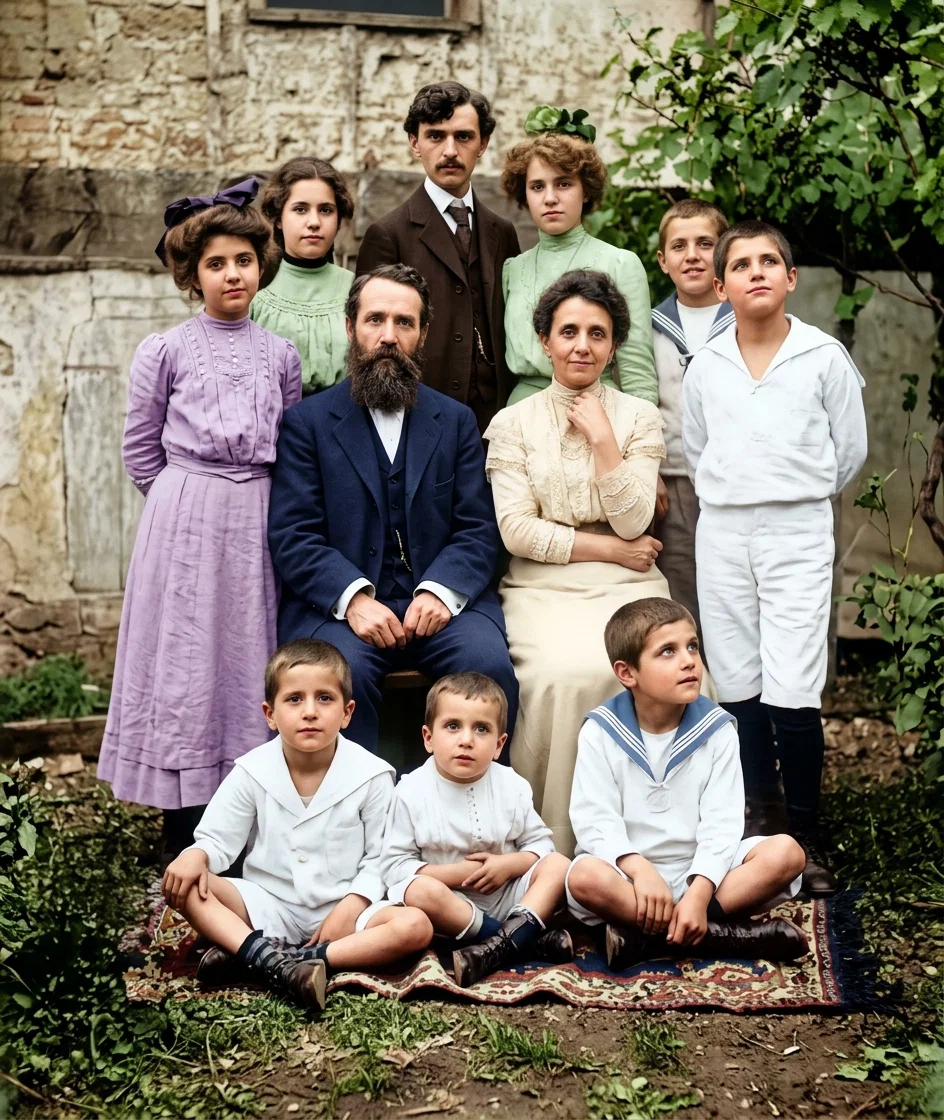
A MISSIONARY FAMILY OF CONSTANTINOPLE.
Maggie’s tears were falling fast as she said: ‘O Aunt Lizzie, I see myself a selfish and disagreeable girl! To think how brave you have been through your great afflictions, when I have thought my petty trials were so large! I have neglected mamma, too.’
‘Then,’ said Aunt Lizzie in her sweet, persuasive way, ‘Maggie, in the language of the hymn you sang yesterday, will you pray to be more like Him? And will you take up the little duties of home life and be a home maker indeed? If you will, I shall be repaid for giving you the story of my life.’
Maggie replied: ‘I will think about praying; sometime I may. But I will try to control my temper. But, Aunt Lizzie, Uncle Ray is a minister; you said he was in a law school.’
‘Yes, he was; but after he saw how patiently I could bear my trouble, he said: ‘Lizzie, my dear sister, I am the cause of all your blasted hopes. My past life is such a reproach to me, I cannot pass it by; and tell me, if you can, the source of all your comfort.’ The result of the many seasons we afterward had together, was Ray’s conversion. One day he said to me, ‘Lizzie, I must enter the ministry, and tell of the mighty One who can comfort when there is no comfort, and who can give songs in the darkest night.’ So he became the noble man you know today; and, Maggie, perhaps my life would not so fully have reflected the Master’s but for my physical blindness. Ray cannot do enough for me, and many times with broken voice he says, ‘O Lizzie, where should I be today but for your precious influence?’”
It was growing late when Aunt Lizzie and Maggie returned to the house. Aunt Lizzie remained but a few days; but she had sown the seed which in a few years was to bring forth an abundant harvest. No one could fail to see that Maggie was a different girl. There were times when she was very hasty; but gradually she learned to look to One “strong to defend, mighty to save;” and several months after Maggie had begun to bear public testimony for the Master, people said, “Maggie is growing to be like her Aunt Lizzie.”
WASHING VEGETABLES, JAPAN.
Five years later we again meet Maggie Leslie. We find her in a large church which is filled to its utmost capacity with friends who desire to hear Dr. Maggie Leslie give her parting words before sailing to a people who sit in darkness and in the shadow of death, to tell them that a Light has sprung up.
During the years that have intervened, Maggie has completed a medical course. She was able to do this through the kindness of Uncle Ray, who assisted her when she told him that she would like to take up Aunt Lizzie’s chosen work.
Tonight as she stands before the people, she tells them of her love for those benighted souls for whom Christ died, and in closing she says: “It is through the influence of my noble Aunt Lizzie, who pointed me to the Lamb of God, that I am before you this evening. Aunt Lizzie’s work is done, but her holy life and unselfish devotion for others will ever be an inspiration to me. She triumphed over her sufferings, and eternity will reveal how much she accomplished by her quiet, unconscious influence.”
And here we shall leave Maggie as she starts on her errand of love.
In the case of Lizzie Leslie, whose sweet Christian influence sent a minister and a missionary into the world’s great harvest field, we have seen how full even a blighted life may be. And shall not we watch for our larger opportunities, and grasp them as they come to us?
“The smallest bark on life’s tumultuous ocean
Will leave a track behind forevermore.
The lightest wave of influence set in motion
Extends and widens to the eternal shore.”