DURING my stay in Mosul, a town on the Tigris, built on the site of a suburb of Nineveh, I met an old weaver, one of the first converts to Protestantism in that region some forty years ago. This man came across an article about Seventh-day Adventists which appeared in an Arabic magazine published in Beirut, Syria, thirty or thirty-five years ago. It set him to thinking. Six years ago he made a journey to Aleppo, and one day his attention was called by some one to the place where the Sabbath keepers worship. This set him to thinking again of the words of God, “The seventh day is the Sabbath of the Lord thy God.”
Some four years later he was again in Aleppo, and on his way to church on Sunday saw a young boy shining shoes. The boy offered to black his boots, and the man, seeing the lad was a Christian, said, “Why do you shine shoes on Sunday?” The bootblack replied, “Well, you see I am a Sabti” (a Sabbath keeper). As the man was in haste to reach the church, he had no time to inquire further, but the boy opened his box and handed him a few Arabic tracts. These tracts the man took to Mosul, where he and some others studied them carefully.
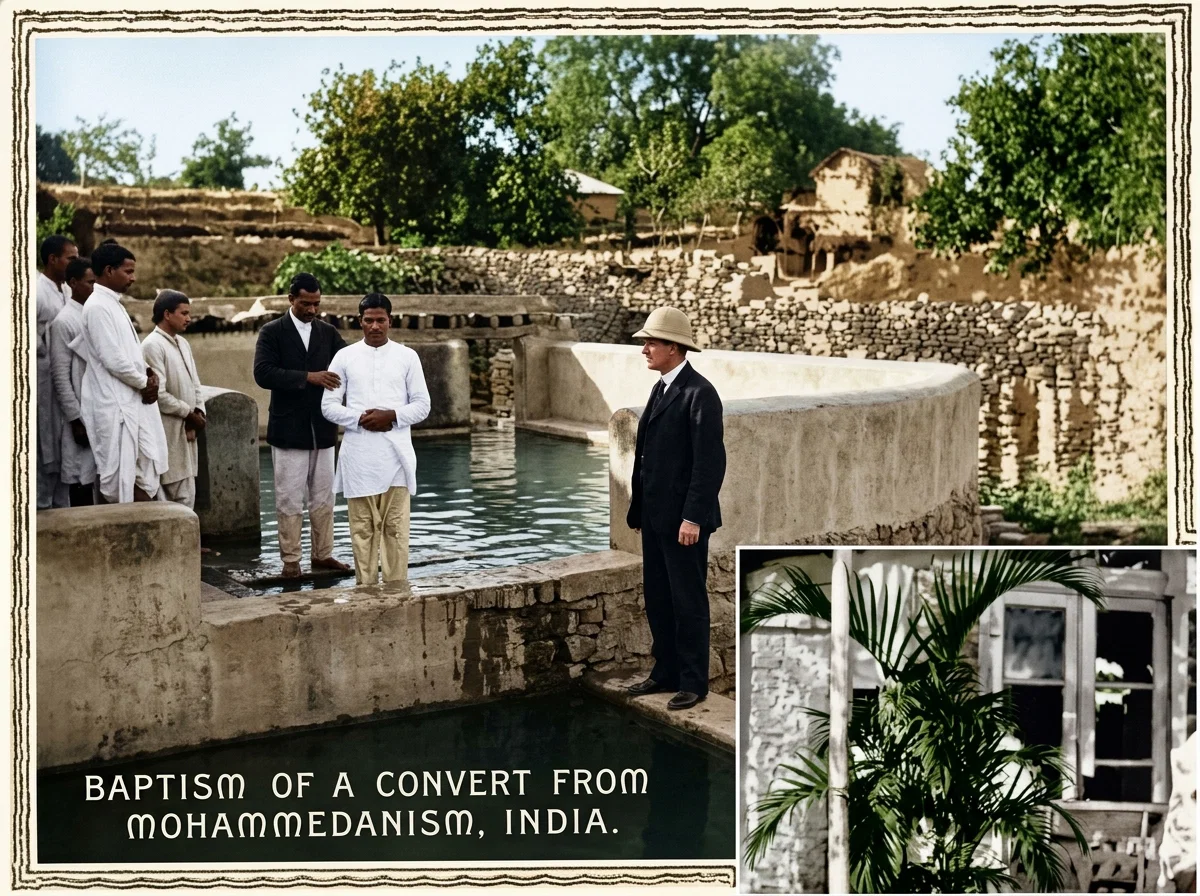
BAPTISM OF A CONVERT FROM MORAMANG BAPTISTS, INDIA.
“Three or four times,” he said, “I took up paper and ink, thinking to refute the arguments of the tracts; but when I compared my own writings with the tracts, I was convinced, every time, that my arguments were too weak, and would not stand the test of the Scriptures.”
Whatever men may say or write, the Lord, who made the Sabbath holy and blessed it, still declares, “The seventh day is the Sabbath of the Lord thy God.”