Publishing and Home Missionary Convention for the South
By R. L. Pierce
THE publishing and home missionary convention for the Southeastern, Southern, and Southwestern Union Conferences was held in the chapel of the Southern Publishing Association, Nashville, Tenn., December 24 to January 2.
From these unions there were present the three union conference presidents, the three general agents, the three auditors, all the field missionary agents and tract society secretaries, and eleven local conference presidents. Elders N. Z. Town, W. W. Eastman, and F. W. Paap, and Miss E. M. Graham, of the General and North American Division Conferences, were in attendance during the entire convention, while Elder I. H. Evans and Brother J. J. Ireland, of Washington, D. C., were present a portion of the time. The help and instruction of these workers were appreciated, and did much toward making this the best and most practical convention of its kind ever held in the South. Elder W. W. Eastman acted as chairman, and Brethren L. D. Randall and R. W. Parmele as secretaries.
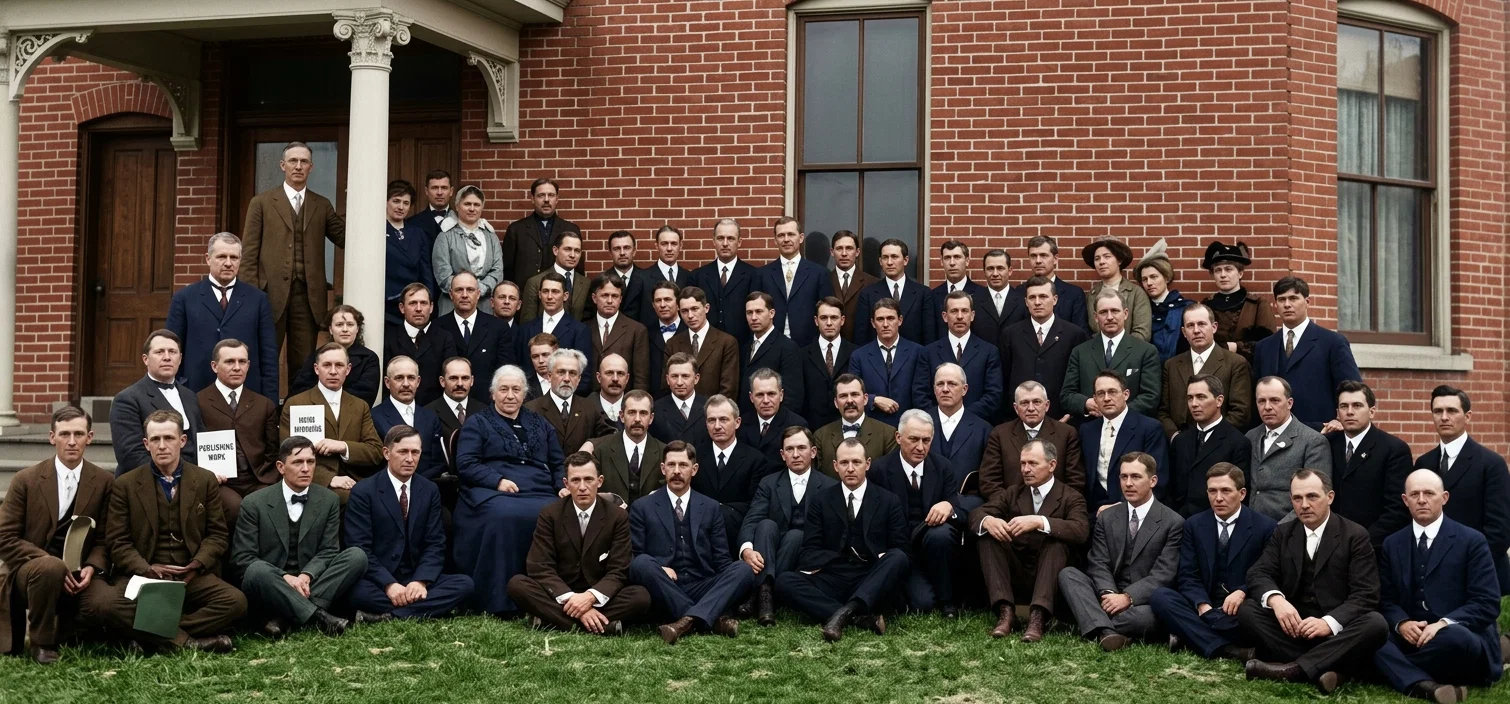
DELEGATES TO THE PUBLISHING AND HOME MISSIONARY CONVENTION,
NASHVILLE, TENN.
During the past five months the conditions confronting our colporteur work in the South have been most trying and perplexing. A conservative estimate of the loss to the South on account of the foreign market for cotton being shut off by the war, has been placed at seven hundred million dollars. As can be imagined, this greatly hampered our fall deliveries, especially so as nearly all these orders were taken before it was known what would befall the cotton market, and many of them even before the war broke out. Our workers have had difficulties to meet during these few months which they have never had to meet before, and therefore those who attended the convention keenly felt the need of all the instruction and help they could receive. The result was that there was practically a full attendance at every session. Meals were served near the office, while lodging for the delegates was also secured in the homes of our brethren convenient to the publishing20house. No pleasure-seeking trips were made about the city, every one seeming to sense the solemnity of the times and the need of receiving a better preparation for the great work before us.
The convention was conducted on the order of round-table discussions. A suggestive program of topics had been prepared in advance, which, with the question box, furnished ample work for the convention. This plan enabled the delegates promptly to get at the kernel of the various questions considered, and in this way much valuable time was saved. The instruction and counsel of Elders Town and Eastman in behalf of the colporteur work, and the help rendered by Elder Paap and Sister Graham on the tract society and home missionary work, were very timely and beneficial. Both union and local conference presidents took a lively part in the discussions, and manifested the keenest interest in all that was done. This was appreciated by the field agents, tract society secretaries, and others upon whom this part of the work directly rests.
One of the questions considered was the following: “What shall be our attitude in times of drought, political campaigns, money panics, wars, etc.?” An intensely interesting discussion of this topic showed that hard times and forbidding conditions can be used as levers to attain success; that they drive worldly agents from the field, leaving it clear for our workers; and that workers should not take sides in discussions of wars and political campaigns. Later the committee on plans brought in the following resolution, which was enthusiastically passed, and which shows the courageous spirit and determination of our workers as they again take up their work in the field under the present trying conditions:—
“Resolved, That in times of drought, war, and other difficulties, these calamities be used as a means of obtaining orders; and that the deliveries be made at shorter intervals than is usually the case.”
One very important feature of the convention was the morning devotional meetings, one of which was conducted by Elder I. H. Evans, and the others by the three union conference presidents and Elder Paap. These services proved to be seasons of refreshing. As the workers unitedly sought a deeper experience, the Spirit of the Lord came in in rich measure. These meetings really served to prepare the delegates for the day’s work.
The Watchman male quartet rendered a number of appropriate selections, which seemed to be thoroughly enjoyed by all present. This feature added much to the interest of the convention. All who attended the convention felt that it was a grand success, and that the Spirit of the Lord met with us in a special way. It was the firm conviction of every one that the results which will be seen in our work the coming year will many times repay the cost of the convention. It was indeed an occasion of genuine refreshing, and the workers returned to their respective fields of labor with renewed courage and determination.
We trust that the readers of the REVIEW will not forget to pray for the workers in the South; for surely at times like this it needs the prayers of God’s people.