Iceland

9%

Review and Herald Publishing Association · Takoma Park Station, Washington, D. C. · Feb 11, 1915

FromReview and Herald, Vol. 92, No. 8.

Read the full edition

Iceland

J. C. RAFT
In the far north, between 63½° and 66½° north latitude, and about eighty miles east of Greenland, we find the rock-bound island of Iceland. It covers an area equal to one third of Great Britain and Ireland, but is very thinly populated, having about ninety thousand inhabitants. The country mostly consists of high mountains, large portions of which are covered with eternal snow. Some of these mountains have an altitude of six thousand feet. There are also some volcanoes and hot springs. Iceland has grand natural scenery, while the climate is somewhat inclement. Lowlands are comparatively scarce, in most places only a narrow strip, and with very few exceptions these are the only habitable parts of the country. Trees are very scarce, and real forests are not to be found at all. No grains are raised, but some roots, like potatoes, are cultivated. Pastures are excellent. The principal livelihood is fishing and sheep raising. Of late years some have engaged in the dairy business, and butter is exported to Scotland. A large number of small Icelandic horses are sent annually to Denmark.
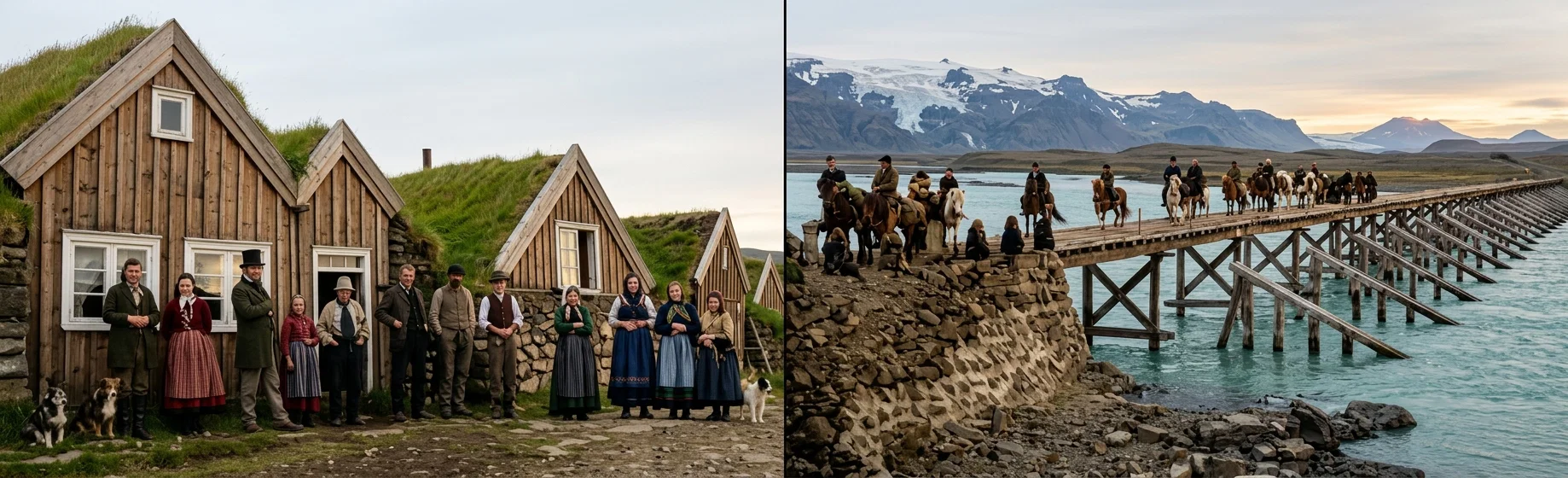
FARM HOUSES IN ICELAND    BRIDGE ACROSS LAGER RIVER
FARM HOUSES IN ICELAND BRIDGE ACROSS LAGER RIVER
As a result of the extended commerce with Scotland, the population of Iceland, in times past of Norwegian origin, has become quite strongly mixed with Celtic blood. The language is, mainly, a northern dialect from the Middle Ages. In proportion to its population, Iceland has a very extended literature, and the Icelanders are well educated. Most of the people live in small towns near the coast; inland they are very scattered, so that frequently houses are several miles apart. The means of travel are very deficient. There are but few roads, and nearlyeverything has to be transported on horseback.
When the Norwegian king, Harold the Fair, in the ninth century, united the entire Norway into one kingdom, a number of the wealthy peasants and chiefs who would not submit to Harold's rule went to Iceland and settled there.
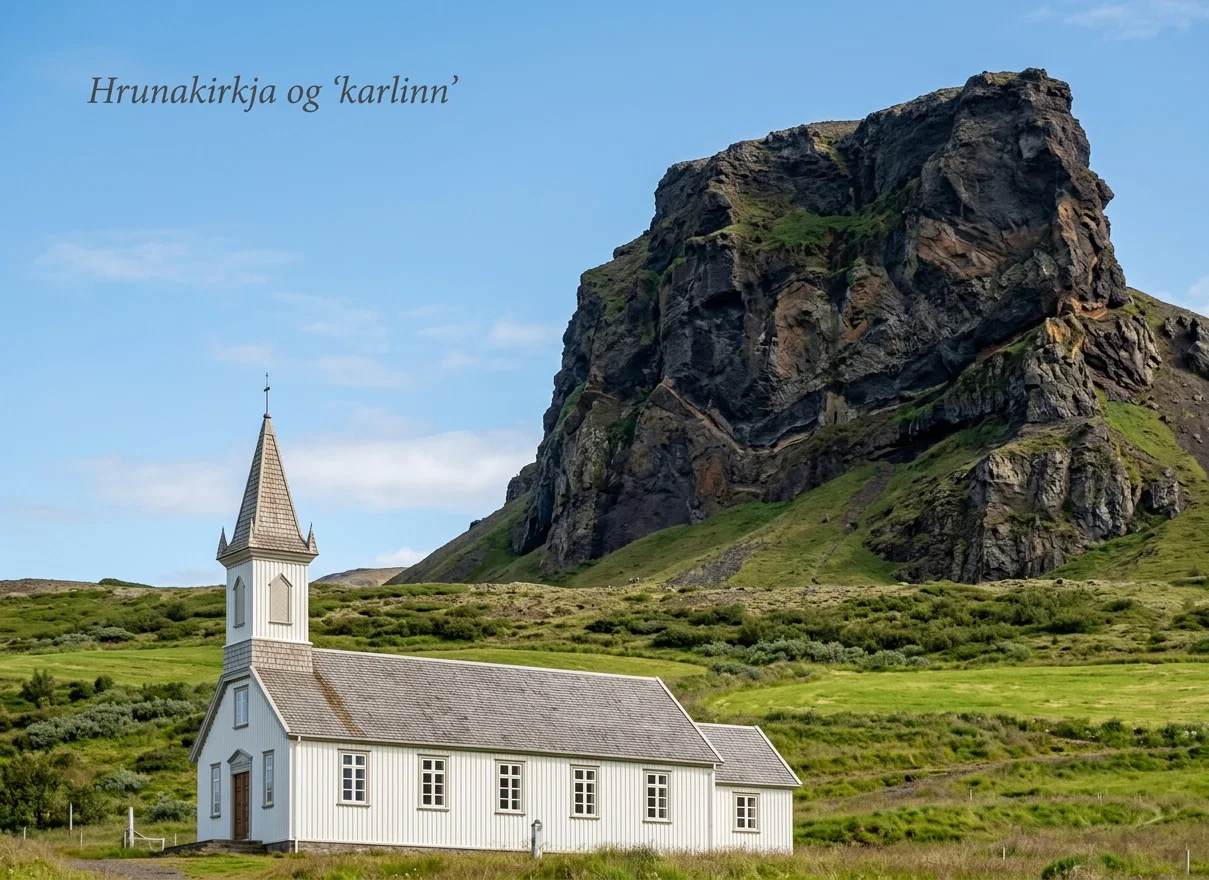
THE CHURCH (NOT OURS) AT HRUNA, AND VIEW OF THE ROCK "OLD MAN," AT RIGHT
In the course of time they established their own government. Iceland is now under the government of Denmark, but has some special rights. It has its own alting (legislature), its own secretary of state, etc.
Catholicism entered Iceland about the year 1000. In the sixteenth century Protestantism was introduced into the country. Both of these forms of religion were introduced by force, the same being true also of the other Scandinavian countries. In consequence of the far-away situation of the island, the Icelanders have been saved from much of the demoralization so common at the present time. A certain earnestness characterizes the people. Their requirements are few, but they lead a diligent and contented life.
In the year 1893 Elder O. J. Olsen Rost made a three months' trip to Iceland and the Faroe Islands. About four years later, one of our young ministers was sent to Iceland to begin work. He settled in the city of Reykjavik. The General Conference supported the Icelandic Mission till 1901, when it was taken over by the European Division. In 1904 the mission was incorporated into the Scandinavian Union, to which it still belongs.
(To be concluded)