1. What statement did Nebuchadnezzar, king of Babylon, make to his wise men whom he had assembled?“And the king said unto them, I have dreamed a dream, and my spirit was troubled to know the dream.”Dan. 2:3.
2. After being threatened with death if they did not make known the dream and the interpretation, what did the wise men say to the king?“The Chaldeans answered before the king, and said, There is not a man upon the earth that can show the king’s matter; therefore there is no king, lord, nor ruler, that asked such things at any magician, or astrologer, or Chaldean. And it is a rare thing that the king requireth, and there is none other that can show it before the king, except the gods, whose dwelling is not with flesh.” Verses 10, 11.
3. After the wise men had thus confessed their inability to do what the king required, who offered to interpret the dream?“Then Daniel went in, and desired of the king that he would give him time, and that he would show the king the interpretation.” Verse 16.
4. After Daniel and his fellows had sought God earnestly, how were the dream and its interpretation revealed to Daniel?“Then was the secret revealed unto Daniel in a night vision. Then Daniel blessed the God of heaven.” Verse 19.
5. When brought before the king, what did Daniel say?“Daniel answered in the presence of the king, and said, The secret which the king hath demanded cannot the wise men, the astrologers, the magicians, the soothsayers, show unto the king; but there is a God in heaven that revealeth secrets, and maketh known to the king Nebuchadnezzar what shall be in the latter days. The dream, and the visions of thy head upon thy bed, are these.” Verses 27, 28.
6. What did Daniel say the king had seen in his dream?“Thy dream, and the visions of thy head upon thy bed, are these: . . . Thou, O king, sawest, and behold a great image. This great image, whose brightness was excellent, stood before thee, and the form thereof was terrible.” Verses 29–31.
7. Of what were the different parts of the image composed?“This image’s head was of fine gold, his breast and his arms of silver, his belly and his thighs of brass, his legs of iron, his feet part of iron and part of clay.” Verses 32, 33.
8. By what means was the image broken to pieces?“Thou sawest till that a stone was cut out without hands, which smote the image upon his feet that were of iron and clay, and brake them to pieces.” Verse 34.
9. What became of the various parts of the image?
*“Then was the iron, the clay, the brass, the silver, and the gold, broken to pieces together, and became like the chaff of the summer threshing floors; and the wind carried them away, that no place was found for them; and the stone that4smote the image became a great mountain, and filled the whole earth.”* Verse 35.
10. With what words did Daniel begin the interpretation of the dream?“Thou, O king, art a king of kings; for the God of heaven hath given thee a kingdom, power, and strength, and glory. And wheresoever the children of men dwell, the beasts of the field and the fowls of the heaven hath he given into thine hand, and hath made thee ruler over them all. Thou art this head of gold.” Verses 37, 38.
NOTE.— The character of the Babylonian Empire is fittingly indicated by the nature of the material composing that portion of the image by which it was symbolized, the head of gold. It was “the golden kingdom of a golden age.” The city of Babylon, its metropolis, according to history towered to a height never equaled by any of its later rivals. “Situated in the garden of the East; laid out in a perfect square sixty miles in circumference, fifteen miles on each side; surrounded by a wall three hundred and fifty feet high and eighty-seven feet thick, with a moat, or ditch, around this, of equal cubic capacity with the wall itself; divided into six hundred and seventy-six miles; laid out in luxuriant pleasure grounds and gardens, interspersed with magnificent dwellings,—this city, containing in itself many things which were themselves wonders of the world, was such another and still mightier wonder. . . . Such was Babylon, with Nebuchadnezzar, youthful, bold, vigorous, and accomplished, seated upon its throne.”
11. What was to be the nature of the next kingdom after Babylon?“After thee shall arise another kingdom inferior to thee.” Verse 39, first part.
12. Who was the last Babylonian king?“In that night was Belshazzar the king of the Chaldeans slain. And Darius the Median took the kingdom, being about threescore and two years old.”Dan. 5:30, 31.
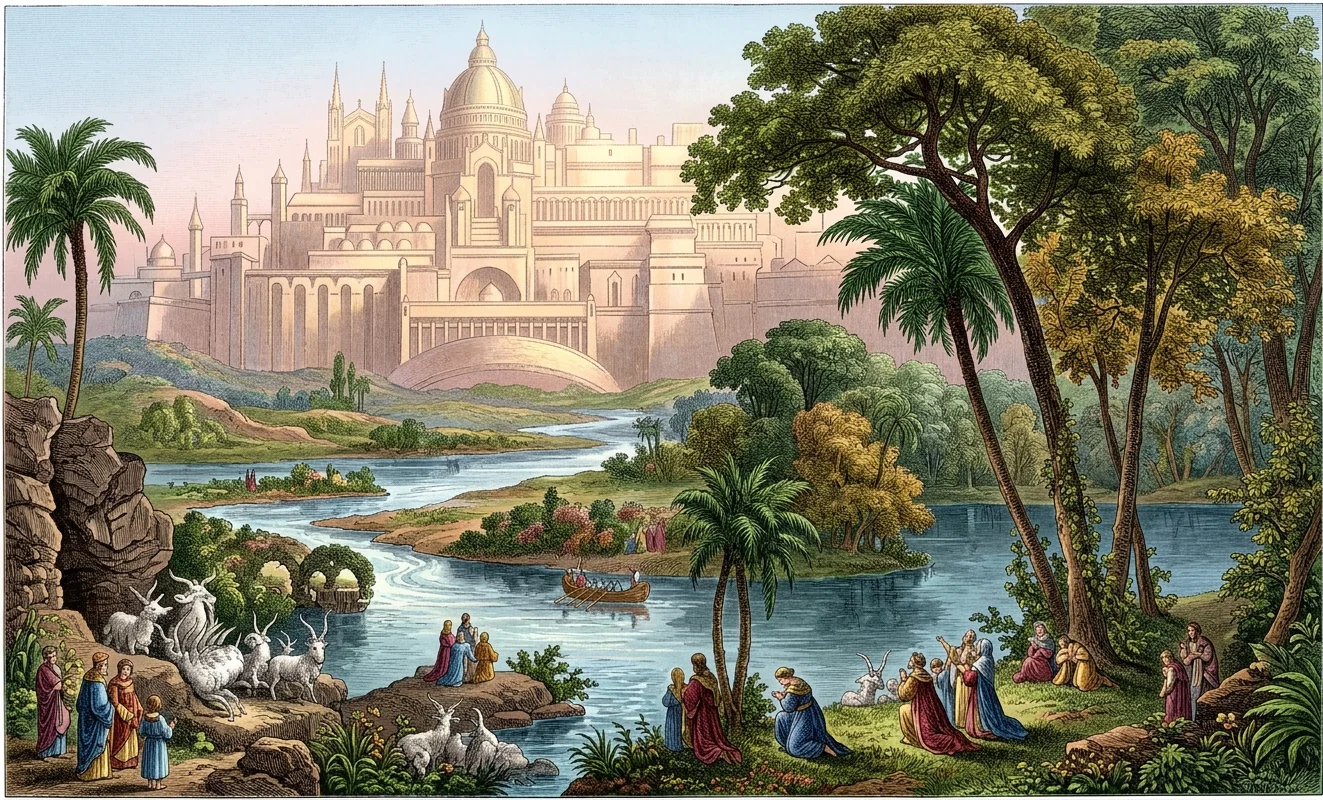
THE LAND OF PEACE.—“I SAW A NEW HEAVEN AND A NEW EARTH.” REV. 21:1
13. To whom was Belshazzar’s kingdom given?“Thy kingdom is divided, and given to the Medes and Persians.” Verse 28.
14. By what is the Medo-Persian Empire represented in the great image?
By the breast and the arms of silver. Dan. 2:32.
15. By what is Grecia, the kingdom succeeding Medo-Persia, represented in the image?“His belly and his thighs of brass.” Verse 32.
“And another third kingdom of brass, which shall bear rule over all the earth.” Verse 39.
16. What is said of the fourth kingdom?“And the fourth kingdom shall be strong as iron: forasmuch as iron breaketh in pieces and subdueth all things; and as iron that breaketh all these, shall it break in pieces and bruise.” Verse 40.
17. What scripture shows that the Roman emperors ruled the world?“And it came to pass in those days, that there went out a decree from Cæsar Augustus, that all the world should be taxed.”Luke 2:1.
NOTE.— Describing the Roman conquests, Gibbon uses the very imagery employed in the vision of Daniel 2. He says: “The arms of the republic, sometimes vanquished in battle, always victorious in war, advanced with rapid strides to the Euphrates, the Danube, the Rhine, and the ocean; and the images of gold, or silver, or brass, that might serve to represent the nations and their kings, were successively broken by the iron monarchy of Rome.”—“Decline and Fall of the Roman Empire,” chap. 38, par. 1, under “General Observations,” at the close of the chapter.
18. What was indicated by the mixture of clay and iron in the feet and toes of the image?“And whereas thou sawest the feet and toes, part of potters’ clay, and part of iron, the kingdom shall be divided.”Dan. 2:41.
19. In what prophetic language was the varying strength of the ten kingdoms of the divided empire indicated?“And as the toes of the feet were part of iron, and part of clay, so the kingdom shall be partly strong, and partly broken” (margin, “brittle”). Verse 42.
20. Were any efforts to be made to reunite the divided empire of Rome?“And whereas thou sawest iron mixed with miry clay, they shall mingle themselves with the seed of men: but they shall not cleave one to another, even as iron is not mixed with clay.” Verse 43.
21. What is to take place in the days of these kingdoms?“And in the days of these kings shall the God of heaven set up a kingdom, which shall never be destroyed: . . . but it shall break in pieces and consume all these kingdoms, and it shall stand forever.” Verse 44.
NOTE.— This verse foretells the establishment of another universal kingdom, the kingdom of God. This kingdom is to overthrow and supplant all existing earthly kingdoms, and is to stand forever. The time for the setting up of this kingdom was to be “in the days of these kings.” This cannot refer to the four preceding empires, or kingdoms; for they were not contemporaneous, but successive; neither can it refer to an establishment of the kingdom at Christ’s first advent, for the ten kingdoms which arose out of the ruins of the Roman Empire were not yet in existence. It must, therefore, be yet future.
22. In what announcement in the New Testament is the establishment of the kingdom of God made known?“And the seventh angel sounded; and there were great voices in heaven, saying, The kingdoms of this world are become the kingdoms of our Lord, and of his Christ; and he shall reign forever and ever.”Rev. 11:15.
23. For what have we been taught to pray?“Thy kingdom come. Thy will be done in earth, as it is in heaven.”Matt. 6:10.
24. What event is closely associated with the establishment of God’s everlasting kingdom?“I charge thee therefore before God, and the Lord Jesus Christ, who shall judge the quick and the dead at his appearing and his kingdom.”2 Tim. 4:1.
25. With what prayer do the Scriptures close?“He which testifieth these things saith, Surely I come quickly. Amen. Even so, come, Lord Jesus.”Rev. 22:20.