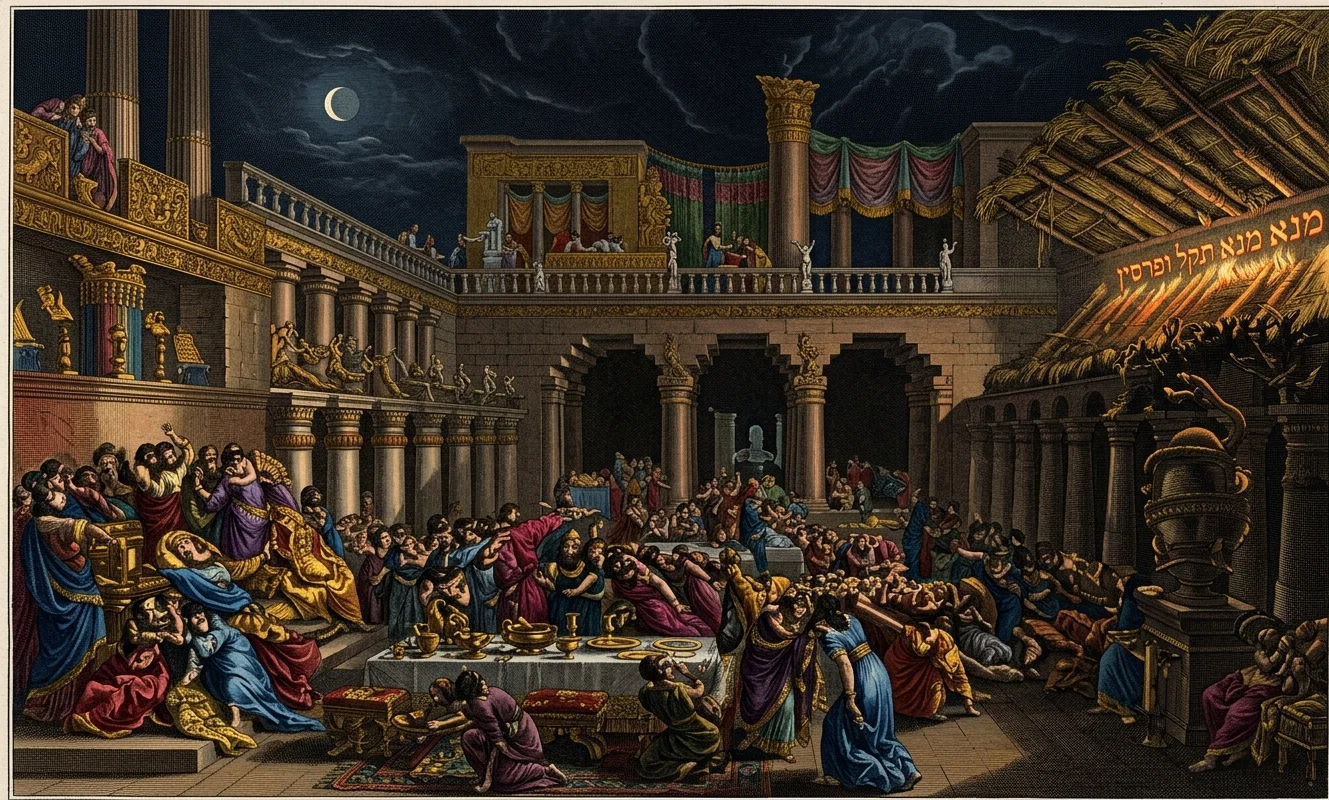
BELSHAZZAR was the last of the Babylonian kings. The great feast which he made for a thousand of his lords was on the last night of his reign. He belonged to the proud and profligate race of the Chaldeans, whom the Hebrew prophets describe as tender and delicate, given to pleasures, dwelling carelessly and trusting in wickedness. Their young men were showy, sensual, and self-indulgent. They dressed themselves in dyed garments of brilliant colors, curled their hair, used unguents and perfumes, wore jewelry, and carried walking sticks with the beak of a bird or the head of a serpent carved on the handle. They were fond of silver plate and splendid carpets, costly furniture and great suppers. They frequented dramatic entertainments in which female singers and dancers appeared on the stage with little dress and less decency, for the amusement of the audience. They drank wine, sang lewd songs, were out late at night, and did everything else that wild, half-intoxicated young men are most likely to do.
All this can be abundantly shown from the Hebrew prophets, Isaiah, Jeremiah, and Ezekiel; from the Greek historians, Herodotus, Xenophon, and Diodorus, and from inscriptions on monuments that remain to this day. Knowing all this concerning the young men of that great and mighty city of ancient time, we are not surprised that Babylon became a desolation. The day of doom is not far off from any great city when its young men have become “tender and delicate,” and given to pleasure; when they have grown effeminate, self-indulgent, fond of amusement, and afraid of work; when they are excited and passionate about trinkets and trifles—nerveless and spiritless about the nobler demands of effort and duty.
The Germs of Decay
There is no more effectual way to destroy a great and mighty nation than to give its young men all the money they want, provide them with plays and festivities and amusements and dances and wine, and leave them to sweat the life and manhood out of body and soul in the hotbed of pleasure and self-indulgence. That is the way Babylon was ruined. That is the way imperial Rome became an easy prey to northern barbarians. That is the way Christian Constantinople came under the debasing and abominable sway of Mohammedans. That is the way Venice ended a thousand years of independent and glorious history with shame and servitude. And nothing worse could come upon the fairest and most Christian city in the world than to have a generation of tender and delicate young men, without energy, without principle, without conscience, with money enough to support elegant pleasures and costly vices. Let such young men give tone to public opinion, and take the lead in the highest circles of society in any city of our land, and they would soon make it the Sodom of America.
A Character Sketch of Belshazzar
Belshazzar had everything to flatter his pride and indulge his passions. He was an absolute monarch, holding the life and property of his thousand lords and his countless people entirely at his disposal. His servants were princes. His concubines were the daughters of kings. His capital was enriched with the spoils of nations; his provinces were cultivated by captive people. He was hasty and violent in temper, yet effeminate and luxurious in his habits of living. He was gracious and indulgent toward his favorites; and yet when their best efforts to please him did not happen to suit his caprice at the moment, he would be as cruel as the grave. His anger kindled at the slightest provocation, like flax in the flame, and he yielded to the seductions of pleasure and flattery as the early frost melts in the morning sun. In his soft and passive mood he could be molded like wax by those who studied his caprices and played upon his weaknesses; but let him be crossed in his will, let him receive a slight or a sudden provocation, and his effeminate face would darken with the ferocity of a demon.
The Dimensions of Babylon
We have several independent statements in regard to the dimensions of Babylon, and although they all seem like immense exaggerations, we shall venture to take them as they stand for the purpose of illustration, without attempting to improve upon them by our conjectures. Let Herodotus, the father of history, be our principal authority.
The front of the great palace of Belshazzar was six times as great as the front of St. Peter’s Church at Rome, four times as great as the length of the Capitol at Washington. The whole structure was surrounded by three walls, so high that it would take thirteen tall men, standing erect one above the other, to reach the top. The outer wall of the palace inclosed more ground than Central Park in New York. The city in which Belshazzar reigned was a square fifteen miles on a side, surrounded by walls as wide on the top as a large church, and seventy-five feet higher than the highest tower or steeple in America. If Broad Street, in Philadelphia, were graded and built up to the full extent of the city limits, it would be the longest, straightest, widest street in the world. Ancient Babylon had fifty such streets, straight as an arrow, crossing each other at right angles, and wider by one third than the widest street in Philadelphia. And this mighty city of old was furnished with towers and temples and palaces and pleasure gardens correspondent to its greatness. Belshazzar’s so-called father, Nebuchadnezzar, was the most magnificent builder the world ever saw. According to Herodotus, he put into the walls of his capital alone more than five thousand millions of solid feet of masonry. Babylonian bricks, a foot square, inscribed with the name of Nebuchadnezzar, have been found by Sir Henry Rawlinson in more than a hundred different places in the country about the ruins of the great city, and there are millions of such bricks today lying just where they were placed by the hand of the workmen twenty-four hundred years ago.
THE HANDWRITING AT BELSHAZZAR'S FEAST
The King’s Inheritance
Belshazzar inherited the pride, the glory, the riches, the power, the palaces, the capital, the kingdom, of his great father. He inherited enough to ruin any young man who was not fortified by great strength of character and a severe mastery of his own appetites and passions. He was admitted to a share in kingly power at fifteen, and the glory, which was too great for the mighty Nebuchadnezzar, easily turned the head of an effeminate and giddy youth, who had earned by his own exertions nothing of all he had. He lifted himself up against the Lord of heaven, and despised the kings and armies of the earth.
The Stratagems of Cyrus
At the time immediately preceding the great feast which Belshazzar made for his thousand lords, the province of Babylon had been overrun and the capital assailed by a great army from the north. But, for some strange and inexplicable reason, the besieging force had apparently withdrawn. No effort appears to have been made to discover what had become of the enemy or what had occasioned their disappearance. It was enough that they could no longer be seen from the towers and walls. It was taken for granted that the siege was abandoned and the war was over. The whole city was immediately given up to rejoicing and every form of riotous excess. Belshazzar set the example, and people and princes were only too ready to imitate their king. The retiring enemy were ridiculed. The guards deserted their posts. The gates in the palace walls and the river banks were left open. No attention was given to the strange and startling fact that the water in the river was beginning to fall, and that when the night of the great feast began the bed of the stream was in many places bare, and that the empty channel left an open pathway for an army to march beneath the walls. There was feasting and dancing everywhere, and the mad revelers thronged the streets and houses, the palaces and pleasure gardens, through all the city. The flames of idolatrous sacrifice rose high into heaven from the lofty tower of Belus. The Hanging Gardens were hung with lanterns and torches, till they seemed like a mountain of fire at midnight. Torchlight processions flowed like rivers through the broad streets. The light of lamps outshone the starlight, and the blue Chaldean heavens looked black above the blaze of the great illumination.
Babylon’s Fatal Hour of Revelry
Meanwhile, Belshazzar has entered the hall of banquet—
“And a thousand dark nobles all bend at his board;
Fruits glisten, flowers blossom, meats steam, and a flood
Of the wine that man loveth runs redder than blood;
Wild dancers are there, and a riot of mirth,
And the beauty that maddens the passions of earth;
And the crowd all shout, while the vast roofs ring,
All praise to Belshazzar, Belshazzar the king!”
“The music and the banquet and the wine; the garlands, the rose odors, and the flowers; the sparkling eyes, the flashing ornaments, the jeweled arms, the raven hair, the braids, the bracelets, the thin robes floating like clouds; the fair forms, the delusion and the false enchantment of the dizzy scene,” take away all reason and all reverence from the flushed and crowded revelers. There is now nothing too sacred for them to profane, and Belshazzar himself takes the lead in the riot and the blasphemy. Even the mighty and terrible Nebuchadnezzar, who desolated the sanctuary of Jehovah at Jerusalem, would not use his sacred trophies in the worship of his false gods. But this weak and wicked successor of the great conqueror, excited with wine and carried away with the delusion that no foe can ever capture his great city, is anxious to make some grand display of defiant and blasphemous desecration.
“Bring forth,” cries the monarch, “the vessels of gold
Which my father tore down from the temples of old;
Bring forth, and we’ll drink, while the trumpets are blown,
To the gods of bright silver, of gold, and of stone.
Bring forth.” And before him the vessels all shine,
And he bows unto Baal, and he drinks the dark wine,
While the trumpets bray and the cymbals ring,
‘Praise, praise to Belshazzar, Belshazzar the king.’
Now what cometh? Look! look! without menace or call, Who writes with the lightning’s bright hand on the wall?
What pierceth the king, like the point of a dart?
What drives the bold blood from his cheek to his heart?
Let the captive of Judah the letters expound.
They are read, and Belshazzar is dead on the ground.
Hark! the Persian has come on the conqueror’s wing,
And the Mede’s on the throne of Belshazzar the king.”
The Last Ceremonial of the Chaldean Kings
The graphic lines of the modern poet do not exaggerate the rapidity with which the ministers of vengeance came upon Belshazzar and his thousand lords on the last night of his impious reign. At the very moment when their sacrilegious revelry was at its height, the bodiless hand came forth and wrote the words of doom upon the wall of the banqueting room; the armies of Cyrus had turned the Euphrates out of its channel and marched into the unguarded city along the bed of the stream beneath the walls; they were already in possession of the palace gates when Belshazzar and his princes were drinking wine from the vessels of Jehovah and praising the gods of gold and silver and stone. That great feast of boasting and of blasphemy was the last ceremonial of the Chaldean kings. “In that night was Belshazzar the king of the Chaldeans slain. And Darius the Median took the kingdom,” Dan. 5:30, 31.