Russia and Constantinople

3%

Review and Herald Publishing Association · Takoma Park Station, Washington, D. C. · Mar 11, 1915

FromReview and Herald, Vol. 92, No. 13.

Read the full edition

Russia and Constantinople

“But tidings out of the east and out of the north shall trouble him: therefore he shall go forth with great fury to destroy, and utterly to make away many. And he shall plant the tabernacles of his palace between the seas in the glorious holy mountain; yet he shall come to his end, and none shall help him. And at that time shall Michael stand up, the great prince which standeth for the children of thy people: and there shall be a time of trouble, such as never was since there was a nation even to that same time: and at that time thy people shall be delivered, every one that shall be found written in the book.” Dan. 11: 44, 45; 12: 1.
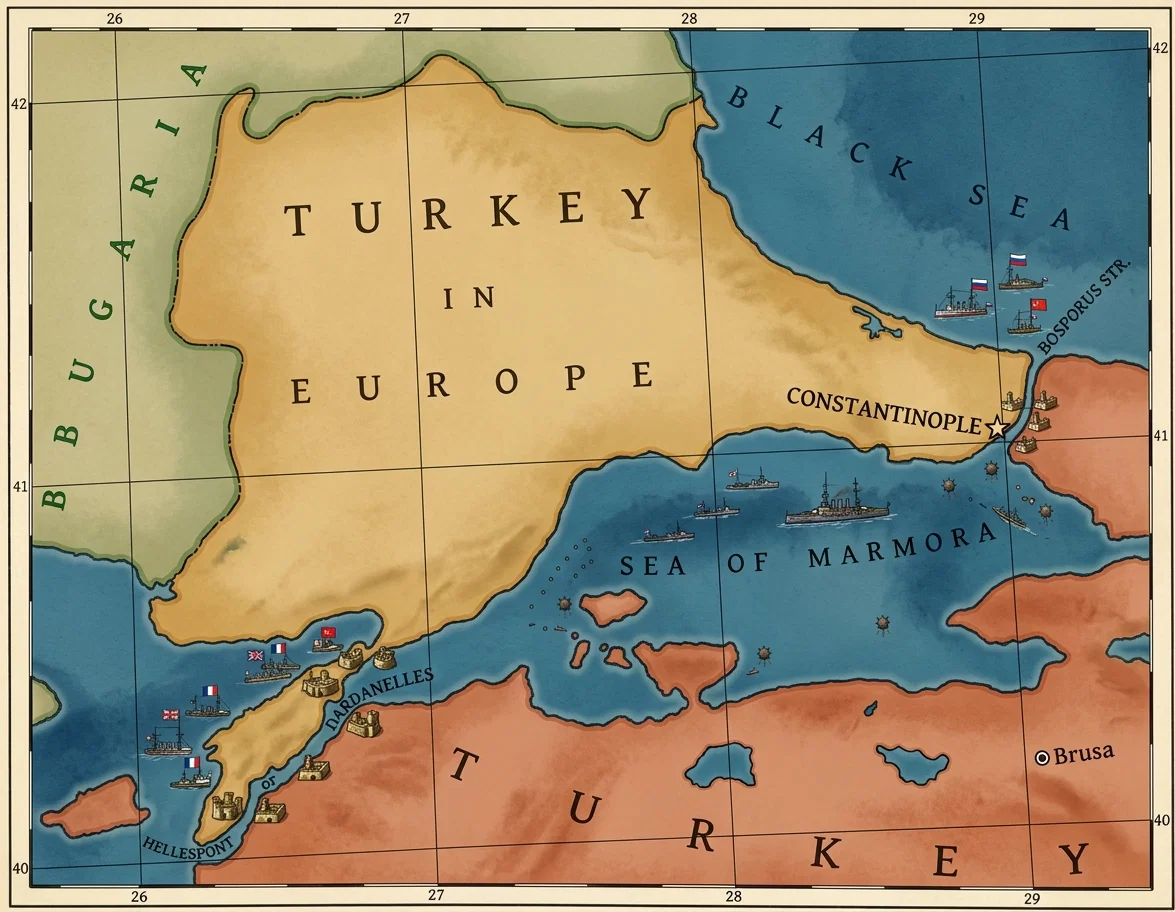
By the striking events of the last few days in the war zone of Europe, our attention is directed with new interest to the fulfillment of prophetic prediction concerning the future of Turkey as brought to view in the eleventh chapter of Daniel. Advices from Europe tell us that a concerted attack is being made by more than half a hundred battleships of the Allied fleet upon the naval defenses of Constantinople. The Russian Black Sea fleet is endeavoring to penetrate the Bosporus from the north, while the combined fleets of England and France have already entered the Dardanelles from the south. The strong forts at the entrance of this southern strait have fallen; several of the interior forts have likewise been reduced; and at this writing, it seems only a matter of a few days when Constantinople will pass under the flags of the Allies.
Russia is now engaged in her tenth effort to secure possession of Constantinople. She has urged, for the welfare of her national growth and development, the necessity of an open warm-water port. Otherwise she must remain an insular nation, cut off from engaging in that trade and commerce with the outside world which the development of her great national resources demands. The intervention of other European powers has succeeded in the past in robbing Russia of her coveted prize. England for the most part has been the dominant influence in blocking the way to Russian aggression. Great Britain has felt that the possession of Constantinople by Russia would prove a menace to English Oriental trade, and that the integrity of English domination in the East would be threatened. Recently there has come a change in England’s attitude in respect to this question. This is most significant.
A recent editorial in the Spectator, a leading English journal, discusses the question of England’s attitude toward the designs of Russia in securing Constantinople. The editor holds that in event the war turns on the side of the Allies, the question of a reconstructed Ottoman government at Constantinople is unthinkable. He says:—
We think it must be admitted, however, that Turkey’s attitude means suicide for the Turkish Empire, and that if the Allies win there must not be any attempt to set up a reconstructed Ottoman Empire at Constantinople. . . . Ottoman power must cease at Constantinople, and, what is more, Constantinople must be placed in the hands of the Russians. That is a result of the war which we are free to confess will give us very special pleasure, for, as our readers know, the Spectator for the last twenty years has urged that the Russians are the appropriate successors of the Turks at Constantinople. Russia is by far the greatest of the Black Sea powers, and she ought to be given the key to her own back door—the possession of the Bosporus and the Dardanelles being conditioned, of course, by the guaranty of free access to the Black Sea for the shipping of other powers, on the lines that govern the Suez Canal and the Panama Canal.
He considers that England need have no fear that the possession of Constantinople will make Russia so formidable as to prove a menace to England’s future; that nations possessing great qualities are great without respect to their geographical position:— Another fear which used to be entertainedhere, but which we are glad to say has now died down, though it may still exist to some extent on the Continent, is that Russia will become too powerful by the possession of Constantinople. That is an entire delusion. Nations are great and powerful owing to the energy, ability, patriotism, and power of self-sacrifice of their inhabitants, and not because of geographical positions. Happily for Russia, she possesses those qualities in abundance, and they will make her and keep her great whether she is or is not at Constantinople. If she had not got them, the possession of Constantinople, as we see from the example of Turkey, would not make her great.
Russia he feels should not be charged with selfishness in her determination to possess Constantinople. He believes that her contention is a reasonable one, and that the Bosporus and Dardanelles afford her most natural outlet to the sea:—
The Russians, indeed, may be perfectly well excused from any charge of selfishness when they say that the possession of Constantinople is vital to them, and is vital to no other power, and that therefore the city and the double straits ought to be theirs. We, at any rate, as we have said, have always recognized the absolute soundness of this plea, and therefore have always desired that Russia should be at Constantinople. The result of the recent Balkan wars was a disappointment to us, because it seemed as if the presence of Russia at the Golden Horn was indefinitely postponed, and no doubt this disappointment was very strongly felt in Russia. An unexpected turn of the wheel of fate has, however, altered that.
In conclusion he assures the world in general, and Russians in particular, that the English people have experienced an entire change of heart with reference to this question; that their jealousies and suspicions of Russia have died; that this change is not a case of bowing to the inevitable, but is a genuine transformation of feeling:—
Indeed, our object in this article is not to make even partial suggestions for the disposition of the Ottoman Empire, but merely to point out to our Russian allies how entirely the British people have dropped any feeling of anxiety or dread at the idea of Russia being dominant on the Bosporus. We are, of course, well aware that the Russian government understands this, but there may be—there almost certainly are—a good many people in Russia who still think that their possession of Constantinople would meet with opposition here. They can be reassured on this point. There will be no more opposition in Britain than there will be in France. And let Russians remember that this will be no case of bowing to the inevitable, but will be due to a complete change of feeling. Our old jealousies and suspicions of Russia have died out, and at the same time the old superstitious idea that the balance of the world power would be upset by any one of the great powers possessing Constantinople has also passed away. We now see things from both points of view in their true perspective.
The above map shows the situation of Constantinople on the Bosporus. This strait connects the Black Sea with the Sea of Marmora. It is about seventeen miles long and is strongly fortified. The Russian Black Sea fleet is endeavoring to force its way through this strait. The Sea of Marmora is about one hundred and seventy-five miles long. It is heavily mined. The Dardanelles is a narrow strip of water connecting the Sea of Marmora with the Mediterranean. It has been strongly fortified at the Mediterranean entrance and at strategic points along the course of the waterway. The combined fleets of England and France have already reduced the forts at the entrance, and are now about halfway through the strait. Both the Russian and the Allied fleets have Constantinople as their objective.
That the view expressed by the editor of this London journal really represents the sentiment of the English people, and that the English government is in accord with this program, is further evidenced by the reports of a recent speech made by Sir Edward Grey in the House of Commons. Some days ago the Russian foreign minister, M. Sazonof, made a statement in the Duma to the effect that Russia hoped soon to realize her aspirations in the possession of Constantinople. Sir Edward was asked if England knew and approved of this statement of the Russian foreign minister. To this the English foreign secretary replied that Britain was in entire accord with Russia’s desire for access to the sea. “With these aspirations England is in sympathy. What form their realization will take will no doubt be settled in the terms of peace.” Thus according to the statement of English journals and of the secretary who has to do with the shaping of England’s foreign policy, the English nation has entirely changed front on this question, and now professedly stands in full sympathy with the aspirations of Russia, and ostensibly, by her warships in the Dardanelles cooperating with Russia in the Black Sea, is acting the part of an abetter of Russian designs. Of the statement from Sir Edward Grey the editor of the New York Times for February 27 says:—
There has been no more momentous declaration of policy since the war began than that of Sir Edward Grey in the House of Commons on Thursday, when he said that England was in sympathy with the aspirations of Russia to secure access to the sea.
It would seem from the human standpoint that in this action the last barrier had been removed which has hindered the expulsion of Turkey from Europe. In the opinion of practically the whole world, when Turkey entered the present European conflict she reached the most fateful hour in her history. This was expressed by leading writers and statesmen throughout the world. Voicing the sentiments of the Russian people, the Bourse Gazette declared:—
It is Russia’s opportunity. There is no general combination of powers such as several times saved Turkey from final destruction by the heavy hammer of Russian forces. With the blood of our sons we have shown the Allies our friendship, and therefore nothing will move them once more to hold back our hand. We shall for once receive only help and cooperation from the Anglo-French fleets in the Ægean. We will let them watch the enemy from the rear; we will tackle him in front by the sea and by land. Russia accepts the challenge thrown down by the mad hirelings of Germany, and marches to the fulfillment of her destiny with undimmed faith.
To this the Novoe Vremya adds:—
The day when the Turkish forces were handed over to the Germans was the day of virtual death of the once glorious Ottoman Empire. The commander of the German army and other German officials simply acted as the funeral guard.
The Courrier of Paris expresses the way the situation was regarded from a French standpoint, in these words:—
It is, alas, too late. Nothing will check the Allies in their task to settle once and forever the Turkish question. . . . Indeed, the last day of the Ottoman Empire is not very remote, and we can hardly pity the Turkish people for the sad fate that will be Turkey’s.
And the English journals voice the same sentiments. On the eve of the entrance of Turkey into the conflict, the Telegraph of London said:—
If Turkey chooses war, let her clearly understand that it will mean the end not only of Turkey in Europe, but of Turkey in Asia, and that the Allied powers will exact the fullest retribution.
And the statements of the English press presage the downfall of Turkey no matter how the conflict ends. They foresee that from every human standpoint, whether the Dual Alliance or the Triple Entente come off victorious, Turkey will be eliminated from the map of Europe. Says the editor of the London Times of November 6, weekly edition:—
Let us even suppose that Germany wins this war. What then will be the fate of Turkey? Will the Germans, who have so often explained their scheme for colonizing Asia Minor, release the grip in which they hold the Turks? A victorious Germany would forge fresh fetters for Turkey, and the kaiser would invite Islam to regard him as the guardian of the holy cities. Suppose the Germans lose. . . . What will then happen to Turkey? Great Britain, Russia, and France in alliance form the greatest Mohammedan power in the world. They will sweep Turkey out of Constantinople, and crush her forever because she has been false to her trust. . . . Turkey has betrayed the interests of Islam by making wanton war upon the Allies, and has thereby pronounced her own death sentence.
Nor have the journals in Europe been alone in the expression of such views. We have been surprised at the comments made by many leading journals in the United States, some of which have quoted the prophecy of Daniel 11 as referring to the present Turkish situation, predicting that the last hour in Turkish history had arrived.
To what place the Turkish government would first be removed in event of the fall of Constantinople we cannot say. Several Asiatic cities have been suggested as a possible choice. Brusa, Smyrna, Beirut, Konieh, and other places have been mentioned. The correspondent of the Daily News at Rome, under the date of March 1, telegraphed: “The prophetic mantle, together with all the important relics and treasures, has been removed to Brusa, where the sultan’s harem has also been sent. The decision of the Turks to transfer their capital to Brusa, in Asia Minor, is in direct opposition to Germany, which wished the transfer, if made, to be to Adrianople.”
The glorious holy mountain, between the two seas, according to the prophecy of Daniel 11, will be ultimately chosen for the seat of the government of the king of the north. Just how long after Constantinople is abandoned before Jerusalem will be reached, we have no means of knowing. Just how long after Jerusalem is made the seat of government before the king of the north is overthrown, prophecy does not indicate.
Some have wildly stated that the fall of Constantinople would mark the close of probation, but the prophecy does not warrant that interpretation. Indeed, so far as the Scriptures are concerned, nothing whatever is said about the surrender of Constantinople. We can see in the surrender of this city a significant and important link in the chain of events which leads us to the closing scenes in the drama of earth’s history, and as such the events now taking place should make to us earnest and sensible appeal.
We know that, even though a few months or a year or several years should intervene between the removal of the Turkish government from Constantinople and the final overthrow at Jerusalem, this will be none too long for the accomplishment of the work of God. Indeed, the time will be altogether too short for the careless and indifferent. (To those among our church members today who have not been moved to a new consecration and new endeavor by the stirring events of the last few weeks we feel the events of the future will make but small appeal.)
As we watch the record of unfolding events and note where we are on the stream of time, we must act the part of sane, sensible men. We must give the message of God free from the spirit of sensation or fanaticism. But let us realize as never before that this work is soon to close. A few more years and we shall witness the end of earth’s history and the coming of our Lord. Let us be diligent to make our calling and election sure, that we may be found of him in peace. And as we prepare our hearts for the coming of the Lord, let us sound abroad the message of his coming, making our fellows acquainted with the meaning of the things which are coming on the earth, that they, too, may find refuge under the banner of Christ the Lord.
F. M. W.