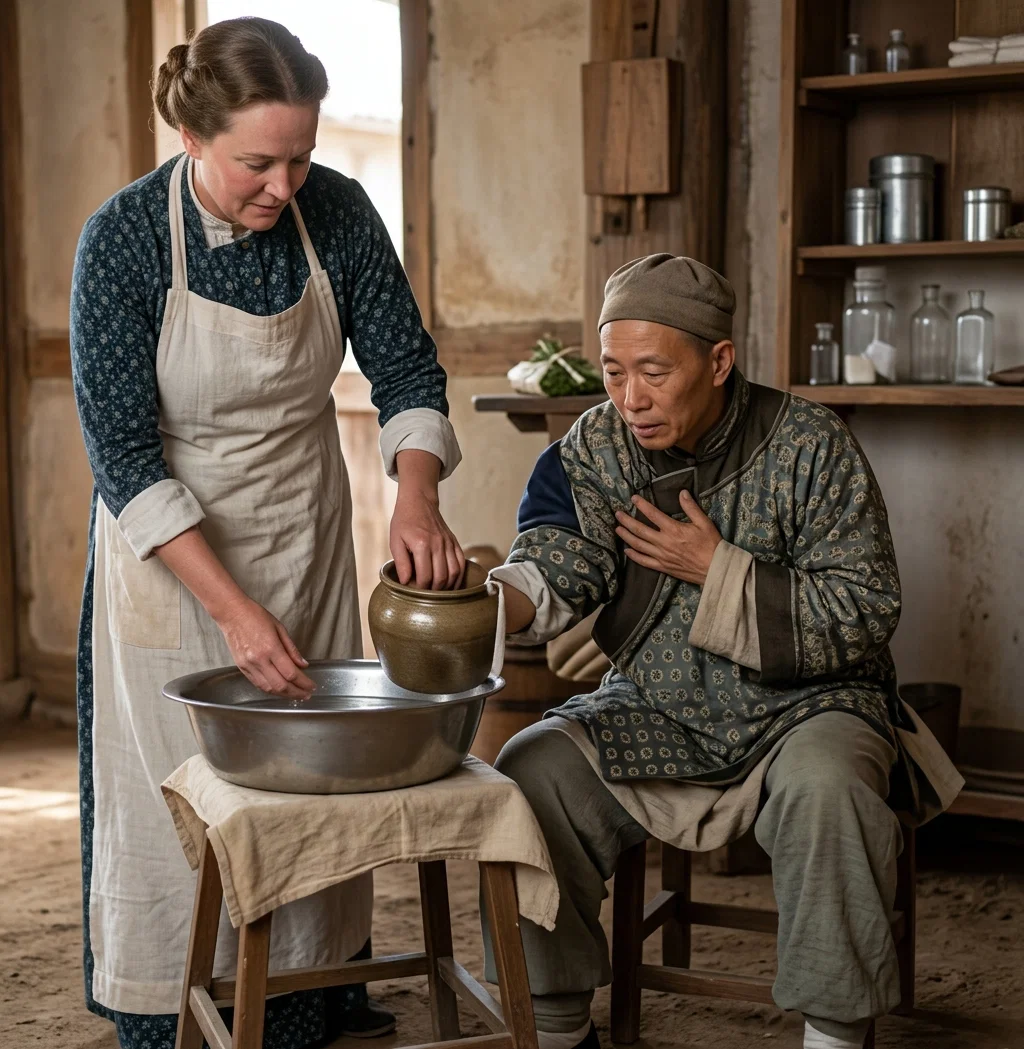
“COME ye after me, and I will make you to become fishers of men.” With these words Christ not only called Peter and Andrew, but also made plain that in the catching of men, as in the catching of fish, there are various methods that may be employed. There are two methods commonly used in catching fish: one is the hook-and-line method, and the other is the net method. Needless to say that more fish are caught with the net than with the hook and line. Applying this to the work of fishing for men, the Lord has indicated a net method of catching men, which he himself made use of, and which has been made use of by his followers in every land; namely, the medical missionary work.
In showing what opportunities there are for the medical missionary work in China, and in helping those who are in training to get an idea of the conditions they will meet in the mission field, I shall give a somewhat detailed account of the work which Mrs. Selmon and I have done during the last few weeks.
Recently we left Shanghai for a trip to our mission station in Ying-shang. Ying-shang is a city in the province of Anhwei, seven days’ journey to the northwest of Shanghai. Our mission work there is in charge of a Chinese evangelist, Brother C. D. Han, and his wife. Before the coolies had brought all our baggage from the boat, two sick persons came for help. They had heard we were coming, and some days before our arrival they had come in from their homes in the country, a distance of more than ten miles.
A room ten feet long by eight feet wide was fitted up for a temporary dispensary, and here we cared for the sick every afternoon from two o’clock until five. During the remaining hours of the day we conducted for eight days a general meeting of all the Sabbath keepers in that section. Before the general meeting, a trip was made to the two outstations. Following the general meeting, we had a three weeks’ Bible institute. After closing the institute the forenoons were spent in teaching in our church school and in drilling the Chinese teacher in modern methods of teaching.
It was some days before the report of our arrival became noised abroad to any extent. There was also a downpour of rain for eight days, which made the roads impassable, so that our little dispensary was open only three hours a day for five weeks.
Every case was examined and treated by either Mrs. Selmon or me. It was our purpose to do the best that could be done under the circumstances for every one that came for help, rather than to run through a large number of cases with a snapshot diagnosis and a dose of Epsom salts for treatment. This is a method that is not so very uncommon in medical work where such large numbers are treated. But in this instance most of the treatments could have been given by trained assistants working under our direction; and with a dispensary properly fitted up and a corps of trained assistants, we could easily have cared for four or five times as many patients every afternoon as we were able to care for under the circumstances.
As the people came, they paid an examination fee of fifty cash (about two cents United States money), and were given a numbered slip. We are obliged to hold quite rigidly to the payment of this fee. Of course exception is made in the case of those who are really sick and cannot pay even this small sum. Where no examination fee is charged, crowds of idlers come and simply consume time. Out of one hundred Chinese it will barely be possible to find more than four or five who do not have some sort of bing (disease).
TREATING THE SICK
The chronic grumblers are very keen on coming to the foreign doctor for an examination and advice; but they are seldom willing to part with a cash for any treatment that may be required; and in case medicine is given to them, they may throw it away, or sell it to some one else supposed to be suffering with a similar malady. After paying the examination fee the patients wait in the chapel, where an evangelist and a Bible woman are either preaching or conversing with them.
During the five weeks 259 persons were treated. This number is exclusive of the several hundred who came with itch and ordinary malaria. As there were so many of these, and as they came at all hours of the day and were usually looked after by the Chinese assistant, no record was kept of them. A large number of the sick whom we treated came back the second time, and some had to return several times. There were in all 216 returns, making a total of 475 dispensary cases.
In the treating of diseases peculiar to women there is, in China, certainly a unique opportunity presented to the woman medical missionary. China has a superabundance of quack doctors, but, fortunately for the women, they are all men; and Chinese custom does not allow them to do more than feel the pulse of a sick woman and make out a prescription. The result is that no one professes to be able to cure the women, and so they do not even dream that there is any help for them, but suffer patiently year after year with conditions that can easily and quickly be relieved by modern methods of treatment. The condition of many of the Chinese women who come to the dispensary, shows that they are sufferers probably beyond the women of any other land, with the possible exception of India.
The widespread prevalence of disease in China should not lead to the conclusion that the climate is especially unfavorable to health; for, taking the country as a whole, climatic conditions are as good as will be found in any other nation of this size. But the people, old and young, high and low, are ignorant, densely ignorant, of the simplest principles of hygiene and the nature and treatment of disease. No thought has been taken in the past by the government for the physical welfare of this countless number of human beings. Very recently there has arisen some agitation over this among the leaders of the new China, but the task can be accomplished only by the education of about four hundred million people.
The principal diseases met with are affections of the eye, parasitic skin diseases, malaria, infections and abscesses, female pelvic diseases, tuberculosis, ear troubles, leg ulcers, intestinal parasites, digestive disturbances, syphilis, and bronchitis. The order of frequency of some of these diseases would of course vary greatly, depending on the locality and the time of year. There are numerous cases of tumors, stone in the bladder, and heart lesions; and, in fact, most of the ordinary cases met with in a general dispensary are included in the list, together with several of the diseases peculiar to the tropics, such as beriberi, kala azar, elephantiasis, etc.
Of the two hundred and fifty-nine persons examined thirty were afflicted with conditions that required a major surgical operation. Many of these pleaded with us to operate. Having neither place nor proper equipment, we were compelled to send them to a Presbyterian hospital, eighty miles to the east of Ying-shang. It is safe to say that not more than two of the thirty were able to go.
In the estimation of results accruing from such a work as is mentioned above, it should be stated at the outset that the most fruitful medical work, judged from the number who are led in a short time to accept the gospel, is that carried on in a hospital. In a hospital the patients are resident for some time, and cannot but see and hear the gospel daily. Many of them, having been helped physically after they had given up all hope, are ready to learn the doctrine that leads people to do for others what the doctors and nurses have done for them. Moreover, any line of efficient medical missionary work results in a kindly feeling on the part of the public toward the missionary and his work. He is looked on as one who helps people. In some cases the influence of the help received from a visit to the dispensary is very marked. Many who have publicly vowed they would rather die than enter a Yesu tong (Jesus hall), will, when seeking relief from physical suffering, come into a gospel hall to see the doctor. In some cases those of other missions who have heard nothing but evil reports of us and our work, are, through coming to our dispensary, brought into contact with us, and get a glimpse of the spirit of our work.
The work to be done in this field is a proposition that we can grapple with in but one way, and that is by the training of an army of Chinese young men and women who will give the message. Viewed from this standpoint, all medical missionary work should be training work.19—the training of Chinese young men and women in the fundamentals of hygiene and in the recognition and treatment of the common maladies. The need of this training is surely not less than the need of such training for our young people in the homelands. To the one who has been in the mission fields the need for such training seems many, many times more imperative than is the need in the homelands. We find that the majority of our present staff of Chinese evangelists and Bible women are earnestly desirous of securing some training in medical ways. Any missionary who has ever been in the interior of China can testify to the fact that the Chinese people look upon the missionary as one who can help the sick; and being besieged day after day by the sick, has led more than one missionary without a medical training to leave his work for the time being, and enter school for a preparation that would enable him to treat the sick. Our evangelists in the interior have a similar experience, as the sick come to them for help. And why should it be thought strange for the sick to come for help to the man or woman who holds up Jesus and the work he did as the perfect example?