Native Life and Mission Work

6%

Review and Herald Publishing Association · Takoma Park Station, Washington, D. C. · Apr 8, 1915

FromReview and Herald, Vol. 92, No. 17.

Read the full edition

Native Life and Mission Work

Southern Rhodesia, South Africa

(Concluded)
T. J. GIBSON

Religion

THE religious belief of the natives is so variously manifested that it is difficult to define. They have the common belief in a Creator, or Great Spirit, and they are very superstitious. They have some forms of worship, the most common of which perhaps is the praying for rain. In this, they pray to the spirits of their dead chiefs to intercede for them with the Great Spirit. They visit the graves in succession, having a ceremony at each, and then a general assembly at the conclusion. A priesthood officiates in such a ceremony, which may last two or three weeks at a time. We know of one instance where they worshiped a large cream-of-tartar tree, and at the time when rains were due they brought garlands of wild flowers, placing them on sticks against this tree, and there offered up their prayers. Witchcraft, though forbidden by law, is still practiced among them, and leads to a great deal of evil and mischief.

Educational Advantages

Missions have been responsible for most of the school work done for the native. Along the coast this work has been carried on for the past century, but in Rhodesia and other parts of the interior it is yet in its infancy. Industrial schools are most favored by the government, and are considered to give the best results. A great deal of day school work is also done, and is a feeder for the industrial institutions. Many of the mining camps have night schools for their native help. These are well patronized, and are usually taught by native teachers from the missions. Several denominations have night schools in the towns. At most of the industrial missions, the natives are taught general farm work, brickmaking, and building. Printing, bookbinding, and trades classes are carried on by some of the older institutions with good results.
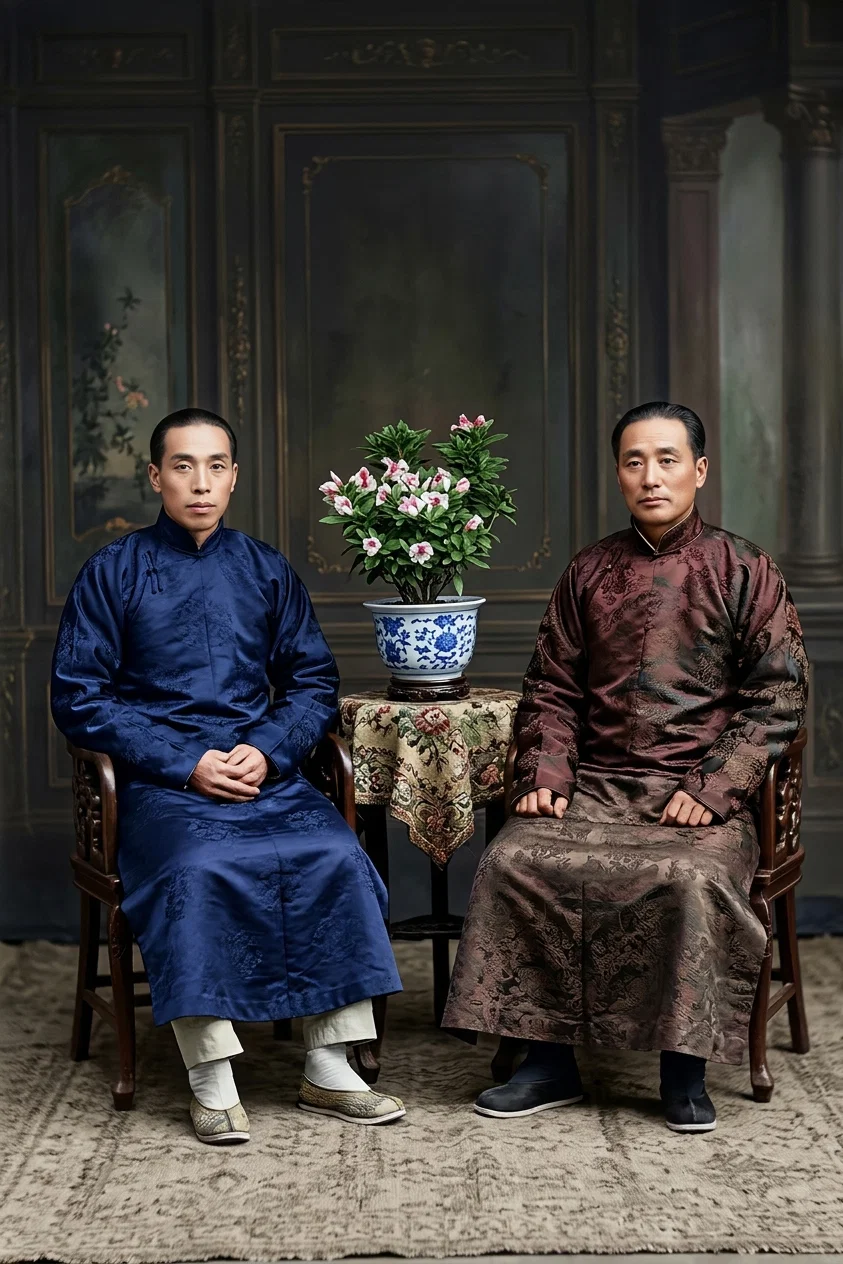
TWO COLPORTEURS IN HUPEH, CHINA
At most of our mission day schools, only the vernacular is taught, first with a primer and then the Scriptures. From these schools are brought to the main stations the young people, both boys and girls, who are the most apt in their studies. At the main stations the native language is taught first, and as soon as a pupil is able to read the Scriptures in his own tongue, he is then given an English primer, followed by standard readers. Reading, writing, spelling, simple arithmetic, grammar, physiology, and geography make up the curriculum of the school. Naturally the Scriptures are most studied and are readily accepted by the young people coming into the schools. The Bible is their one book, and its plain teaching is final, and its authority unquestioned.
The older people who come in touch with the missions, are for the most part silent lookers-on. We think of one notable exception in this instance, a middle-aged man, at Somabula Mission, Gwelo. He must have been over forty years of age when he joined the mission family, not as a pupil, but as a water carrier. He is partially blind, but finds his way between the spring and the camp. He was there several years before he manifested any particular interest. Finally he gave testimony of a desire for a renewed life, and was converted and baptized. He is now about fifty years old, and apparently a sincere Christian. He is always happy. We hear of other cases of those advanced in life, but they are not frequent.

Dress

The dress of the natives in their rural state consists chiefly of skins with the hair scraped off. These skins are used in the form of aprons tied around the waist, also under the arms or about the shoulders. The older women adhere to their own way of dress, but the younger women are adopting short, plaited skirts, made from imported cotton goods; also shawls. The old men frequently wear one or two European-made garments. The ordinary shirt or singlet, and perhaps a waistcoat, jacket, or overcoat, are sometimes adopted, but very seldom the trousers or hat. They wear sandals of rawhide. Children up to their teens are not much encumbered. Ornaments in the form of necklaces, bracelets, and anklets, composed of beads, seeds, teeth, tusks, and even of bones and horns, are extensively used. Brass rings and spirals are worn about the neck, forearm, and ankles, and seem to be favorites with women. Sometimes they have a spiral collar to the depth of four inches.

Results of Mission Work

One of the first indications of improvement we observe in the raw natives who come to us is that they begin to clean up and wash their clothing. In very rare cases do we need to remind the newcomer that liquor and tobacco are not to be used on the mission farm. We have one man here with us now, between thirty-five and forty. Doubtless he had been using tobacco for ten or fifteen years, but he gave it up without any apparent struggle. Not only do the natives clean up when they come in contact with the missions, but there is soon an indication of improved health. They invariably fatten. We have noticed this so often that we are convinced of its certainty. This becomes very marked when a boy leaves for a few months and returns.
We do not see the all-round improvement in their lives that we wish, but considering the short time they have been in contact with civilization and missions, we may well wonder at the advancement that has been made. In estimating the results of mission work for the native, we do well to consider the words of Isaiah, “Look unto the rock whence ye are hewn, and to the hole of the pit whence ye are digged.” After eighteen hundred years' proclamation of the gospel among us Europeans, the text still reads, “Look . . . to . . . the pit whence ye are digged.” There are many real jewels amongthis people, and we find them in our work. We have with us a Basuto boy who came to this country from the Transvaal about twenty years ago as a lead boy for oxen, and he followed the transport life until about five years ago. He accepted Christianity soon after joining the mission school, and is now one of our most stanch believers.
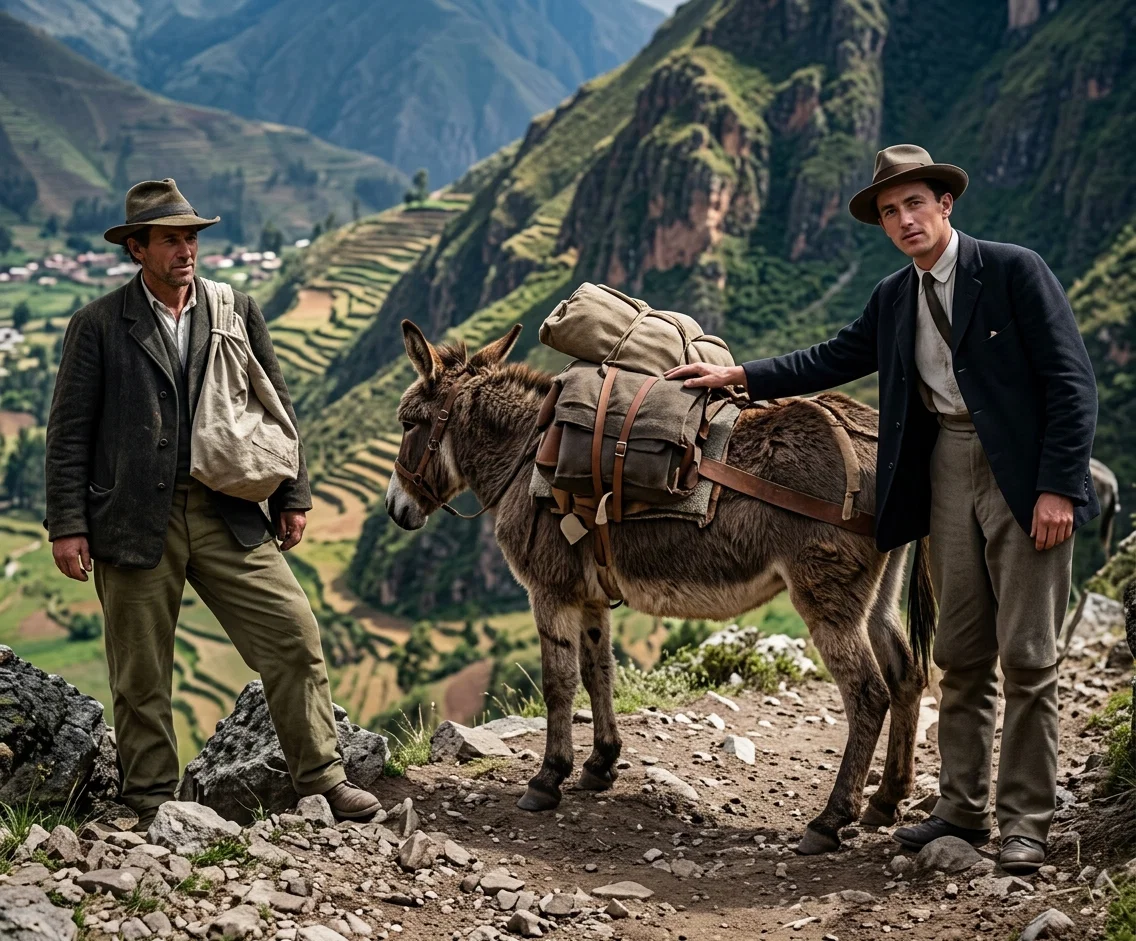
BRETHREN MAXWELL AND STAUFER EN ROUTE TO LANCA, PERU
Though he is about forty years old, he has made remarkable progress, especially in the Bible. He has a burden for souls, and two months ago we started him out as an evangelist. We have three other boys about the same age preparing for evangelistic work. The younger men with more schooling are used as teachers, but the older men have greater influence in doing pioneer work. It is on these we depend to open up the work at native villages and arrange for out-schools.