A Visit to India

6%

Review and Herald Publishing Association · Washington, D. C. · Apr 15, 1915

FromReview and Herald, Vol. 92, No. 19.

Read the full edition

A Visit to India

Our journey across the Indian Ocean from West Australia to Ceylon was pleasant, quiet, and yet quite eventful. We left Freemantle in the Orient liner “Osterly,” November 3, and landed at Colombo the morning of the twelfth. About the third day out we saw in the distance ahead of us great clouds of smoke rolling up, suggesting a heavy forest fire on some island. As we drew nearer, we discovered that it was a convoy of thirty-six transports carrying 30,000 Australasian soldiers to the seatof war.
These transports were being protected by eight men-of-war — one leading, one on each side near by, one following up the rear, two scouting at some distance to the northwest, and two doing the same work to the southwest. Forty-four great steamers, carrying between thirty and forty thousand armed, fighting men, and keeping a steady but noiseless step on the mighty deep, was a remarkable sight, and it somehow made one feel peculiarly strange.
Our vessel bore down close enough to the first line of twelve ships to enable our passengers and the soldiers to exchange greetings, though for doing this our captain was reprimanded by the commodore of the transport fleet. Orders were flagged to us not to write of this to any of our friends within fourteen days, and to destroy, or at least keep secret, all photographs that may have been taken as we passed the transports. Everybody seemed disposed to comply with the wishes of the admiralty, and I judge all kept the secret very well.
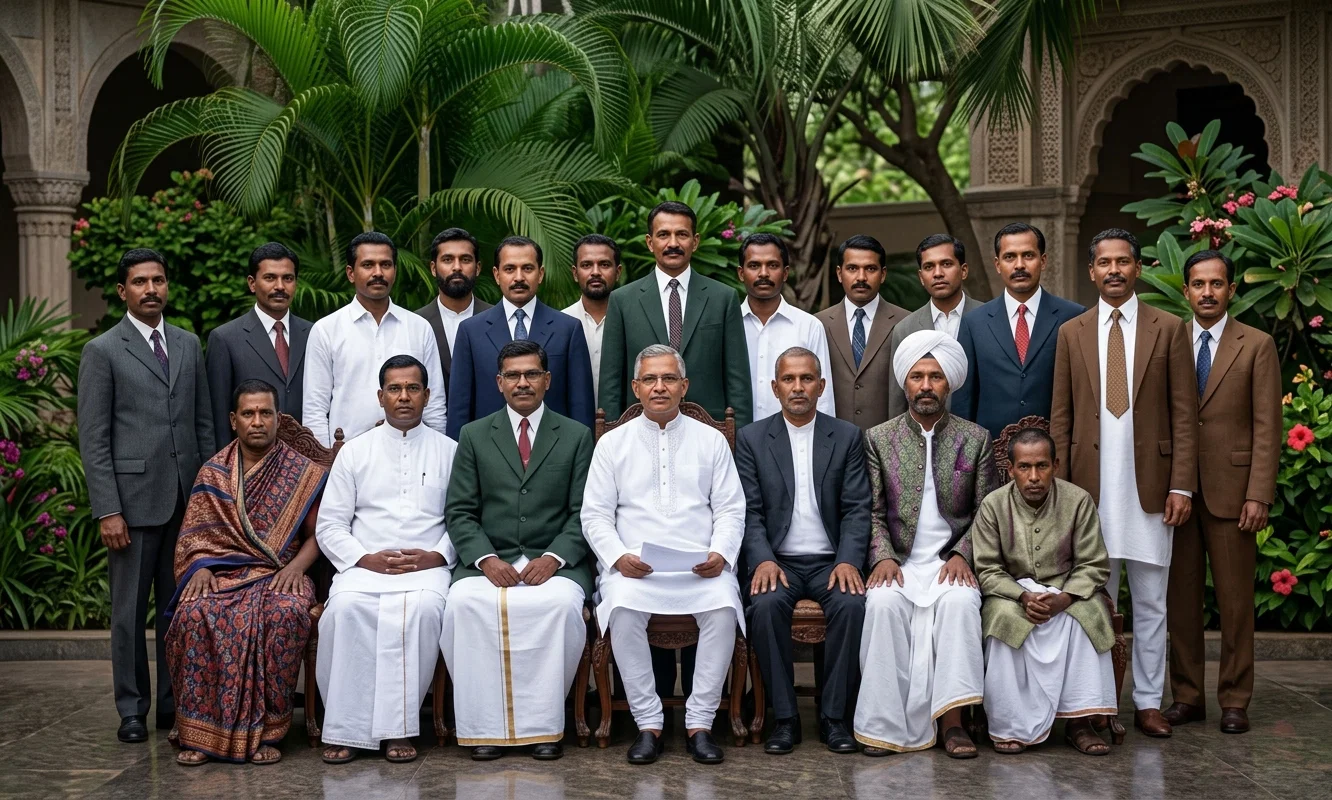
NATIVE WORKERS, INDIA UNION MISSION
The regular course of our steamer was by the Cocos Islands, but for some reason our captain steered fifty or sixty miles to the south, and all the way steamed ahead through the darkness of the night with all the lights of the ship out. One day I remarked to an officer that it looked rather dangerous to me not to have even a light in the front mast. “Yes, it is,” said he, “but that is one of the dangers war causes.”
We were up at an early hour on the morning of November 12, to get our first glimpse of Ceylon, that island of which we had so many times sung:—
“What though the spicy breezes Blow soft o’er Ceylon’s isle, Where every prospect pleases, And only man is vile.”
By eight o’clock we had dropped anchor in Colombo harbor, and launches and rowboats were coming to us from the wharves. From Australia I had notified Prof. H. R. Salisbury of my plans to reach Colombo that day, and we were hoping to find him or Elder J. S. James there to meet us. Launches and dinghies came and left, but none of them brought a familiar face to us.
We had about concluded that we should have to pilot ourselves ashore, when a voice sang out sharp and clear, “Brother Daniells!” Looking down, I saw Brother M. M. Mattison, from Texas, waving to us. The thrill that ran through our hearts is known only to our dear workers out in these mission fields. I first met Brother Mattison while he was a student in Keene Academy. The last interview I recall having with him was when we made final arrangements for him to come to India. And now, on my arrival at Ceylon, he extends to me a warm, cordial welcome — the kind a Texan gives.
In due time we were ashore. Communications from Professor Salisbury notified us that new military regulations had made him one hour too late to catch the ferry across the strait that separates India and Ceylon, but that he was waiting at the landing port on the Indian side, and for us to leave Colombo by the evening train. Although I greatly desired to spend a few days in Ceylon, it seemed best to hasten on in order to carry out the program that had been planned by the brethren.
We greatly enjoyed the day in Ceylon. It was gratifying to find Brother Mattison so familiar with the customs and language of the people that he could transfer our luggage, make all arrangements for our railway accommodations, and pilot us around the city with perfect ease. During the day we were able to get at least a glimpse of the best and most interesting features of Colombo. The business part of the city is quite English in appearance, and it is up-to-date in many respects, with modern facilities everywhere. The semitropical foliage gives the residence quarters a most attractive appearance.
But that which interested us most of all was the question of proclaiming the message for this hour to the three millions of Ceylon. Thus far we have done very little work in this island. Several years ago Elder Harry Armstrong settled in Ceylon and began a series of tent meetings, but owing to failing health his work was cut short, and he left for England. In addition to this short effort, a little has been done in canvassing for our books and periodicals. Brother Mattison’s work during the half year he was in that field was in behalf of our Indian periodicals. He reports that he finds the people ready to purchase our literature, and he urges most earnestly that active, permanent work be entered upon at once. There are a few scattered Sabbath keepers in the island who will give a worker a cordial welcome and substantial support. The Indian Union Committee is planning to locate an evangelist in Colombo as soon as one can be secured. The first effort will be in English, to raise up a strong church in the city. It is intended that when we enter Ceylon this time, it will be to stay until our work is done. We cannot help feeling very anxious that the Lord will guide in the selection of just the right laborers to locate in that promising field.
A ten hours’ run by rail took us from Colombo through the island to Talaminar, on the northwest coast. This is the terminus of that line of railway. Here we transferred to a ferry that took us across to Dhanuskoti, on the Indian side of the strait. The distance is twenty-two miles. This route across the strait is called “Adam’s Bridge.” There is a ridge of sand bars all the way. The governments of India and Ceylon have extended their railway lines along this ridge until they are only forty miles apart. It is the plan eventually to join the lines, thus making an all-rail route from the northwestern point of India to Colombo.
As our ferry drew near the wharf at Dhanuskoti, we were delighted to see our dear friend and fellow worker, Professor Salisbury, awaiting us. As this was Friday, it was planned that we should run to Trichinopoli to spend the Sabbath with Brother and Sister J. S. James. What a privilege it was to meet these dear fellow workers whom we had known years before, in Iowa and Minnesota! We found them comfortably located and full of courage in their work. Brother James does not look so strong and vigorous as we should wish. However, he is exercising care and is laboring hard. The work in southern India has become very dear to Brother and Sister James, and their strong desire and earnest prayer is that they may be permitted to remain in that field until the work of God closes, and the workers are gathered home. It is truly cheering to find this earnest missionary spirit filling the hearts of our workers in these distant and difficult fields.
A. G. DANIELLS.