The Signs of the Times

1%

Review and Herald Publishing Association · Takoma Park, Washington, D. C. · May 10, 1915

FromReview and Herald, Vol. 92, No. 23.

Read the full edition

MODERN INVENTIONS
MODERN INVENTIONS

The Signs of the Times

God the Revealer of Secrets

A BIBLE STUDY

1. How may the people of this world know beforehand the things that are coming upon the earth? “Surely the Lord God will do nothing, but he revealeth his secret unto his servants the prophets.” Amos 3:7.
NOTE.— One hundred and twenty years before the flood, God revealed that coming event to Noah, and sent him, “a preacher of righteousness,” to warn the world of its impending destruction. Every blow struck in building the ark was a warning message to the world. Jonah, also, was sent to Nineveh to warn the people of the coming judgment, unless they should repent. Thus, from the beginning, God has sent his prophets with messages of warning; and has hung out signs and wonders in the heavens and in the earth, that men might have opportunity to repent and turn to the Lord.
2. What sign had been foretold by the prophet Isaiah by which Christ, at his first advent, might be known as the Messiah? “Therefore the Lord himself shall give you a sign; Behold, a virgin shall conceive, and bear a son, and shall call his name Immanuel.” Isa. 7:14. For fulfillment see Matt. 1:22, 23.
3. Where had the prophet said Christ should be born? “But thou, Bethlehem Ephrathah, though thou be little among the thousands of Judah, yet out of thee shall he come forth unto me that is to be ruler in Israel.” Micah 5:2. For fulfillment see Matt. 2:1.
4. What prophet had foretold Christ’s ride into Jerusalem? “Rejoice greatly, O daughter of Zion; shout, O daughter of Jerusalem; behold, thy King cometh unto thee; he is just, and having salvation; lowly, and riding upon an ass, and upon a colt the foal of an ass.” Zech. 9:9. For fulfillment, see Matt. 21:4, 5.
5. For what did Christ reprove the Pharisees and Sadducees? “O ye hypocrites, ye can discern the face of the sky; but can ye not discern the signs of the times?” Matt. 16:3.

The Destruction of Jerusalem Foretold

6. In what words did Jesus foretell the destruction of Jerusalem? “And when he was come near, he beheld the city, and wept over it, saying, If thou hadst known, even thou, at least in this thy day, the things which belong unto thy peace! but now they are hid from thine eyes. For the days shall come upon thee, that thine enemies shall cast a trench about thee, and compass thee round, and keep thee in on every side, and shall lay thee even with the ground, and thy children within thee; and they shall not leave in thee one stone upon another; because thou knewest not the time of thy visitation.” Luke 19:43-44.
7. What pitiful appeal did he make to the impenitent city? “O Jerusalem, Jerusalem, thou that killest the prophets, and stonest them which are sent unto thee, how often would I have gathered thy children together, even as a hen gathereth her chickens under her wings, and ye would not!” Matt. 23:37.
8. As he was about to leave the temple, what did he say? “Behold, your house is left unto you desolate.” Verse 38.
NOTE.— That which was to fill up the cup of their iniquity was their final rejection and crucifixion of Christ, and their condemnation and persecution of his apostles and people after his resurrection. See Matt. 23:29-35; John 19:15; Acts 4-8.

Our Lord’s Great Prophecy

9. Hearing these words, what questions did the disciples ask? “Tell us, when shall these things be? and what shall be the sign of thy coming, and of the end of the world?” Matt. 24:3.
NOTE.— Christ’s answers to these questions are worthy of the most careful study. The destruction of Jerusalem and the overthrow of the Jewish nation attending it are a type of the final destruction of all the cities of the world, and the overthrow of all nations. To some extent, therefore, the descriptions of the two great events seem to be blended. When Christ referred to the destruction of Jerusalem, his prophetic words reached beyond the event to the final conflagration when the Lord shall rise out of his place “to punish the inhabitants of the earth for their iniquity,” and when the earth “shall disclose her blood, and shall no more cover her slain.” Isaiah 26:21. Thus the entire discourse was given, not for the early disciples only, but for those who were to live during the closing scenes of the world’s history. During the discourse Christ did, however, give definite signs, both of the destruction of Jerusalem and of his second coming.
10. In his reply, how did Christ indicate that neither the end of the world nor of the Jewish nation was immediately at hand? “Jesus answered and said unto them, Take heed that no man deceive you. For many shall come in my name, saying, I am Christ; and shall deceive many. And ye shall hear of wars and rumors of wars; see that ye be not troubled: for all these things must come to pass, but the end is not yet.” Matt. 24:4-6.
11. What did Christ say of the wars, famines, pestilences, and earthquakes which were to precede these events? “All these are the beginning of sorrows.” Verse 8.
NOTE.— These were to precede and culminate in the great calamity and overthrow, first, of Jerusalem, and finally of the whole world, for, as already noted, the prophecy has a double application, first, to Jerusalem and the Jewish nation, and second, to the whole world; the destruction of Jerusalem for its rejection of Christ at his first advent being a type of the destruction of the world at the end for its rejection of Christ in refusing to heed the closing warning message sent by God to prepare the world for Christ’s second advent.
12. In what language did Christ briefly describe the experiences of his people previous to these calamities? “Then shall they deliver you up to be afflicted,and shall kill you; and ye shall be hated of all nations for my name’s sake. And then shall many be offended, and shall betray one another, and shall hate one another. And many false prophets shall rise, and shall deceive many. And because iniquity shall abound, the love of many shall wax cold.” Verse 9-12.
13. Who did he say would be saved? “But he that shall endure unto the end, the same shall be saved.” Verse 13.

The Gospel to All Nations

14. When did Christ say the end would come? “And this gospel of the kingdom shall be preached in all the world for a witness unto all nations; and then shall the end come.” Verse 14.
NOTE.— In 60 A. D. Paul carried the gospel to Rome, which was then the capital of the world. In A. D. 64 he wrote of the saints of “Cæsar’s household” (Phil. 4:22); and the same year he says that the gospel had been “preached to every creature which is under heaven” (Col. 1:23). Very soon after this (October, 66 A. D.) the Romans began their attacks against Jerusalem; and three and one-half years later the overthrow of the city and of the Jewish nation followed in the notable five months’ siege under Titus, in the spring and summer of 70 A. D. Thus it was respecting the end of the Jewish nation; and thus it will be in the end of the world as a whole. When the gospel, or good news, of Christ’s coming kingdom has been preached in all the world for a witness unto all nations, the end of the world—of all nations—will come. As the end of the Jewish nation came with overwhelming destruction, so will come the end of the world. Armageddon, the battle of the nations, will be fought, and the world will be swept with the besom of destruction under the seven last plagues.

Signs of the Destruction of Jerusalem

15. What sign did Christ mention by which his disciples might know when the destruction of Jerusalem was near? “And when ye shall see Jerusalem compassed with armies, then know that the desolation thereof is nigh.” Luke 21:20.
16. When this sign appeared, what were the disciples to do? “When ye therefore shall see the abomination of desolation, spoken of by Daniel the prophet, stand in the holy place, (whoso readeth, let him understand;) then let them which be in Judæa flee into the mountains.” Matt. 24:15, 16.
NOTE.— In October, 66 A. D., when Cestius came against the city, but for some unaccountable reason suddenly withdrew his army from it, the Christians discovered in this the sign foretold by Christ, and fled. After the departure of Cestius, Josephus, in his “Wars of the Jews,” chapter 20, says that “many of the most eminent of the Jews swam away from the city, as from a ship when it is going to sink.” It is a remarkable fact that in the terrible siege which occurred under Titus three and one-half years later, not a single Christian is known to have lost his life, while 1,100,000 Jews are said to have perished in it. Here is a most striking lesson on the value and importance of studying and believing the prophecies, and giving heed to the signs of the times. Those who believed what Christ had said, and watched for the sign which he had foretold, were saved, while the unbelieving perished. So it will be in the end of the world. The watchful and believing will be delivered, while the careless and unbelieving will be snared and taken. See Matt. 24:36-44; Luke 21:34-38; 1 Thess. 5:1-6.
17. When the sign appeared, how suddenly were they to flee? “Let him which is on the housetop not come down to take anything out of his house; neither let him which is in the field return back to take his clothes.” Matt. 24:17, 18.

A Period of Great Tribulation

18. What trying experience did Christ then foretell? “For then shall be great tribulation, such as was not since the beginning of the world to this time, no, nor ever shall be.” Verse 21.
NOTE.— In paragraph 4 of his preface to the “Wars of the Jews,” Josephus, referring to the destruction of Jerusalem, says: “The misfortunes of all men, from the beginning of the world, if they be compared to those of the Jews, are not so considerable.” In this terrible calamity, the prophecy of Moses recorded in Deut. 28:47-53, was literally fulfilled. He said, “Thou shalt eat the fruit of thine own body, the flesh of thy sons and of thy daughters, . . . in the siege, and in the straitness, wherewith thine enemies shall distress thee.” For an account of the fulfillment of this, see Josephus’s “Wars of the Jews,” book 6, chap. 3, par. 4. Following the destruction of Jerusalem came the persecution of the early Christians under the pagan emperors during the first three centuries of the Christian era, that begun under Diocletian in 303 A. D., and continuing for ten years (Rev. 2:10), being the most bitter and extensive persecution of God’s people the world had yet witnessed. Following this came the still greater and more terrible persecution of the saints during the long centuries of papal supremacy, foretold in Dan. 7:25 and Rev. 12:6. All these tribulations occurred under either pagan or papal Rome.
19. For whose sake did Christ say the period of papal persecution would be shortened? “And except those days should be shortened, there should no flesh be saved; but for the elect’s sake those days shall be shortened.” Matt. 24:22.
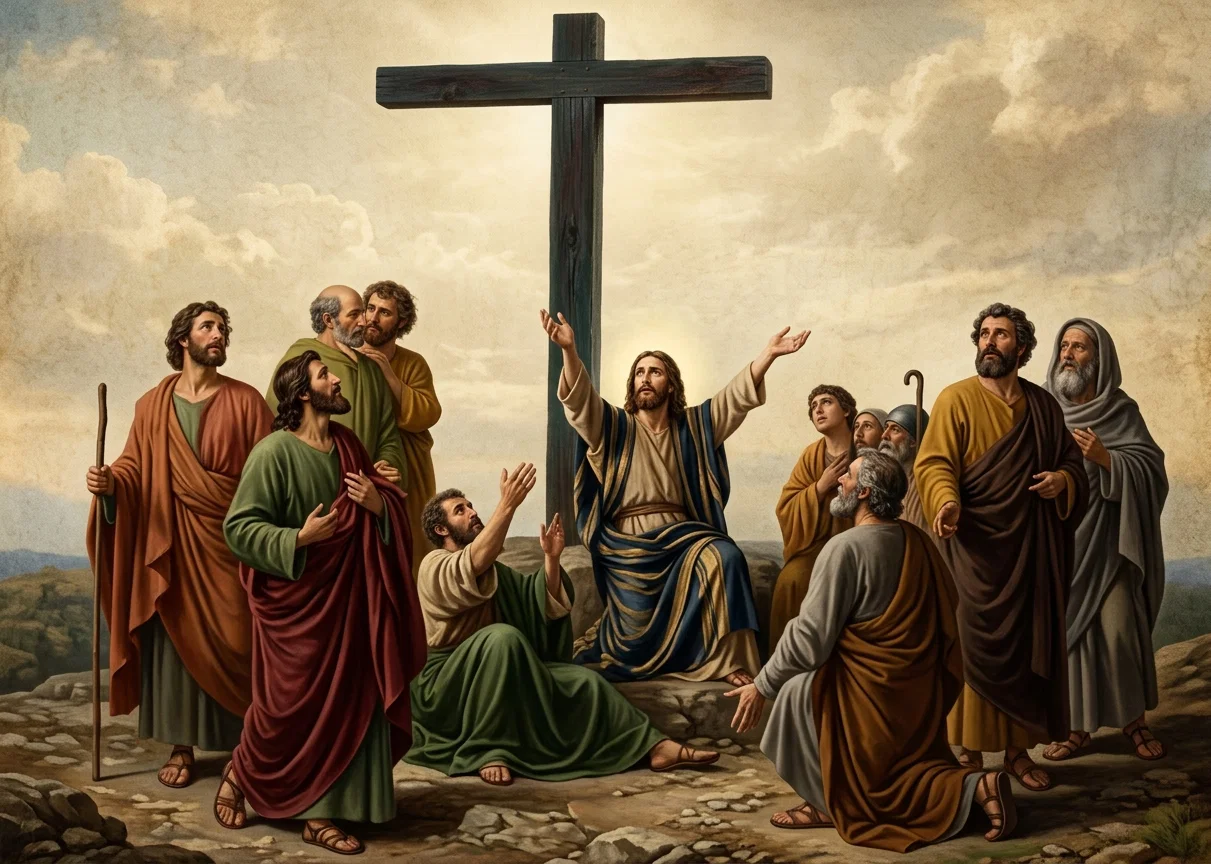
GO YE INTO ALL THE WORLD, AND PREACH THE GOSPEL TO EVERY CREATURE
NOTE.— Through the influence of the Reformation of the sixteenth century, and the movements which grew out of it, the power of the Papacy to enforce its decrees against those it pronounced heretics was gradually lessened, until persecution ceased almost wholly about the middle of the eighteenth century—the beginning of an epoch of freedom.

Signs of Christ’s Second Coming

20. Answering the question as to what would be the sign of his coming and the end of the world, what did Christ say? “There shall be signs in the sun, and in the moon, and in the stars; and upon the earth distress of nations, with perplexity; the sea and the waves roaring; men’s hearts failing them for fear, and for looking after those things which are coming on the earth; for the powers of heaven shall be shaken.” Luke 21:25, 26.
21. When were the first of these signs to appear, and what were they to be? “Immediately after the tribulation of those days shall the sun be darkened, and the moon shall not give her light, and the stars shall fall from heaven.” Matt. 24:29.
22. How is this expressed by Mark? “But in those days, after that tribulation, the sun shall be darkened, and the moon shall not give her light.” Mark 13:24.
NOTE.— As already noted, papal persecution almost wholly ceased about the middle of the eighteenth century. Then, true to Christ’s words, the signs of his coming at once began to appear, and before the 1260-year period of Dan. 7:25, Rev. 12:6, 14, and Rev. 13:5, allotted to papal persecution, had closed.

The Darkening of the Sun

23. When was there a wonderful darkening of the sun? Ans.— On May 19, 1780.
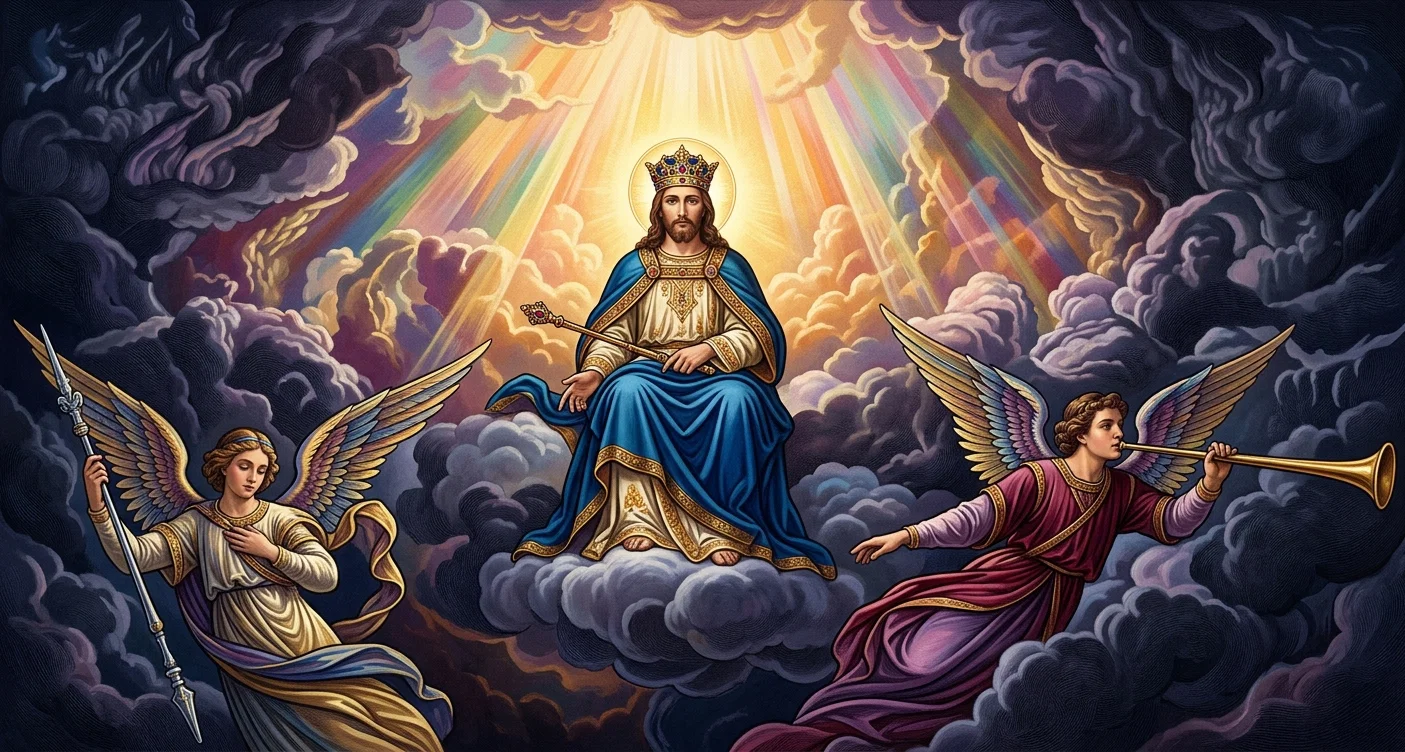
CHRIST COMING IN GLORY
NOTE.— May 19, 1780, is known in history as “the dark day.” On this day over a large portion of the New World, upon which at this time the eyes of all the world were centered, there occurred, at midday, a remarkable darkness. Candles were lighted in many houses. The birds were silent and disappeared. The fowls retired to roost. In harmony with the impression God evidently designed should be made by the sign, many thought the day of judgment was at hand.

The Darkening of the Moon

24. When did the moon refuse to give her light? The night following the darkening of the sun, May 19, 1780.
NOTE.— Although the moon had failed only the night before, the darkness of this night was so intense that for a time no luminous body whatever appeared in the heavens, and a sheet of white paper could not be seen when held within a few inches of the eyes.

The Falling of the Stars

25. What sign was to follow the darkening of the sun and the moon? “And the stars shall fall from heaven.” Matt. 24:29.
26. When did the stars fall, as here predicted? Ans.— Nov. 13, 1833.
NOTE.— On the morning of Nov. 13, 1833, there occurred the most wonderful exhibition of shooting stars the world has ever seen. Those who witnessed it, says Professor Olmsted, the celebrated astronomer of Yale College, “probably saw the greatest display of celestial fireworks that has ever been since the creation of the world, or at least within the annals covered by the pages of history.” The extent of this shower, he says, “was such as to cover no inconsiderable part of the earth’s surface.” And, like the darkening of the sun and moon, it was considered by many who saw it as “the harbinger of the coming of the Son of man.”

Signs Upon the Earth

27. What were to be the signs on earth of Christ’s coming? “And upon the earth distress of nations, with perplexity; the sea and the waves roaring; men’s hearts failing them for fear, and for looking after those things which are coming on the earth: for the powers of heaven shall be shaken.” Luke 21:25, 26.
NOTE.— This is an exact picture of things in the world today. Through greed of gain, lawlessness, licentiousness, increasing violence, foolish strife between capital and labor, international complications, and preparations for war, the nations are perplexed, and men’s hearts tremble with fear as they look into the future. The elements are also disturbed, as seen in great earthquakes and storms on land and sea.
28. What is predicted of the moral condition of the world in the last days? “This know also, that in the last days perilous times shall come. For men shall be lovers of their own selves, covetous, boasters, proud, blasphemers, . . . lovers of pleasures more than lovers of God; having a form of godliness, but denying the power thereof.” 2 Tim. 3:1-5.
29. How did the apostle Peter say the message of the Lord’s coming would be treated by some? “Knowing this first, that there shall come in the last days scoffers, walking after their own lusts, and saying, Where is the promise of his coming? for since the fathers fell asleep, all things continue as they were from the beginning of the creation.” 2 Peter 3:3, 4.

The Next Great Event

30. What did Christ say was to be the next great event following these signs? “And then shall they see the Son of man coming in a cloud with power and great glory.” Luke 21:27. See Matt. 24:30.
31. When these things should begin to come to pass, what did Christ tell his people to do? “And when these things begin to come to pass, then look up, and lift up your heads; for your redemption draweth nigh.” Luke 21:28.

The Certainty of These Things

32. When the trees put forth their leaves, what do we know? “Now learn a parable of the fig tree; When his branch is yet tender, and putteth forth leaves, ye know that summer is nigh.” Matt. 24:32.
33. What may we know with equal certainty when these signs have been seen? “So likewise ye, when ye shall see all these things, know that it is near, even at the doors.” Verse 33. “So likewise ye, when ye see these things come to pass, know ye that the kingdom of God is nigh at hand.” Luke 21:31.
34. What did Christ say of the certainty of this prophecy? “Verily I say unto you, This generation shall not pass, till all these things be fulfilled. Heaven and earth shall pass away, but my words shall not pass away.” Matt. 24:34, 35.

Be Ready to Meet Him

35. Who alone knows the exact day of Christ’s coming? “But of that day and hour knoweth no man, no, not the angels of heaven, but my Father only.” Verse 36.
36. What did Christ say would be the moral condition of the world just preceding his advent? “But as the days of Noe were, so shall also the coming of the Son of man be. For as in the days that were before the flood they were eating and drinking, marrying and giving in marriage, until the day that Noe entered into the ark, and knew not until the flood came, and took them all away; so shall also the coming of the Son of man be.” Verses 37-39.
37. In view of the fact that we do not know the exact time of Christ’s coming, what important admonition has he given us? “Therefore be ye also ready; for in such an hour as ye think not the Son of man cometh.” Verse 44.
38. What will be the experience of those who say in their hearts that the Lord is not even coming? “But and if that evil servant shall say in his heart, My lord delayeth his coming; and shall begin to smite his fellow servants, and to eat and drink with the drunken; the lord of that servant shall come in a day when he looketh not for him, and in an hour that he is not aware of, and shall cut him asunder (margin, ‘cut him off’), and appoint him his portion with the hypocrites: there shall be weeping and gnashing of teeth.” Verses 48-51.
39. What will God’s faithful servants be doing at this time? “Who then is a faithful and wise servant, whom his lord hath made ruler over his household, to give them meat in due season?” Verse 45.
NOTE.— The “meat in due season” here spoken of evidently refers to the proclamation of the message based upon the signs which indicate the near approach of the Lord. The preaching of this message is what causes scoffers mockingly to ask, “Where is the promise of his coming?”