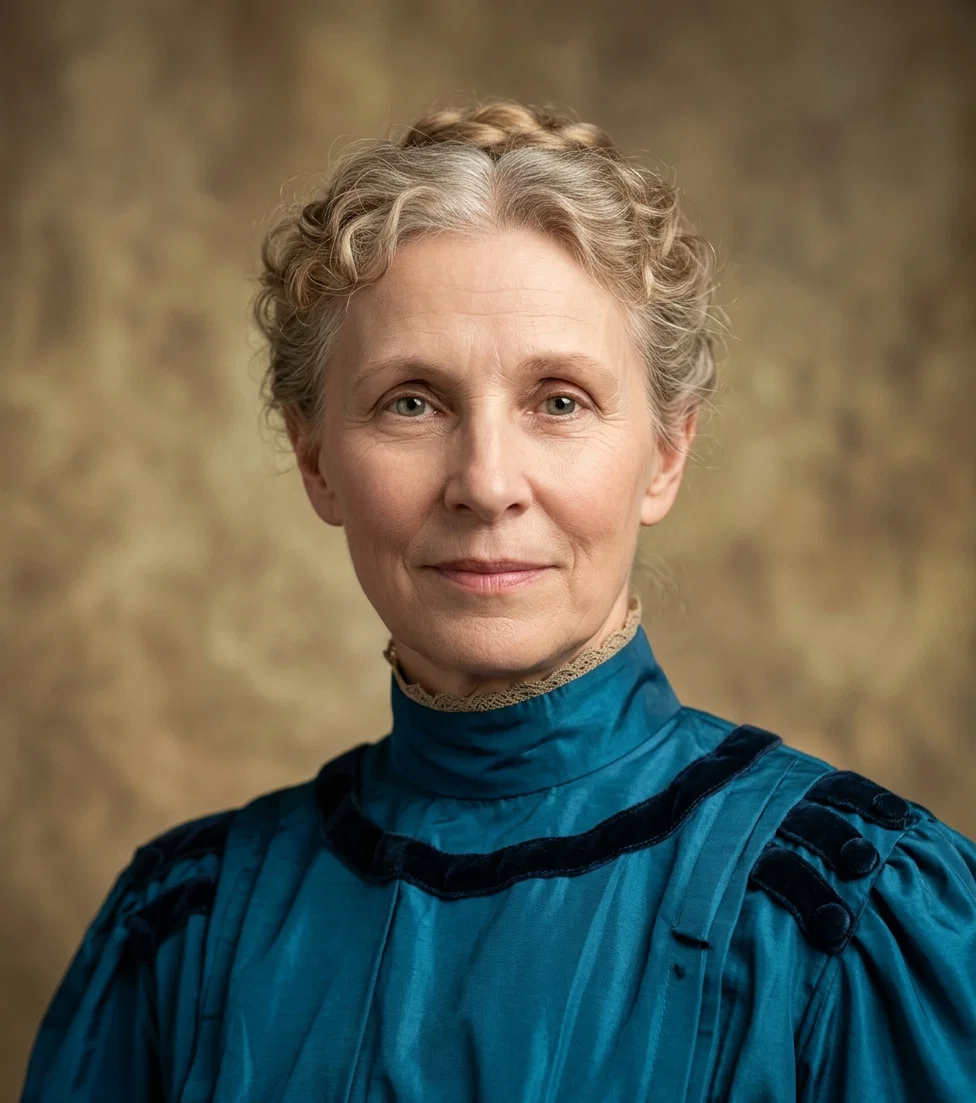
The Review last week announced to its readers the passing to rest of Mrs. C. C. Lewis. We are sure that this word carried sorrow to many hearts. It seems fitting that we should present in this department, which Sister Lewis has conducted with such loving, sympathetic ability during the past year, a record of her life experience.
Elizabeth Ann Wiley was born in Camilla, near Toronto, Canada, Aug. 11, 1857. When she was eleven years old, the family moved to Cuba, Mo., and nine years later moved by wagon to northwestern Kansas, the deceased driving one of the teams. They settled in Long Island, Phillips County. This is still the family home, and several brothers and sisters, as well as other relatives, reside in the vicinity.
During these strenuous pioneer days on the Western plains the subject of this sketch worked out to help support a large family of younger children, and enjoyed but few school privileges until she had grown to young womanhood. However, she always had an earnest desire for an education, and encouraged by a woman for whom she worked, studied privately, and later attended school for a short time at Republican City, Nebr. Struggling along in this way, she prepared herself to teach a small country school.
About this time, through the efforts of Elder C. L. Boyd, she was led to accept the third angel's message; and although the way seemed hedged about with impossibilities, she determined to attend Battle Creek College. From her slender salary she managed to save enough to pay railroad fare, and the fall of 1877 found her in school.
Returning home after two years, she took up a claim near Oxford, Nebr., and this she held until it was sold for enough to enable her to return to college, where she spent a large part of three or four years. During this time she supported herself by teaching in the summer and working in the Review and Herald bindery on Sundays of the school year.
MRS. C. C. LEWIS
The deceased was married to Charles C. Lewis Dec. 12, 1882, at Sumner, Mich. There they taught a winter school, and in the summer assisted Elder A. O. Burrill in the conduct of a tent effort in St. Louis, Mich.
During the following four years Mrs. Lewis was connected with Battle Creek College as teacher and preceptress. As a worker in the Battle Creek church she assisted in organizing the first kindergarten Sabbath school conducted by Seventh-day Adventists.
The scene of her next labor was the Minnesota Conference school at Minneapolis, where for two years she had charge of the girls' home. The five years following were spent in College View, Nebr. Here she was able to do but little public work, as her own children claimed her care; but she introduced the kindergarten method into the Sabbath school, and edited a little monthly paper entitled Early Education. This was discontinued when the family moved to Texas and connected with the Keene Academy. There she sacrificed the joy of private home life to answer the call of duty, and took her children into the dormitory, serving as preceptress and matron until five years later, when Professor Lewis accepted the presidency of the Walla Walla College. During their two-year stay there Mrs. Lewis had charge of the church school. The next six years were spent at Union College, where she was preceptress in the ladies' dormitory, and taught a number of classes.
At St. Helena, Cal., she enjoyed for three years a rest from public labor, but shortly before coming to Takoma Park about two years ago, at the earnest solicitation of the General Conference Educational Department, she became editor of the Home Education department in Christian Education. Her work closes with the current issue of that magazine.
Mrs. Lewis also had charge of the Mothers' Normal Course of the Fireside Correspondence School. From her own wide and varied experience she had a wealth of material for use in the preparation of lessons, and the second series of the course was more than half finished when sickness seized her pen and laid it down. Her efforts were deeply appreciated by our mothers the country over, and many drew upon her sympathetic interest in the problems of young and old, and the sound, candid advice she was able and willing to give regarding their solution.
Nine months ago she was requested to take charge of the Home department of the Review and Herald. It is through her work in this capacity that a large number of our readers have learned to know and love her. The work for our homes lay so very near her heart that she found it difficult to believe she must soon lay it aside. Only a few weeks after entering upon her duties the first symptoms of her disease appeared, so subtle in their working that the true nature of her malady, cancer of the right femur, was not discovered until the beginning of the present year.
Earnest prayers were offered for her recovery, and with steadfast faith and earnest pleading she claimed the promises of God. "I am not afraid," she often said, "and it is all right if my work is done, but I do not believe it is finished." Her heart yearned to serve a little longer, and the loving Father granted this boon. She rallied and for three months, although confined to a bed of suffering, was able to continue her literary work. The messages received from her friends during this time of waiting were appreciated; and aside from the preparation of articles, she wrote and dictated many letters, remembering with special solicitude young people whom she had "mothered" during the years of her preceptress work. Life was sweet to her, and the future held15bright promises, but with unwavering trust and a courage that never faltered, she bowed with reverent submission to the will of an all-wise Father. In one of her last intelligent moments she sighed: "I am so tired. I long to be at rest. Tell the dear people that all is well."
"If charity, unselfish giving,
If noble life be worth the living;
If eager helpfulness unbought,
If kindly deed, if loving thought;
If gentle wish to soothe or share
Another's sorrow, pain, or care;
If cheerful word, if sunny smile,
In this sad world are worth the while;
If heart from pride and envy freed,
If quick response to every need,
If outstretched hand, if willing feet,
If love, if sympathy, be sweet;
If shining attributes like these
Entitle one to sweet surcease
Of toil, to lasting joy and peace,
Then surely, dear, dear friend of mine,
Such blessed recompense is thine."
Mrs. Lewis died at her home in Takoma Park, Md., April 22, 1915, aged 57 years, 8 months, and 11 days. Her devoted husband, one son, and two daughters sorrow with us, but the poignancy of their grief and ours is lessened by the assurance that her hope, "both sure and steadfast," is anchored within the veil; and that she will awake to see the King in his beauty when he comes to claim his own.